What Is WUI Fire Investigation and Why Does It Require Its Own Methodology?

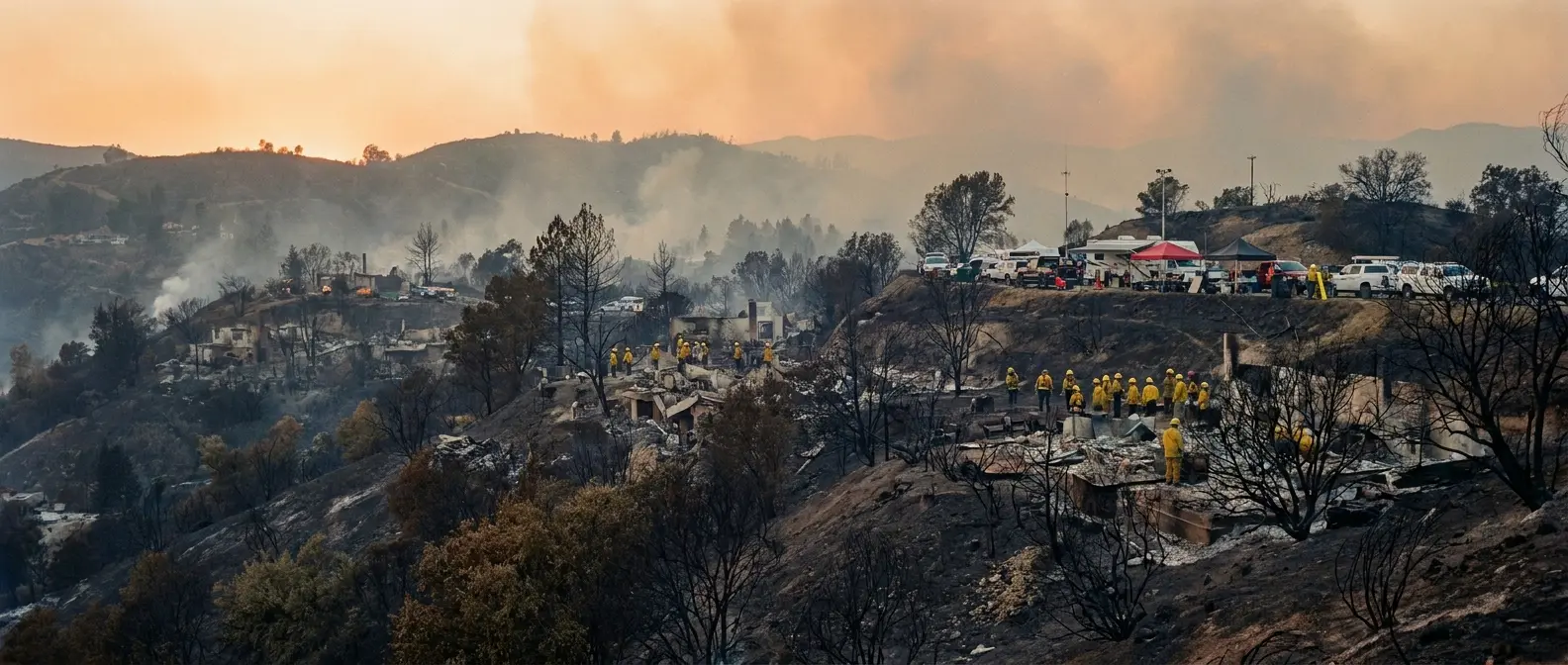
WUI fire investigation is the specialised discipline of determining fire origin and cause in the wildland-urban interface, where developed areas meet or intermix with undeveloped wildland vegetation. The defining characteristic is the presence of both structure and wildland elements requiring analysis within a single investigation.
Scene scope varies dramatically. A single home with surrounding vegetation qualifies as a WUI fire scene. So does a multi-structure loss spanning hundreds of acres of mixed-use terrain. What unites these cases is the interaction between built environments and natural fuel sources, which creates fire behaviour, evidence types, and liability questions that neither pure structure nor pure wildland investigation methods address on their own.
The stakes reflect this complexity. WUI fires routinely generate criminal investigations, civil litigation, insurance subrogation claims, and utility liability proceedings simultaneously. Expert witnesses testify on origin and cause findings where financial consequences reach hundreds of millions of dollars. The discipline demands integrated expertise that treats the interface as its own investigative environment rather than an overlap of two separate ones.
The wildland-urban interface creates investigation conditions absent from either pure structure or pure wildland settings. Mixed fuel types, infrastructure exposure, and the physical interaction between buildings and vegetation produce fire behaviour and evidence patterns that require adapted methodology.
How do mixed fuel types affect fire behaviour?
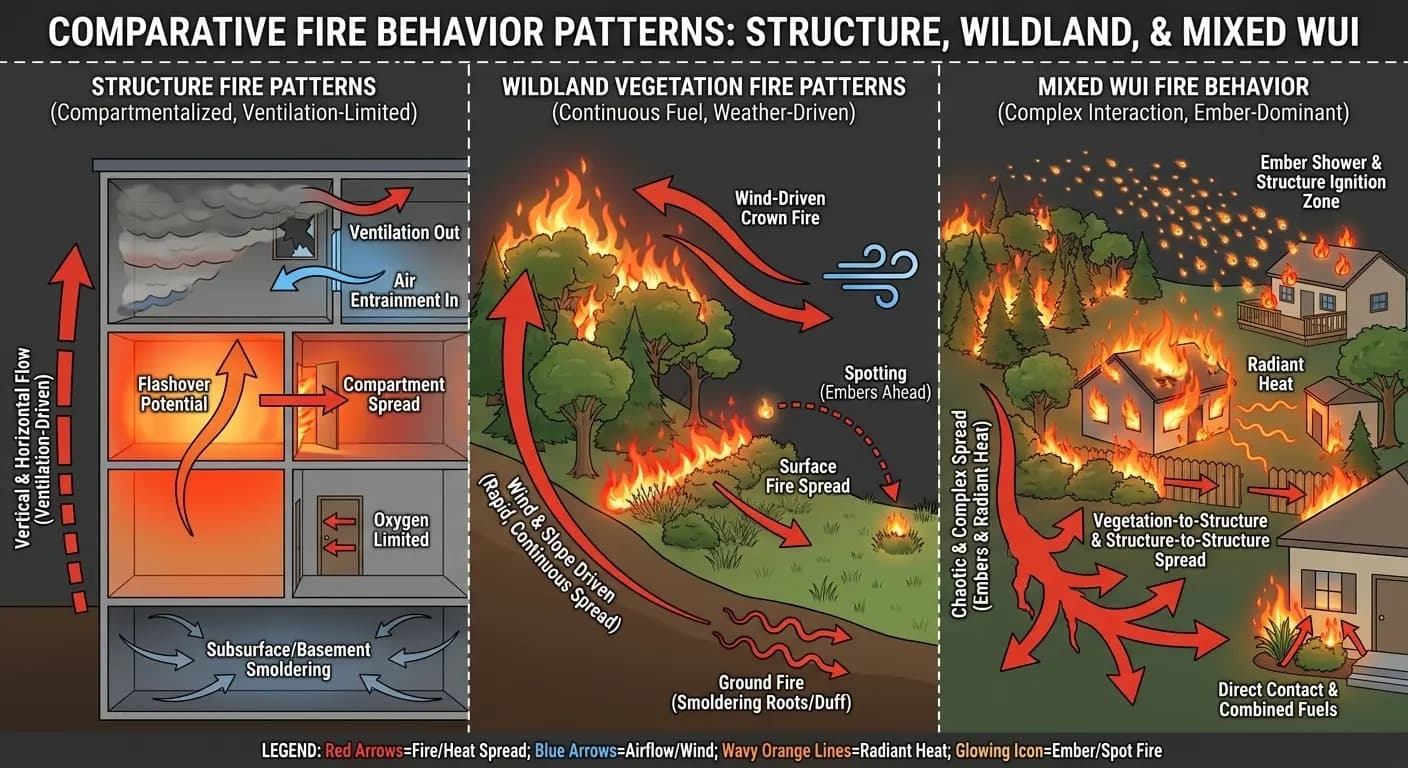
The combination of structure materials and wildland vegetation generates fire behaviour that differs from either fuel type alone. Radiant heat from burning structures ignites surrounding vegetation. Wildland fire intensity breaches structure defences. Fire can transition between fuel types multiple times within a single event, creating burn patterns that reflect both compartment dynamics and terrain-driven spread.
Investigators at WUI scenes account for flashover, ventilation-controlled burning, and vertical spread through building elements alongside spotting, terrain-influenced runs, and wind-driven behaviour in vegetation. These phenomena occur simultaneously, not sequentially, and their interaction produces patterns that neither discipline's methodology fully explains in isolation.
Why does infrastructure exposure create unique ignition scenarios?
Utility infrastructure, roads, equipment, and human activity in the interface introduce ignition sources absent from wilderness areas. Powerlines run through vegetation. Transformers mount on poles surrounded by trees. Vehicles, tools, and recreational equipment operate where a single spark can ignite continuous fuel beds.
These elements create a broader range of potential ignition sources than investigators encounter in either pure structure or pure wildland environments, and determining cause requires familiarity with both electrical systems and wildland ignition mechanisms.
WUI investigation requires integrated analysis where both structure and wildland techniques inform every conclusion. Investigators examine appliances and electrical panels inside structures while reading fire patterns in surrounding vegetation and analysing how terrain influenced fire movement between buildings. This is not sequential application of two separate methodologies. It is simultaneous analysis where findings in one fuel type directly affect interpretation of evidence in the other.
What structure fire techniques apply in WUI cases?
Compartment fire behaviour analysis remains essential. Examination of electrical systems, appliances, and building construction continues. Individual origin and cause determination for each affected structure is necessary because wildland fire may have entered multiple buildings, and each requires independent analysis. Standard fire investigation procedures for interior examination apply even when wildland fire surrounds the structure.
What wildland fire techniques become necessary?
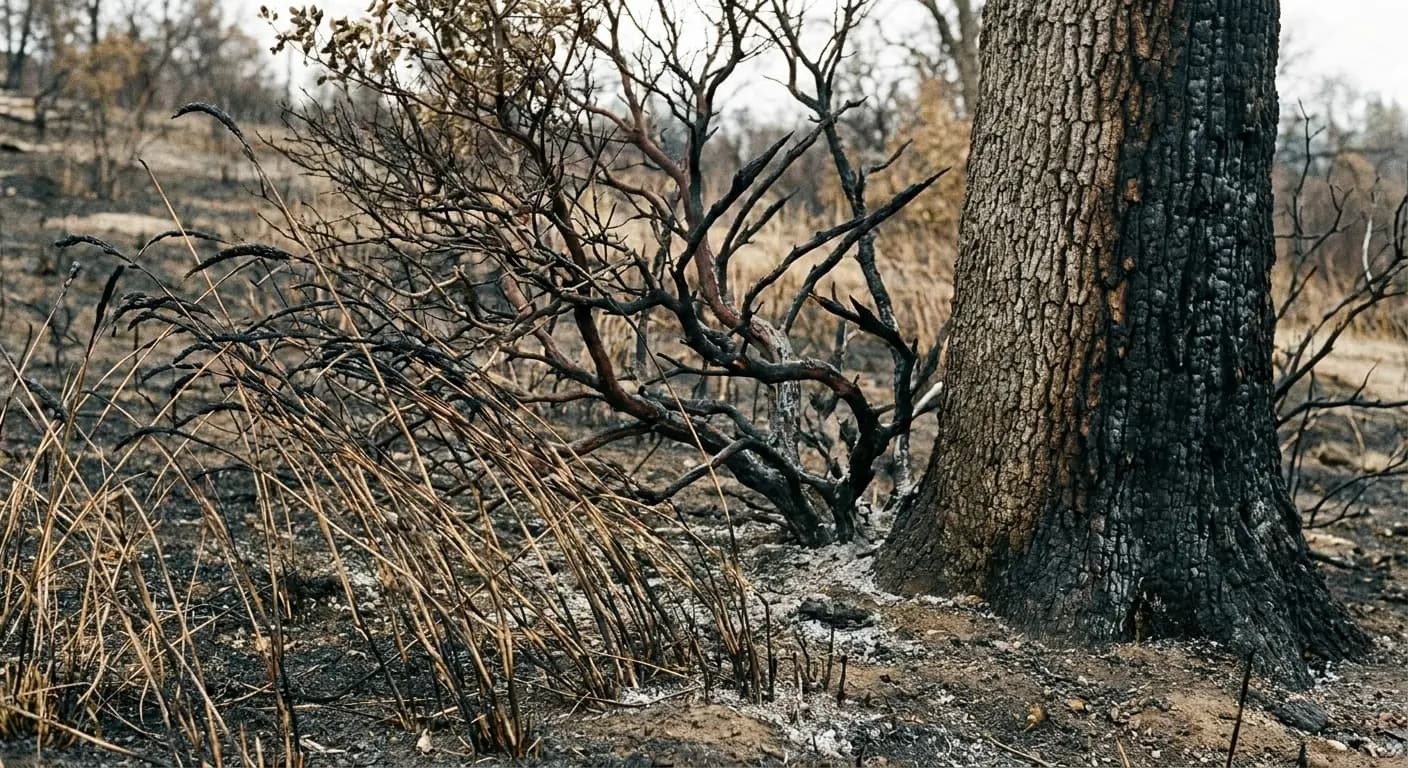
Reading directional indicators in vegetation becomes critical. Grass lean, branch consumption patterns, and bark char provide directional information. Weather reconstruction establishes wind speed, direction, temperature, and humidity at ignition.
Terrain effects on fire behaviour require analysis. These techniques remain essential even when structures are involved because fire may originate in vegetation and spread to buildings, or transition from structure to wildland fuels and continue spreading. The fire dynamics principles governing wildland spread differ fundamentally from compartment behaviour.
How does integration work in practice?
Consider a residential fire originating from a kitchen appliance in a home built into a hillside surrounded by chaparral. Fire spreads from the structure into adjacent vegetation, then runs uphill driven by wind and terrain. Four additional homes across 15 acres burn before containment.
A structure-only examination of the origin home might correctly identify the appliance failure but miss the vegetation management failures that allowed structure-to-wildland spread. A wildland-only investigation might accurately map fire progression across the fuel bed but lack the expertise to examine the electrical failure that started the event. WUI methodology determines the appliance cause through compartment analysis while documenting how inadequate defensible space, terrain, wind, and fuel moisture enabled a single-structure fire to become a multi-structure catastrophe.
WUI fires result from a broader range of causes than either pure structure or pure wildland fires because the interface contains ignition sources from both environments. Determining which cause applies requires different investigative approaches and has significant implications for liability and subrogation.
Why is utility equipment the leading cause category?
Utility infrastructure runs through the wildland-urban interface by necessity, creating constant exposure between energised equipment and wildland fuels. Conductor-vegetation contact, equipment arcing, and component failures ignite fires directly in continuous fuel beds, allowing rapid spread before suppression response arrives. Understanding how electrical arcing occurs and what evidence it produces is critical when utility equipment is a potential ignition source.
How do vegetation management failures contribute?
Inadequate defensible space and vegetation management may not be the ignition cause but frequently becomes a contributing factor in fire spread and loss magnitude. These failures create liability questions involving property owners, homeowner associations, and government entities responsible for fuel management on public lands adjacent to development. Documenting vegetation conditions, clearance distances, and maintenance history becomes essential because these findings feed directly into civil litigation and subrogation proceedings.
The fundamental principle remains: work from areas of lesser damage toward areas of greater damage. Application of this principle across mixed fuel types and potentially large geographic areas requires adaptation, but the core methodology does not change.
What challenges do large-scale scenes present?
WUI fire scenes may span acres or miles. Documenting and analysing large areas presents physical challenges that exceed typical structure investigation timescales. Multiple structures with individual fire patterns require examination. Aerial documentation (drones, helicopter surveys) captures the full scene. GPS coordinates provide precise location data across areas too large for traditional sketch-based documentation.
Origin determination in large WUI fires may take days or weeks rather than hours. Multiple investigators working simultaneously, systematic grid coverage, and daily coordination briefings become necessary to ensure thorough coverage without duplicating effort or disturbing undocumented evidence.
How do multiple potential origin points complicate analysis?
Fire spread patterns in WUI fires sometimes suggest multiple possible origin locations. Investigators evaluate and eliminate potential origin points through systematic analysis, witness statements, and timeline reconstruction. Multiple apparent origins are more common in WUI cases than in structure fires due to spotting (ember transport igniting new fires ahead of the main front), wind shifts that change fire behaviour mid-event, and the sheer scale of fire spread across mixed fuels.
Distinguishing true multiple origins (which may indicate arson) from spotting requires careful fire pattern analysis and weather reconstruction. Wind-driven fire spread can create patterns that appear to indicate origin locations far from the actual ignition point.
Why is weather reconstruction essential?
Weather conditions at the time of ignition and during fire spread directly inform origin determination. Wind direction and speed, temperature, relative humidity, and fuel moisture all affect how fire moves through both structures and vegetation. Weather data from multiple nearby stations must be cross-referenced to account for local terrain effects, because canyons, ridges, and valleys create microclimates that may differ significantly from regional weather readings. This reconstruction establishes whether observed fire patterns are consistent with natural spread or indicate anomalies requiring further investigation.
WUI fire scenes combine evidence types from both structure and wildland investigations, creating preservation and documentation requirements that exceed either discipline alone. Evidence distributes across large areas with mixed fuel types. Weather exposure, suppression activity, and scene scale compound each other.
How does fire suppression affect evidence?
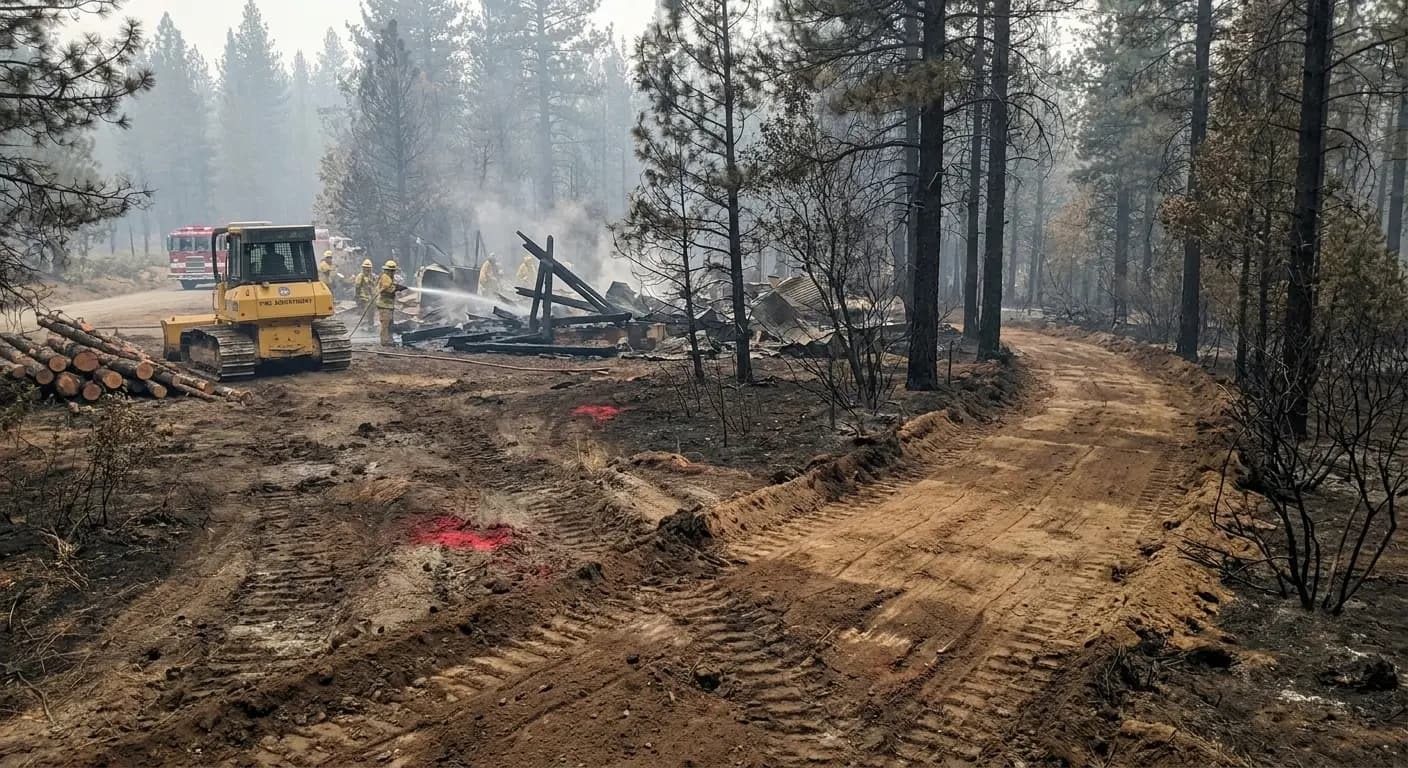
Wildland firefighting tactics (handlines, backburning, heavy equipment) disturb large areas. Structure protection efforts (ventilation, overhaul, water application) affect building evidence. The extended duration of WUI fire suppression means evidence undergoes prolonged disturbance before investigators gain access.
Coordination with suppression personnel establishes what tactics were applied where. Incident action plans, suppression maps, and equipment operation logs allow investigators to distinguish fire effects from suppression effects when interpreting patterns. Early communication with incident command can flag suspected origin areas for preservation when tactical conditions permit, though firefighter safety and suppression effectiveness always take precedence.
How does weather exposure degrade evidence across mixed fuel types?
WUI scenes remain unsecured for extended periods across areas too large to protect comprehensively. Rain washes away ash and disturbs soil evidence in vegetation while altering structural debris. Wind scatters lightweight evidence. Temperature changes affect accelerant residues differently in soil versus structural materials.
Investigators prioritise evidence collection based on degradation vulnerability. Accelerant soil samples and vegetation indicators degrade fastest and require immediate collection. Structural evidence (metal components, electrical system elements) is more durable and can wait. This triage approach accepts that complete preservation is impossible and focuses resources on the most time-sensitive and case-critical evidence, a reality that requires careful documentation to guard against spoliation challenges in subsequent litigation.
WUI fires routinely involve six or more agencies with different mandates, priorities, and investigative authorities. Jurisdiction determination, coordination of investigation activities, and information sharing while respecting each agency's constraints all require structured management.
Which agencies typically respond?
Local fire departments and their investigation units respond to structure fires. State forestry or natural resources agencies deploy for wildland components. Federal land management agencies (Forest Service, Bureau of Land Management, National Park Service) have jurisdiction when fire involves federal lands. Law enforcement investigates when criminal origin is suspected. Utility companies send investigation teams when their equipment may be involved. Insurance carriers retain private investigators representing their interests.
The specific agencies depend on where the fire occurred, what it impacted, and what caused it. Agency involvement may expand as investigation reveals new information about origin and cause.
Why does jurisdiction become complicated?
Jurisdiction depends on where the fire originated (private property, state land, federal land), what the fire impacted (structures, vegetation, or both), whether criminal activity is suspected, and what caused the fire. Jurisdiction may be shared or may shift as investigation progresses. Criminal investigation priorities (evidence preservation for prosecution) sometimes conflict with civil liability investigation priorities (rapid documentation for subrogation), creating tension that requires explicit coordination agreements.
How is coordination managed in practice?
A WUI fire ignites on private property, spreads across state forestland, and burns 12 homes in a residential subdivision. The local fire department investigates the structure fires. The state forestry division deploys investigators for the wildland component. The county sheriff assigns a detective after witnesses report suspicious activity. The utility company sends an investigation team after learning powerlines run through the origin area. Three insurance carriers retain private investigators for the destroyed homes.
By day two, seven entities attempt to access the same origin area. Without coordination, investigators repeatedly disturb evidence, create conflicting documentation, and potentially reach incompatible conclusions. A unified command approach with daily briefings, agreed scene access protocols, and shared evidence handling procedures allows all parties to fulfil their mandates while preserving investigation integrity.
Powerlines, transformers, and other utility equipment create constant proximity between energised electrical systems and wildland fuels throughout the interface. When utility equipment is a potential ignition source, the investigation transforms into a complex technical analysis with significant financial and legal implications.
How do investigators examine utility equipment?
Examination includes conductors (breaks, damage, contact evidence), insulators and connectors (condition, failure indicators), transformers (internal faults, external damage), and protective devices (operation status, trip history). Documentation of equipment maintenance history and inspection records establishes whether the utility met its obligations.
This examination requires understanding of electrical systems and utility infrastructure that many fire investigators lack, often necessitating consultation with electrical engineers. Equipment examination must occur quickly because utilities seek to restore service, creating pressure to document and preserve evidence before equipment is removed or replaced.
Why does vegetation clearance compliance matter?
Regulatory requirements establish minimum clearance distances between conductors and vegetation. Documentation of vegetation condition at the time of the fire, including height, species, moisture content, and proximity to equipment, establishes whether clearance violations existed. Clearance violations can constitute negligence in civil litigation, and the specificity of documentation matters: species identification, precise measurements from multiple angles, and photographs establishing spatial relationships between vegetation and equipment.
How does utility causation affect liability?
Utility causation triggers strict liability in some jurisdictions. In California, inverse condemnation holds utilities liable even without negligence if their equipment caused the fire [VERIFY: confirm current legal status of inverse condemnation doctrine]. These cases often involve multiple plaintiffs: property owners, insurance carriers pursuing subrogation, and government entities seeking suppression cost recovery.
Investigation findings directly influence settlement negotiations and trial outcomes, and liability exposure can reach hundreds of millions of dollars. Investigators working utility-caused fires should expect their conclusions to face review by opposing experts and challenge in deposition and trial.
WUI fires create subrogation scenarios more complex than typical structure fires because losses span multiple properties with different carriers, causation may involve multiple contributing factors, and potentially liable parties include utilities, government entities, property owners, and equipment manufacturers.
What makes WUI subrogation complex?
Multiple structures with different carriers create coordination requirements. Overlapping liability theories (utility equipment failure, inadequate vegetation management, equipment ignition) exist simultaneously. Contribution and comparative fault issues arise when multiple parties bear partial responsibility. Government entities may assert immunity defences. A single WUI fire can generate dozens of subrogation claims with different plaintiffs pursuing different defendants based on the same fire event.
Investigation findings drive subrogation decisions. Carriers coordinate when pursuing common defendants. Documentation requirements increase substantially when investigation supports subrogation claims, because investigation reports must meet legal sufficiency standards and withstand expert review from opposing parties.
What documentation standards apply?
Subrogation documentation must be more thorough than investigation conducted solely for internal carrier use. Origin determination must be specific: the exact area, the spatial relationships between evidence, and the reasoning connecting physical findings to conclusions. Chain of custody for physical evidence requires tracking through the established protocols that ensure admissibility. Reports distinguish clearly between observation and interpretation, avoid speculation, and document methodology with sufficient detail to survive cross-examination.
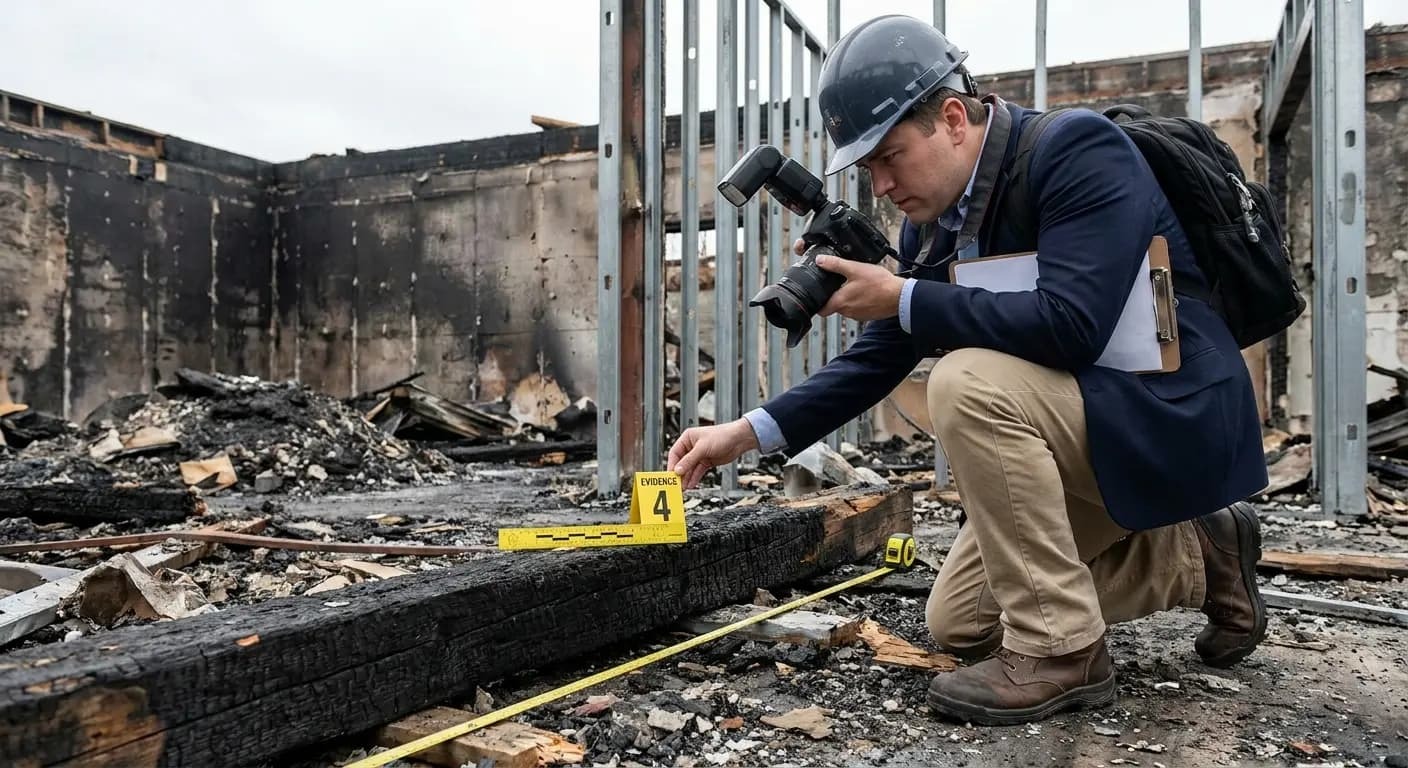
Investigators document with the expectation that reports will be disclosed to opposing parties and scrutinised for methodology flaws, unsupported conclusions, or gaps in evidence handling. This standard applies from the first scene photograph through the final report.
WUI fire investigations generate documentation demands that exceed structure fire cases by orders of magnitude. Origin determination across mixed fuel types, evidence tracking from multiple structures and vegetation areas, witness interviews with personnel from six or more agencies, weather data compilation, utility equipment documentation, and suppression activity records all require systematic management that paper-based systems and structure-focused software cannot handle at this scale.
Blazestack's evidence and media management platform addresses WUI-specific requirements. Investigators log observations, photograph evidence, and record GPS coordinates across large mixed scenes in a single system that maintains spatial relationships and timeline organisation. Evidence from multiple properties stays linked to its origin location, preventing the cross-contamination of case data that plagues multi-structure investigations managed through disconnected notebooks and photo folders.
The automated origin and cause report compiles findings from both structure and wildland elements into formats meeting NFPA 921 standards. When cases extend over months from initial investigation through multi-party litigation, documentation created at the scene remains accessible, organised, and ready for discovery requests, deposition preparation, and courtroom testimony across all parties involved.
What qualifications do WUI fire investigators need?
WUI fire investigators require training in both structure and wildland fire investigation. Structure fire investigation certification provides foundational knowledge in compartment analysis, electrical systems, and appliance examination. Additional training specific to wildland fire behaviour, terrain analysis, weather reconstruction, and vegetation pattern interpretation is necessary.
How long does a typical WUI fire investigation take?
Investigation duration varies based on scene size, complexity, and the number of structures involved. A single-structure WUI fire with clear origin and cause may be completed in days. Multi-structure fires spanning large areas with utility involvement and multiple agencies require weeks or months. Final reports often follow extensive analysis, expert consultation, and laboratory results. Timeline pressures from insurance carriers, litigation schedules, and agency mandates frequently conflict with the time required for thorough investigation.
Can investigators determine origin when fire has burned across acres?
Origin determination in large WUI fires is possible but challenging. Investigators use directional indicators from vegetation, fire patterns in structures, witness statements, and timeline reconstruction to work backward from areas of final fire extent toward the origin area. Weather data establishes how wind influenced fire spread.
The process requires systematic analysis of the entire scene, often with multiple investigators covering sections simultaneously. Some large WUI fires narrow to a specific origin point. Others narrow only to a general origin area, and investigators must acknowledge when evidence is insufficient for more precise determination.
Who pays for WUI fire investigation?
The entity requesting investigation typically funds it. Insurance carriers pay for investigations supporting coverage decisions and subrogation efforts. Government agencies fund investigations into fires on public lands or when criminal origin is suspected. Utility companies investigate fires potentially involving their equipment.
Property owners may retain private investigators when they dispute findings or face liability claims. In large WUI fires, multiple parties often conduct independent investigations, each funding their own investigators and experts.
What happens when agencies reach different conclusions about fire causes?
Different agencies investigating the same fire may reach different conclusions based on their focus, access to evidence, and investigative resources. These conflicts are addressed through peer review, additional investigation, or litigation when cases proceed to trial.
Courts evaluate competing expert opinions based on methodology, evidence support, and adherence to professional standards. Investigators should expect their conclusions to face challenges when they conflict with other agencies' findings and should ensure their methodology and documentation withstand scrutiny under the scientific method framework.
How do investigators handle evidence across multiple properties?
Evidence collection across multiple properties requires coordination with property owners and clear documentation of where each piece of evidence originated. Search warrants may be necessary if property owners deny access. Chain of custody documentation tracks evidence from collection through analysis, noting the specific property of origin.
When multiple structures have burned, investigators prioritise evidence collection at the suspected origin area while documenting conditions at other structures. The scale of multi-property evidence management in WUI cases makes systematic case management essential to prevent information confusion across concurrent examinations.
How does terrain affect WUI fire investigation?
Terrain influences fire behaviour in the wildland-urban interface by affecting wind patterns, fire spread rates, and suppression access. Fires burn uphill faster than downhill, creating directional indicators investigators use for origin determination.
Terrain features (ridges, valleys, canyons) channel wind and create localised effects that may differ from regional weather station data. Steep terrain complicates suppression efforts, potentially allowing fire to spread further before control. Documentation of terrain features and analysis of how they influenced fire behaviour throughout the event is essential for defensible origin and cause conclusions.
What role do weather stations play in WUI fire investigation?
Weather data from nearby stations provides critical information about wind speed and direction, temperature, and humidity at the time of fire ignition and spread. Investigators use this data to reconstruct fire behaviour, validate directional indicators observed at the scene, and evaluate whether fire spread patterns are consistent with reported conditions.
Multiple weather stations should be consulted to account for local terrain effects. Reliance on a single station risks inaccurate wind data in complex terrain where canyons and valleys create microclimates. Cross-referencing multiple data points provides the most accurate reconstruction of conditions during the fire event.

Trusted by Public and Private Investigator Teams Everywhere
Whether you're a big state agency, a small local fire department or somewhere in between, Blazestack software (NFPA 921® & CJIS compliant) collects fire scene data and generates standardized origin and cause reports in a fraction of the time of other methods.
To learn more about Blazestack, give us a call at (866) 303-4344 or email us at support@blazestack.com
Get Your Free 14-Day Trial and Custom Price Quote Now
We'll let Blazestack do the talking. Try it out right now for free.
A member of our staff will be in touch shortly.