Fire Dynamics: What Fire Investigators Need to Know to Read a Fire Scene

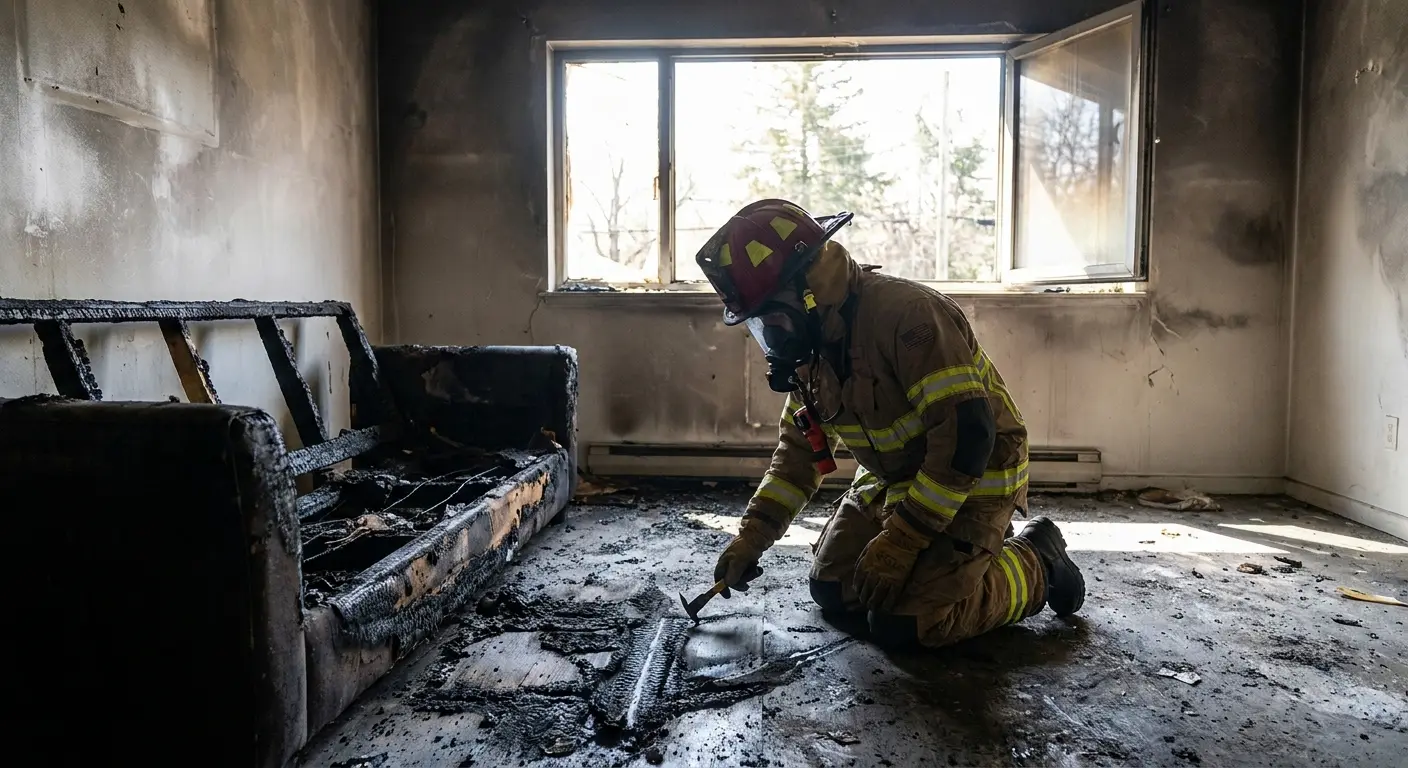
Fire dynamics is the scientific study of how fires ignite, develop, and spread through structures. NFPA 921 requires investigators to understand it, not as background knowledge, but as the active framework for reading physical evidence at every scene.
Every piece of physical evidence at a fire scene is the direct record of fire behavior. Charring depth, burn patterns, smoke deposits, structural damage: all of it reflects how fire behaved under specific conditions. Without fire dynamics, investigators read that evidence without the vocabulary to interpret it accurately. According to the Fire Protection Research Foundation, misapplication of fire behavior science remains one of the leading causes of incorrect origin and cause determinations in the United States.
The practical stakes are high. A 2023 review of wrongful arson determinations found that ventilation effects, high heat release rate fuel packages, and post-flashover conditions were misread as incendiary indicators in a significant proportion of reviewed cases. Investigators who apply fire dynamics systematically produce more accurate origin determinations, more defensible reports, and testimony that withstands Daubert challenge. Those who ignore it risk misidentifying origins, overlooking critical evidence, and losing credibility under expert scrutiny.
Understanding fire scene evidence begins with understanding the fire behavior that created it.
Three elements make fire possible: fuel, heat, and oxygen. Each leaves distinct physical evidence. Understanding how they interact allows investigators to read a scene accurately.
What does fuel evidence look like?
Fuel determines what burns and how intensely. Different materials produce different heat release rates, flame spread characteristics, and combustion products. Fuel evidence appears as char depth, ash patterns, remaining fuel packages, and material composition. It tells investigators what burned, how completely it consumed, and whether damage severity is consistent with the available fuel load.
What does heat evidence reveal?
Heat creates the ignition point and drives fire development. Heat sources leave ignition point indicators, radiant heat damage, and thermal effects on structural members. Tracing heat damage patterns backward through the structure leads toward the origin. The intensity and distribution of heat damage reveals information about the ignition source: a small flame, an electrical arc, and sustained radiant heat from an adjacent fire all produce different signatures.
What does oxygen evidence tell investigators?
Oxygen availability, controlled primarily by ventilation, affects burn intensity, flame behavior, and combustion completeness. Evidence appears as soot deposits, smoke staining, ventilation opening patterns, and combustion completeness. A ventilation-limited fire produces heavy soot, incomplete combustion, and lower temperatures. When additional oxygen enters through a broken window, opened door, or firefighter ventilation, fire intensity surges and damage patterns change.
Understanding which triangle element was removed during suppression (and when) helps investigators distinguish fire damage from suppression damage. Water application removes heat. Closed doors eliminate oxygen. Pulling apart burning materials separates fuel. Each suppression method affects the scene differently, making documentation of suppression timing and tactics essential for accurate interpretation.
Heat release rate measures how quickly a fuel releases energy during combustion, expressed in kilowatts or megawatts. HRR is the single most important fire dynamics concept for investigators evaluating burn intensity and damage severity.
High HRR fuels produce intense, rapidly developing fires. Low HRR fuels burn slower and produce less intense damage over longer periods. These differences appear directly in the physical evidence: char depth, heat damage to structural members, and calcination on gypsum board all reflect the HRR characteristics of the fuels involved.
The most consequential finding from modern fire research is this: a polyurethane foam sofa reaches peak HRR exceeding 3,000 kilowatts. That is comparable to a gasoline pool fire. The floor damage beneath a burned sofa that was previously interpreted as evidence of accelerant use may result entirely from the HRR characteristics of the fuel package above it.
HRR also affects fire development timelines. High HRR fuels reach flashover conditions faster. This matters when correlating witness statements with physical evidence. If witnesses report seeing flames within two minutes of ignition and the primary fuel package was polyurethane foam, that timeline is consistent with fire behavior. If the reported fuel was solid wood furniture, the timeline does not align, suggesting either a different fuel source or an earlier ignition time than witnesses recognized.
When evaluating whether damage patterns are consistent with reported fuel packages, HRR provides the scientific foundation for that assessment. Investigators compare observed damage against known HRR values and determine whether physical evidence aligns with fire dynamics principles, not whether damage subjectively seems too severe.
Flame spread describes how fire moves across surfaces and through compartments. Understanding it is essential for tracing fire movement backward toward the origin.
Spread rate depends on fuel orientation, surface area, material composition, and available oxygen. Vertical spread happens faster than horizontal spread due to the natural rise of flame and heat plume. Flames travel upward, preheating materials above the burning surface and accelerating ignition.
Different materials spread flame at different rates. Painted drywall carries a low flame spread rating. Acoustic ceiling tiles carry a significantly higher rating. When fire reaches the ceiling and encounters combustible tiles, horizontal spread accelerates. Investigators who miss this material transition risk misinterpreting why fire moved rapidly in one direction.
In a commercial structure fire investigation, vertical charring extending from floor level to ceiling along a wall section with horizontal spread occurring only after flames reached ceiling level illustrates the principle directly. The vertical spread pattern combined with V-pattern geometry and char depth measurements indicates fire originated at the base of the wall, traveling upward following natural plume dynamics. Horizontal ceiling spread occurred only after encountering combustible acoustic tiles, not because a separate ignition source existed at ceiling level. Thorough analysis of burn patterns in combination with flame spread understanding produces conclusions that eliminate alternative origin hypotheses.
Flame spread analysis also helps differentiate between fire that moved naturally through a space and fire that spread due to falling debris, radiant heat ignition, or separate ignition sources. Discontinuous burn patterns (areas of damage separated by unburned material) require determination of whether flame spread explains the pattern or whether multiple ignition points are involved. Fire dynamics provides the framework for that determination.
Ventilation controls fire intensity, growth rate, and burn pattern formation more than any other variable investigators encounter at the scene.
The availability of oxygen through openings, structural breaches, or HVAC systems determines whether fire burns fuel-limited or ventilation-limited. That distinction changes how every piece of physical evidence must be interpreted.
What does a ventilation-limited fire look like?
Ventilation-limited fires produce incomplete combustion, heavy soot deposits, and lower temperatures. When ventilation increases (a window breaks, a door opens, firefighters ventilate the roof) fire intensity surges, spread accelerates, and damage patterns change. A broken window creates an airflow path. Fire near that window burns more intensely than fire elsewhere in the compartment not because ignition occurred there, but because oxygen was available there.
How do ventilation effects compromise traditional indicators?
Traditional origin indicators (low burn patterns, floor damage, directional charring) can all shift based on airflow rather than proximity to origin. Floor damage that previously suggested accelerant use may result from ventilation-controlled burning where oxygen-rich air flowed along the floor. Directional charring may point toward a ventilation opening rather than away from the origin. These indicators remain useful but only when evaluated in the context of ventilation conditions.
Wind direction and speed at the time of fire matter. Weather data for the exact timeframe provides information about external factors affecting airflow. Strong wind pushing through broken windows creates ventilation paths that shape fire behavior and damage patterns, ignoring wind effects leads to misinterpretation of directional evidence.
Firefighter ventilation actions change fire behavior during suppression. Roof cuts, window breaking, and positive pressure ventilation all introduce oxygen and alter airflow patterns. Distinguishing pre-suppression fire behavior from ventilation-influenced burning during fire attack requires documentation of ventilation timing correlated with fire development observations.
Ventilation Documentation: Key Steps for Scene Examination
- Document all ventilation openings at time of fire department arrival: windows, doors, HVAC registers, structural breaches
- Record which openings were intact versus broken or open before suppression began
- Obtain weather data for exact timeframe: wind direction and speed at time of fire
- Identify ventilation actions taken by fire department: roof cuts, window breaking, positive pressure ventilation
- Document timing of each ventilation change relative to fire development
- Photograph airflow patterns evidenced by smoke staining, directional charring, and debris movement
- Map ventilation paths through the structure, noting how openings created flow patterns
- Interview firefighters regarding ventilation observations and tactical decisions
- Correlate ventilation changes with witness descriptions of fire behavior changes
- Analyze whether damage patterns align with ventilation-controlled burning versus origin proximity
Flashover occurs when radiant heat in a compartment reaches the point where all exposed combustible surfaces ignite simultaneously. That’s typically between 500 and 600 degrees Celsius. The transition from a growing fire to fully developed fire happens in 15 to 30 seconds in most residential compartments.
Post-flashover conditions create widespread, intense damage throughout the compartment, erasing many pre-flashover indicators investigators rely on to determine origin. Floors char uniformly. Walls show deep damage regardless of proximity to origin. Fuel packages burn completely. The compartment becomes an environment where everything burns with similar intensity.
What physical evidence indicates flashover occurred?
- Ceiling and upper wall surfaces show uniform damage
- Floor exhibits widespread charring across the entire surface
- Window glass melted, cracked, or blown out from heat
- All combustible contents consumed or heavily damaged
- Structural members show deep charring throughout the compartment
- Smoke deposits transitioned from black soot to clean burn patterns
- Door and window frames show thermal damage on all sides
Can pre-flashover indicators survive post-flashover conditions?
Yes, in protected areas shielded from radiant heat. Protected areas behind furniture or appliances showing differential damage, directional charring or V-patterns on lower wall sections, fuel packages with partial consumption indicating fire direction, smoke demarcation lines showing initial fire development height, and floor damage variations indicating localized intense burning before flashover can all provide reliable origin evidence even in heavily damaged compartments.
Identifying these protected areas requires the systematic examination that origin and cause investigations demand, working from least damaged to most damaged areas and evaluating each piece of evidence against what fire dynamics predicts.
Flashover timing affects witness statements and firefighter observations. Witnesses who saw the fire before flashover describe localized flames and smoke venting from specific areas. Witnesses arriving after the flashover describe flames throughout the compartment and blown-out windows. Correlating these observations with physical evidence helps establish when flashovers occurred and which damage patterns formed before that transition.
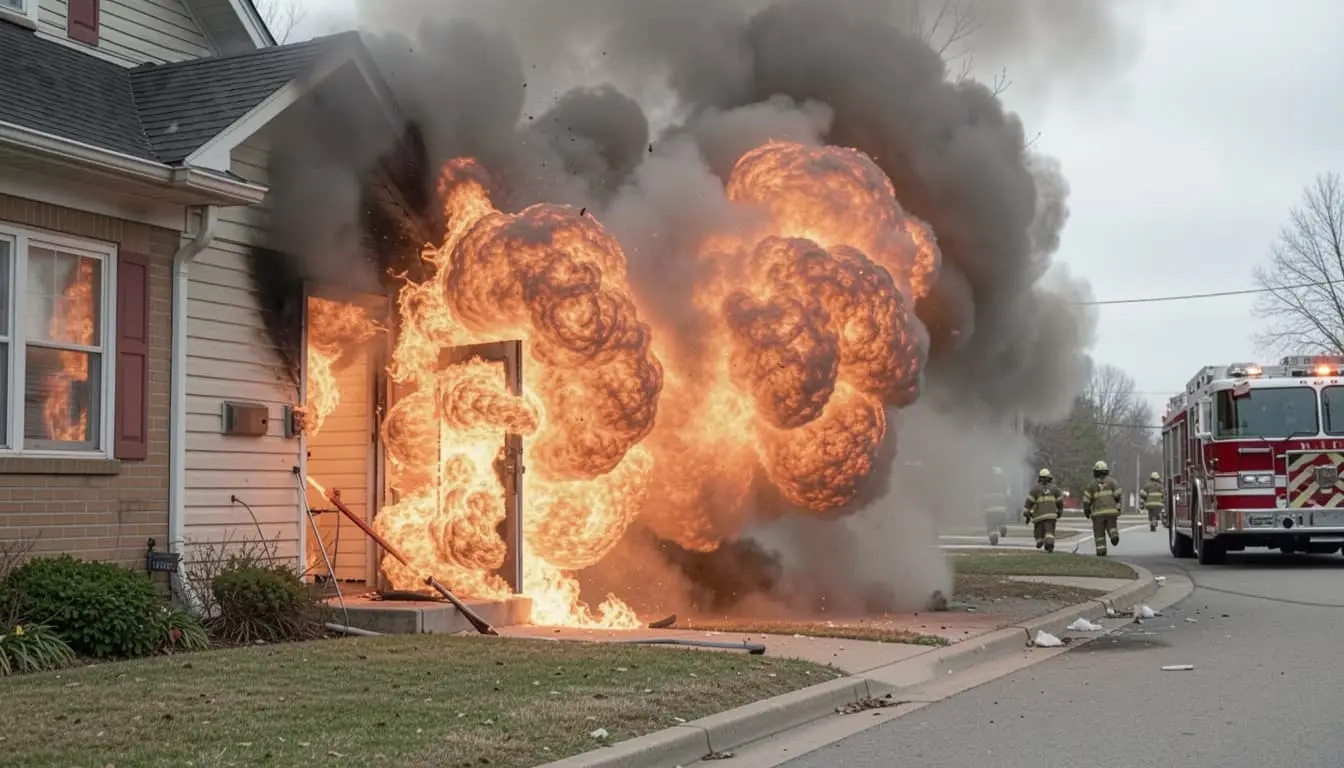
Backdraft occurs when oxygen suddenly enters a ventilation-limited, high-temperature compartment filled with unburned pyrolysis products. The rapid combustion creates an explosion-like event that damages walls, blows out windows, and displaces contents, moving or destroying items that would otherwise support origin determination.
What physical evidence indicates backdraft?
- Windows and doors blown outward rather than inward — pressure from inside the compartment
- Structural damage showing outward force — walls pushed out, ceiling materials displaced downward and outward
- Heavy soot deposits throughout with minimal flame damage — indicates prolonged smoldering before the event
- Condensed pyrolysis products staining window glass
- Contents displaced across the compartment from original positions
Backdraft affects evidence preservation because the sudden combustion and pressure wave can displace contents, obscure origin indicators with thrown debris, and create damage patterns resembling explosion damage. Without understanding the fire dynamics that produce backdraft, investigators risk misinterpreting displacement patterns as unrelated phenomena and spending significant examination time on evidence positions that reflect the pressure event rather than the origin.
Firefighter observations of backdraft indicators (pulsing smoke, inward-drawn smoke when openings are created) documented through post-incident interviews provide critical information about fire conditions before the event and help establish the sequence of fire development.
Fire plumes rise due to buoyancy, carrying heat, smoke, and combustion gases upward from the burning fuel. Plume shape and direction depend on heat release rate, ceiling height, and ventilation. Higher HRR produces stronger, more defined plumes. Lower ceilings cause plumes to spread laterally sooner.
Smoke follows the plume, depositing soot on ceilings and walls as it spreads after contacting overhead surfaces. Ceiling patterns, wall staining, and smoke demarcation lines reveal where smoke traveled and how long it remained in specific areas.
How do investigators use plume patterns to determine origin?
In a warehouse fire, a ceiling pattern showing soot deposits in concentric circles radiating outward from a central point with the heaviest concentration directly above a damaged electrical panel illustrates plume evidence at its most useful. The rising plume deposited combustion products overhead before spreading laterally along the ceiling. This corroborates burn pattern analysis on the wall behind the panel, where directional charring shows upward and outward movement from the panel location. Converging plume evidence and burn pattern evidence eliminate alternative origin hypotheses.
Smoke demarcation lines mark the interface between the hot smoke layer and cooler air below. In early fire development, smoke accumulates at the ceiling and gradually banks down as production increases. The demarcation line indicates how far smoke descended before conditions changed (through ventilation, suppression, or development to flashover) and provides information about fire development timing during the growth phase.
Differentiating between smoke from the origin fire and smoke from secondary fires or ventilation-induced redistribution requires understanding plume behavior. Origin fire smoke shows the heaviest deposits nearest the origin with gradual decrease as distance increases. Secondary fires produce distinct plume patterns with their own concentration centers. Ventilation changes can redistribute smoke, creating deposits that do not align with fire travel patterns.
NFPA 921 requires the scientific method and systematic examination process for determining origin and cause. Fire dynamics principles inform every step.
How does fire dynamics inform hypothesis formation? A hypothesis suggesting fire originated in a specific location must account for whether available fuels could produce the observed damage, whether ventilation conditions support the proposed fire development timeline, and whether flame spread patterns align with the hypothesized origin. Fire dynamics provides the scientific foundation for evaluating all three factors.
How does fire dynamics support hypothesis testing? Testing hypotheses against physical evidence means comparing scene observations with what fire dynamics predicts. A hypothesis suggesting fire originated at a wall outlet predicts directional charring moving upward and outward from that location, plume patterns on the ceiling above, and damage severity decreasing with distance. If physical evidence does not match these predictions, the hypothesis fails.
How does fire dynamics eliminate alternative hypotheses? Where proposed ignition sources lack sufficient energy to ignite available fuels, proposed timelines do not account for HRR and flame spread rates, or damage patterns are better explained by ventilation effects, fire dynamics provides the framework for elimination. This is the step that distinguishes systematic investigation from pattern recognition, and the step most often scrutinized under Daubert.
Several recurring errors trace directly to fire dynamics misapplication. Recognizing them is essential for investigators at every experience level.
Identifying ventilation-induced damage as a separate origin Intense burning near a window or door leads to a conclusion that fire originated there, overlooking that the opening provided oxygen that intensified burning in that area. The actual origin may be elsewhere in the compartment.
Mistaking post-flashover damage for origin indicators Uniform floor charring throughout a compartment does not indicate multiple origins, it indicates post-flashover conditions. Deep charring on all walls does not mean fire started everywhere, it means fully developed fire conditions damaged all surfaces.
Overlooking radiant heat ignition Radiant heat from a fully involved sofa can ignite curtains several feet away without flame contact. Radiant heat through a window can ignite exterior materials. Investigators who require direct flame contact for ignition scenarios miss these possibilities entirely.
Applying outdated indicators without accounting for modern fuel packages Low burning does not always indicate accelerants. Spalling does not always indicate accelerants. These indicators persist because investigators learned them early and have not updated their knowledge with current fire dynamics research, including the UL Firefighter Safety Research Institute studies published between 2010 and 2023 that fundamentally changed the field's understanding of ventilation-influenced fire behavior.
Failing to account for HRR when evaluating burn intensity Modern synthetic furnishings produce high HRR fires that create intense damage without accelerants. Polyurethane foam furniture produces damage comparable to gasoline fires. Investigators who do not understand HRR values for common fuel packages risk accelerant determinations based solely on damage severity.
Fire investigation expert testimony faces increasing scrutiny through Daubert challenges. Fire dynamics provides the scientific foundation that makes testimony admissible.
Courts evaluating expert testimony under Daubert consider whether methodology can be tested, whether it has been subject to peer review, whether it has a known error rate, and whether it is generally accepted in the relevant scientific community. Reports lacking fire dynamics analysis or relying on outdated indicators frequently fail these tests.
What do Daubert-defensible fire dynamics reports contain?
- Explanation of what fire dynamics principles support the origin determination
- Documentation of how ventilation conditions were assessed and what effect they had on burn patterns
- HRR analysis connecting damage severity to available fuel packages
- Identification of post-flashover conditions and which indicators were discounted accordingly
- Plume and smoke deposit analysis corroborating origin determination
- Elimination of alternative hypotheses using fire behavior science
Fire dynamics evidence degrades quickly at the scene. Ventilation conditions change. Smoke deposits get disturbed. Damage patterns become obscured by debris removal. Documenting observations during initial examination captures information that supports fire behavior analysis later.
Blazestack's fire scene data collection features allow investigators to log ventilation observations, photograph smoke patterns, note heat release indicators, and record plume evidence in real time using mobile devices at the scene. That structured data flows directly into the final investigation report, creating a clear connection between fire dynamics observations and origin and cause conclusions. Each observation is tagged with location data, photographs, and notes explaining what the evidence reveals about fire behavior, producing documentation that demonstrates systematic methodology and withstands Daubert scrutiny.
What is fire dynamics in fire investigation?
Fire dynamics is the scientific study of how fires ignite, develop, and spread. In fire investigation, it provides the framework for interpreting physical evidence at a scene, explaining why char patterns, smoke deposits, and burn indicators appear the way they do based on fuel type, ventilation conditions, and heat release rate.
Why does NFPA 921 require fire dynamics knowledge?
NFPA 921 requires investigators to apply fire dynamics principles because physical evidence only makes sense when understood in the context of the fire behavior that created it. Without fire dynamics, investigators risk misreading ventilation effects as separate origins, mistaking post-flashover damage for pre-fire indicators, and misidentifying high HRR fuel damage as accelerant use.
What is heat release rate and why does it matter for fire investigators?
Heat release rate is the measure of how quickly a fuel releases energy during combustion, expressed in kilowatts or megawatts. It matters because modern synthetic fuel packages (particularly polyurethane foam furniture) produce HRR values comparable to gasoline fires. Investigators who do not account for HRR when evaluating burn intensity risk incorrectly classifying naturally intense fires as incendiary.
How does ventilation affect fire investigation?
Ventilation controls fire intensity, growth rate, and damage pattern formation. Areas near ventilation openings burn more intensely because of increased oxygen availability, not because fire originated there. Traditional origin indicators including low burn patterns and directional charring can all shift based on airflow, making ventilation documentation one of the most critical steps in any scene examination.
What is flashover and how does it affect evidence?
Flashover is the near-simultaneous ignition of all exposed combustible surfaces in a compartment, occurring when radiant heat reaches approximately 500 to 600 degrees Celsius. It erases pre-flashover origin indicators by creating uniform, intense damage throughout the compartment. Investigators must identify whether flashover occurred and locate protected areas where pre-flashover evidence may have survived.
How does fire dynamics support Daubert admissibility?
Daubert challenges assess whether expert methodology is testable, peer-reviewed, and generally accepted. Fire dynamics provides that scientific foundation. Reports that connect origin and cause conclusions to established fire behavior principles (HRR analysis, ventilation effects, flame spread patterns, plume behavior) demonstrate the reliability courts require. Reports relying on pattern recognition without scientific backing frequently fail Daubert scrutiny.
What are the most common fire dynamics errors in fire investigation?
The five most common errors are: identifying ventilation-induced damage as a separate origin; mistaking post-flashover damage for origin indicators; overlooking radiant heat ignition; applying outdated indicators without accounting for modern synthetic fuel packages; and failing to account for HRR when evaluating burn intensity.


Trusted by Public and Private Investigator Teams Everywhere
Whether you're a big state agency, a small local fire department or somewhere in between, Blazestack software (NFPA 921® & CJIS compliant) collects fire scene data and generates standardized origin and cause reports in a fraction of the time of other methods.
To learn more about Blazestack, give us a call at (866) 303-4344 or email us at support@blazestack.com
Get Your Free 14-Day Trial and Custom Price Quote Now
We'll let Blazestack do the talking. Try it out right now for free.
A member of our staff will be in touch shortly.