Source of Ignition in Fire Investigation: How to Identify, Classify, and Document It

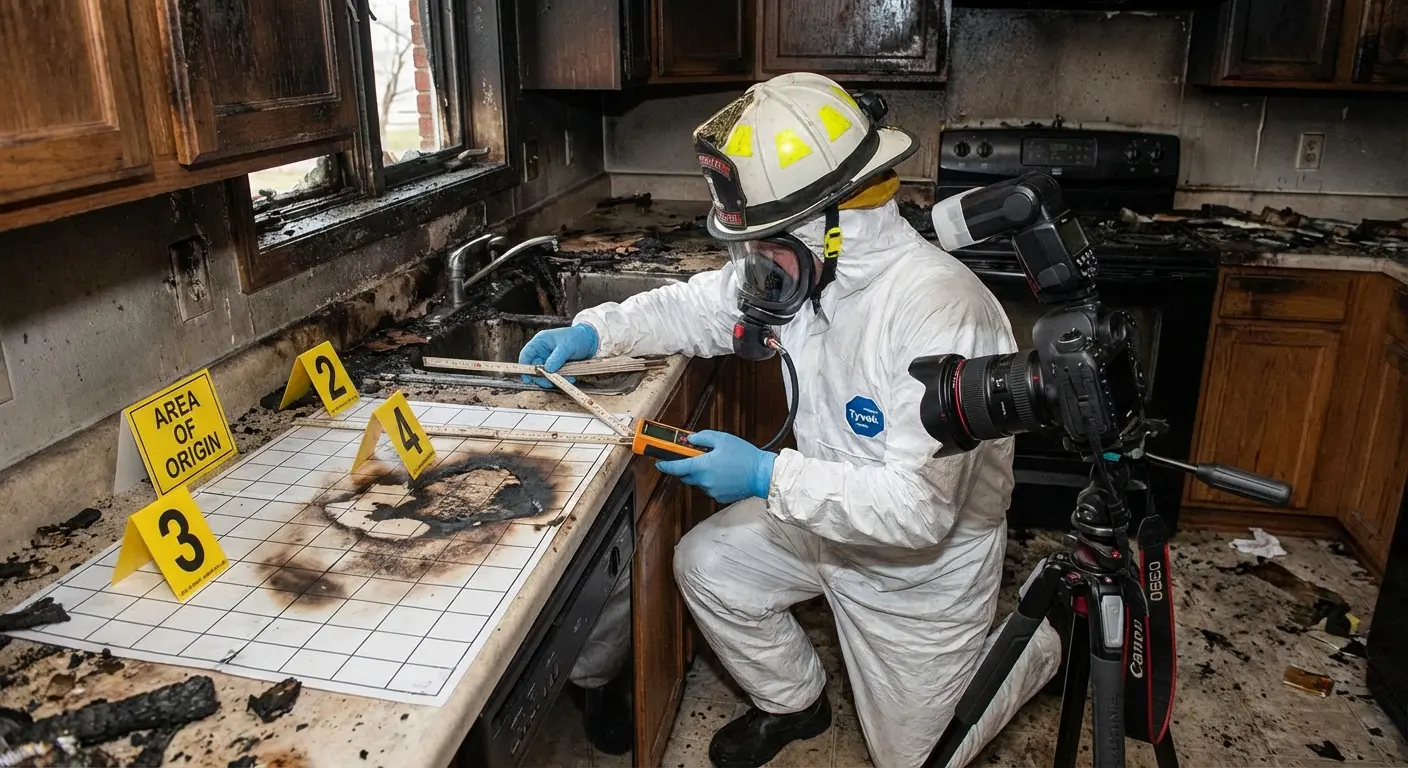
Determining the source of ignition is one of the most critical and most misunderstood steps in any fire investigation. It is not the same as identifying the area of origin. It is not satisfied by writing "electrical malfunction" in a report. And it will not hold up in court, in front of an insurance adjuster, or under peer review if it has not been established with the same rigor applied to every other element of the origin and cause determination.
This guide covers what source of ignition means under NFPA 921, how to identify and classify ignition sources across all six major categories, and how to document findings in a way that survives cross-examination months or years after the scene examination.
These two terms are frequently confused, even by experienced investigators. Understanding the difference is foundational to producing defensible origin and cause determinations.
Area of origin is the physical location where the fire started: the southeast corner of the bedroom, the engine compartment, the space behind the stove. Source of ignition is the specific device, equipment, or energy that provided the heat necessary to ignite the first fuel. NFPA 921 defines it as the mechanism that initiated combustion, not the location where combustion occurred.
The practical consequence of conflating these terms is a determination that is geographically precise but causally incomplete. Documenting where a fire started without identifying what started it leaves the most legally significant question unanswered.
Consider a residential kitchen fire where the area of origin is clearly the countertop adjacent to the stove. The source of ignition might be an electric coffee maker with a failed heating element that reached 800°F, a gas burner left on beneath a plastic cutting board, or a lithium-ion battery from a charging device that entered thermal runaway. Same location. Completely different ignition mechanisms, liability chains, and prevention implications. Both questions require the same level of specificity in documentation and testimony.
While no single database tracks all fire ignition sources comprehensively, electrical equipment and machinery are consistently identified among the most prevalent fire sources in workplace and residential settings. Precision in identifying the specific ignition mechanism has direct consequences for liability determinations, insurance outcomes, and criminal proceedings.
Finding a potential heat source on scene does not complete an ignition source determination. NFPA 921 requires that the ignition source be competent, meaning it must provide sufficient energy to ignite the first fuel under the specific conditions present at the time of the fire.
This standard eliminates more potential ignition sources than it confirms. A cigarette might be competent to ignite loosely piled paper in a dry environment. That same cigarette is unlikely to ignite a solid wood surface or dampened upholstery. The fuel's form, moisture content, and surface area all affect ignitability.
Temperature alone does not determine competence. Heat flux (the rate of heat transfer to the fuel surface), contact duration, and whether the fuel reached its piloted or autoignition temperature all factor into the analysis. A surface that reaches 400°F might ignite certain plastics but not wood under brief contact. That same wood might ignite if exposed to that temperature for an extended period.
Consider a case where a 60-watt bulb was positioned approximately six inches from a wooden shelf. Establishing competency required demonstrating that the bulb had been energized for approximately eight hours based on witness statements and utility records. That sustained exposure, combined with the specific wood type and finish, established competency. Without the documented ambient conditions, contact duration, and fuel characteristics captured on scene, the argument would have relied on speculation rather than evidence.
Environmental conditions that affect ignition competency cannot be reconstructed from memory weeks later. They must be captured on scene.
NFPA 921 organizes ignition sources into six categories. Each requires a distinct documentation approach and presents different evidentiary challenges on scene and in court.
1. Electrical Sources: Beyond "Faulty Wiring"
Electrical ignition sources account for a significant percentage of accidental fires, but "electrical malfunction" communicates almost nothing about what actually happened. NFPA 921 requires identification of the specific failure mechanism that generated sufficient heat for ignition.
Arc faults produce localized temperatures exceeding 6,000°F. Investigators must distinguish between series arcs, which occur along a single conductor due to a poor connection or break, and parallel arcs, which occur between conductors or between a conductor and ground. The physical evidence looks different in each scenario, and the implications for the determination differ accordingly.
Overcurrent conditions generate heat through resistance. The conductor itself becomes the heat source, producing insulation damage, discoloration, or melting that extends along the conductor rather than presenting as the localized damage characteristic of arcing.
Poor connections at terminals, splices, or receptacles create resistance heating at specific points, often leaving evidence of progressive deterioration including oxidation, loosening, and overheating rather than sudden catastrophic failure.
One commonly overlooked step is photographing and documenting non-damaged electrical components in the area of origin. Demonstrating what did not fail supports the conclusion about what did. Defense experts will argue alternative electrical sources if those alternatives have not been explicitly eliminated through documentation.
Electrical Ignition Source Documentation Checklist
- Photograph electrical component in situ before any disturbance
- Document component type, manufacturer, model number, and age if available
- Record circuit breaker position (tripped or not tripped) and amperage rating
- Examine and photograph all conductor connections within 3 feet of suspected ignition point
- Document evidence of arcing (beading, metal transfer, arc mapping on adjacent surfaces)
- Measure and record distances between electrical component and first fuel ignited
- Photograph insulation condition along entire visible conductor length
- Document load on circuit (what equipment was connected or energized)
- Examine and photograph comparison electrical components in the same area that did not fail
- Note any modifications, repairs, or non-code-compliant installations
- Collect utility records showing power delivery at time of fire
- Document environmental factors affecting electrical performance (moisture, corrosion, heat exposure)
2. Open Flame Sources: Documentation Over Assumption
Open flames represent a straightforward category of ignition sources, but they are easy to mischaracterize when investigators rely on assumptions rather than evidence.
Smoking materials remain a frequently claimed but rarely proven ignition source. Cigarettes, cigars, and pipe tobacco can smolder for extended periods before transitioning to flaming combustion, and the physical evidence including cigarette butts, ash patterns, and burn holes in upholstery often does not survive flashover or full room involvement. What can be documented includes witness statements about smoking habits, the presence of ashtrays or smoking-related items, and whether the fuel package is susceptible to smoldering ignition. If occupants claim no smoking occurred in the residence, that statement belongs in the documentation. If cigarette butts are found in the area of origin despite those claims, that contradiction is evidence worth preserving.
Intentionally set fires using open flame sources often leave indicators beyond the flame source itself. Multiple points of origin, pour patterns, accelerant residues, and trailer configurations point toward intentional introduction. These patterns should be photographed from multiple angles with dimensions and spatial relationships recorded systematically.
The question in court is not whether an open flame could have caused ignition. The question is whether the evidence supports the conclusion that an open flame did cause ignition in this specific case. The complexity of this determination is illustrated by a Marion, Iowa house fire investigation where officials identified multiple possible ignition sources but could not definitively determine which one initiated the fatal blaze. The case was ruled undetermined despite thorough investigation, demonstrating that even non-suspicious fires can present overlapping potential ignition mechanisms that resist conclusive determination.
3. Hot Surfaces: The Underestimated Category
Hot surfaces cause more fires than many investigators initially expect, and they are harder to prove because they require documented evidence of sustained contact or proximity between the heat source and combustible material.
Heating appliances including space heaters, furnaces, and water heaters generate surfaces hot enough to ignite combustibles, but they are designed with clearances and safety features intended to prevent contact. The investigative focus should be on documenting how those safeguards failed or were bypassed.
Light bulbs, particularly halogen and high-wattage incandescent bulbs, reach surface temperatures exceeding 400°F. In one warehouse fire investigation, a 150-watt incandescent bulb in a ceiling-mounted fixture was positioned 8 inches below a wooden storage shelf. Cardboard boxes had sagged over time, bringing the cardboard into direct contact with the bulb's glass envelope. The contact area showed progressive charring consistent with sustained heating over several hours before transition to flaming combustion. The investigator's documentation included the bulb wattage, fixture type, measurements showing the standard 8-inch clearance, photographs of the sagged shelf, and calculations demonstrating that cardboard in sustained contact with a 450°F surface would reach ignition temperature within the timeframe established by witness statements.
Exhaust systems generate sustained high temperatures. Catalytic converters reach 1,200°F during normal operation, and exhaust pipes, mufflers, and turbochargers produce surfaces capable of igniting dry grass, oil residues, or other combustibles in proximity. For any hot surface determination, the key is documenting the specific mechanism that brought the hot surface and fuel into contact. Without that connection, the investigation has identified a potential ignition source but has not established a proven one.
4. Mechanical Sparks and Friction
Grinding, cutting, or striking metal produces molten metal particles that can reach temperatures above 2,500°F, capable of igniting flammable vapors, dust, or finely divided combustibles, but unlikely to ignite solid fuels without a vapor or particulate phase present. Mechanical equipment failures including seized bearings, misaligned components, and belt slippage generate friction heating through sustained mechanical contact. Evidence of progressive wear, heat discoloration, and material transfer between components supports these determinations.
Static electricity can ignite flammable vapors or dust clouds but requires specific conditions: sufficient charge accumulation, a discharge path, and an ignitable atmosphere at the discharge point. It should not be used as a default explanation when another ignition source cannot be identified.
A fatal explosion at Horizon Biofuels in Fremont, Nebraska illustrates the stakes involved in mechanical ignition source determinations. An OSHA investigation found that a belt out of alignment on equipment including a wood grinder and hammermill likely served as the ignition source. Combined with combustible dust accumulations exceeding one-eighth of an inch on multiple surfaces, the friction-generated heat ignited the dust cloud, killing three people and resulting in nearly $150,000 in OSHA penalties.
5. Chemical Reactions and Spontaneous Heating
Spontaneous heating occurs when organic materials oxidize faster than heat dissipates, gradually increasing internal temperature until ignition. This requires sufficient mass to retain heat, moisture to support oxidation, insulation to prevent heat dissipation, and time for temperature to build. Linseed oil-soaked rags are the textbook example, but spontaneous heating occurs in agricultural products including hay, compost, and grain, as well as industrial materials such as coal, sawdust, and metal powders.
The burn pattern often distinguishes spontaneous heating from external ignition. Spontaneous heating produces deeper charring at the center of the mass with less damage on the exterior, the inverse of what an external ignition source would produce. Reactive chemical combinations can also produce sufficient heat for ignition, typically in industrial settings or storage areas. As with all chemical ignition determinations, electrical sources, open flames, and hot surfaces must be eliminated before a chemical reaction conclusion can be made with confidence.
6. Human Acts: Accidental and Intentional
Accidental human-caused ignitions typically involve carelessness: unattended cooking, improper disposal of smoking materials, misuse of candles or heating equipment. Investigators should document what the person was doing immediately before the fire, what ignition-capable materials they were using, and what changed that allowed ignition to occur.
Witness statements are critical in human act determinations but require physical evidence corroboration. If a witness claims a candle was extinguished before they left the room but candle evidence is found at the point of origin, both the statement and the physical evidence belong in the documentation without editorial judgment.
Intentional ignition leaves distinct physical indicators: multiple points of origin, accelerant pour patterns, trailer configurations, disabled smoke detectors, and removed or relocated valuables. These should be documented based on what was found, not on what the investigator believes they mean. One pattern that recurs in practice is that investigators document intentional ignition evidence thoroughly but document accidental human-caused ignitions superficially. Both require the same level of rigor.
Identifying a competent ignition source that explains the fire's origin and spread is necessary but not sufficient. A complete determination also documents why alternative potential ignition sources did not cause the fire.
NFPA 921 methodology requires investigators to develop and test hypotheses using the scientific method. That includes testing alternative hypotheses, not only confirming the primary one. If electrical equipment was present in the area of origin but an open flame is determined to be the ignition source, the documentation must address why the electrical equipment was not the ignition source in this case.
Defense experts identify every potential heat source in the area of origin that an investigator did not explicitly eliminate and argue that the alternative theory cannot be ruled out. Thorough elimination documentation removes that argument. The systematic approach is to identify every potential ignition source in the area of origin, evaluate whether each was competent to ignite the first fuel under the conditions present, and document findings for each one — whether eliminated by physical evidence, timing, access, or conditions.
Ignition Source Elimination Documentation Template
Case Number: _______________ Area of Origin: _______________ Determined Ignition Source: _______________
Alternative Ignition Sources Evaluated and Eliminated:
Source #1: _______________
Category: [ ] Electrical [ ] Open Flame [ ] Hot Surface [ ] Mechanical [ ] Chemical [ ]
Human Act Location relative to point of origin: _______________
Reason for elimination: [ ] No physical evidence of failure or activation [ ] Insufficient energy to ignite first fuel [ ] Not present or active at time of fire [ ] Spatial relationship inconsistent with burn patterns [ ]
Other: _______________
Supporting documentation (photo numbers, measurements, witness statements): _______________
(Repeat for each alternative source evaluated)
The Timing Problem
Potential ignition sources do not exist in a temporal vacuum. An appliance in the area of origin is only relevant if it was energized or generating heat when the fire started.
Establishing the fire's start time creates the framework for evaluating potential ignition sources. Witness statements, alarm activation times, 911 call records, and automated system logs all help narrow the window. A space heater loses significance when witnesses confirm it had not been used in three days. A stove becomes unlikely when occupants can demonstrate they were away for six hours before the fire was discovered.
Utility records and digital device logs are among the most objective sources of timing information available. Smart home systems, security systems, and connected appliances generate records showing when they were active. This data should be requested early in the investigation before it is overwritten or deleted.
In one apartment fire investigation, the initial focus was a toaster oven based on its proximity to the point of origin. Smart meter data showed the apartment's electrical consumption dropped to baseline levels at 7:42 AM when the occupant left for work. The fire alarm activated at 2:18 PM, more than six hours later. The toaster oven drew 1,200 watts when operating, a load that would have been visible in the consumption data. The temporal evidence eliminated the toaster oven despite its physical location, and the eventual determination identified spontaneous heating of improperly disposed smoking materials as the ignition source.
Delayed ignition scenarios do occur, and when the evidence supports one the timeline must account for it. When it does not, delayed ignition cannot be used to preserve a suspected ignition source that the timing otherwise eliminates.
The origin and cause report will be written weeks or months after the scene examination. Testimony may follow months or years after that. What is documented on scene determines whether those findings hold up or fall apart under cross-examination.
Memory is not a reliable evidentiary foundation. The exact position of an electrical cord, the specific condition of an outlet, the precise distance between a space heater and curtains — these details blur together over time and across cases. Every potential ignition source should be photographed before anything is moved. Multiple angles are necessary: wide shots establish context, medium shots show spatial relationships, and tight shots capture detail.
Measurements convert photographs from "approximately near" to "exactly 14 inches from." Distances between potential ignition sources and combustibles, heights above floor level, and dimensions of burn patterns all belong in field documentation with specific measurements. Environmental conditions must also be captured on scene — humidity, temperature, ventilation, and fuel moisture all influence whether a heat source qualifies as competent, and these conditions change once the scene is opened.
What gets missed most often is documentation of what was examined but did not yield evidence. If six electrical outlets were examined and five showed no damage, all six should be photographed. Negative findings are not the absence of evidence. They are evidence that alternative sources were considered and ruled out.
Witness Statements: Corroboration Required
Witness statements about ignition sources provide investigative direction but are not on their own sufficient to identify an ignition source. Physical evidence either supports or contradicts what witnesses report, and when it contradicts, both belong in the documentation without editorial judgment.
Structured witness interviews gather specific information about potential ignition sources: what electrical equipment was in use, what appliances were running, whether candles were burning, whether anyone was smoking, what activities occurred in the area where the fire started, and when those activities stopped. Verbatim documentation of key statements is preferable to paraphrasing. "She stated the space heater had been off for approximately two hours before she smelled smoke" captures both the information and the witness's level of certainty in a way that a paraphrase does not.
Witnesses minimize involvement, misremember sequences of events, and sometimes provide accounts inconsistent with scene findings. Documenting both the statement and the physical evidence without editorializing leaves the contradiction on record for investigators, prosecutors, and the fact-finder to evaluate.
Mobile Data Capture: Documenting While Still on Scene
The gap between what is observed on scene and what appears in a final report represents lost information. Traditional documentation workflows involve photographs, field notes, and evidence collection, followed later by organizing that material into a coherent report. Each step introduces opportunities for information loss. Photographs get mislabeled. Notes become ambiguous. Measurements get transposed.
Mobile data capture closes that gap by documenting findings in real time. The investigator photographs an electrical outlet and immediately associates that photograph with structured data about its condition, location, and relevance to the ignition source determination. A distance measurement is recorded directly into the case file while the tape measure is still in hand. Environmental conditions are captured while they are still measurable, multiple investigators contribute to a single case file, and completeness gaps are identified on scene rather than weeks later during report writing.
Blazestack's Fire Scene Data Collection module is built specifically for this workflow. Investigators document ignition sources on scene using structured prompts that capture source type, condition, measurements, photographs, and environmental factors directly into the case file, eliminating the gap between field observation and final documentation.
From Scene Data to NFPA 921-Compliant Reports
Automated report generation eliminates the manual translation steps between field notes and final report. Scene data flows directly into the appropriate report sections. Photographs associated with specific evidence items appear where they are needed, with descriptions and measurements recorded on scene already attached. NFPA 921 compliance is built into the report structure rather than checked after the fact.
The six categories of potential sources evaluated appear in the report with findings for each. Measurements showing spatial relationships are correctly placed. Witness statements are linked to the physical evidence that corroborates or contradicts them. Report writing time drops significantly because the descriptive content is already structured, allowing investigators to focus on the interpretive analysis that requires professional judgment.
AI-Assisted Witness Statement Analysis
AI transcription converts audio and video witness statements into searchable text automatically, allowing investigators to search for every instance a witness mentioned a specific appliance, material, or activity without replaying full recordings. AI summarization identifies key information relevant to the investigation, pulling out statements about potential ignition sources, timelines, and activities before the fire. For cases involving multiple witnesses, this allows investigators to compare accounts and identify consistencies or contradictions efficiently.
AI-generated summaries must be verified against source material. These tools miss context, misinterpret technical terminology, and can produce errors. They should be used to make review more efficient, not to replace it.
Evidence Management and Chain of Custody
Integrated chain of custody management links physical evidence directly to case elements. The electrical outlet photographed on scene, documented as a potential ignition source, and collected as evidence connects to a single case file. Every access, movement, or examination is logged automatically within the evidence item's digital record. When a defense expert requests to examine the electrical component identified as the ignition source, the investigator can locate it and produce an unbroken custody record from scene collection to the present.
Blazestack brings these capabilities together in a single platform built for fire and arson investigators. Scene data captured on mobile flows directly into NFPA 921-compliant reports. Witness recordings are transcribed and linked to case files. Evidence is tracked with automatic chain of custody documentation from collection to courtroom. Investigators can test the platform with a 14-day free trial or schedule a demo to see the full ignition source documentation workflow in action.
The source of ignition determination sits at the center of every origin and cause investigation. Identifying the area of origin with precision, documenting fire spread patterns thoroughly, and explaining the fuel package completely are all necessary steps. But if the specific energy source that initiated combustion cannot be articulated clearly and supported by documented evidence, the determination remains incomplete.
The six categories of ignition sources provide a framework for systematic evaluation. Applying that framework rigorously means evaluating competency under the conditions present at the time of the fire, documenting the elimination of alternative sources, and capturing the temporal relationships that confirm a potential source was active when ignition occurred.
Field documentation is not administrative work that follows the investigation. It is the investigation, preserved in a form that can withstand scrutiny. What is captured on scene is what exists to support the determination. What is not captured cannot be reliably reconstructed.
Investigation practices continue to evolve. The scientific methodology has not changed, but the tools available for applying it have improved substantially. Mobile data capture, automated report generation, AI-assisted witness statement analysis, and integrated evidence management address workflow problems that investigators have managed with inadequate tools for decades. Staying current with both methodology and available tools is part of maintaining the professional standards that courts, insurers, and the public expect from fire investigators.
The ignition source determination represents the culmination of systematic scene examination, hypothesis testing, and evidence-based reasoning. It should be documented accordingly.

Trusted by Public and Private Investigator Teams Everywhere
Whether you're a big state agency, a small local fire department or somewhere in between, Blazestack software (NFPA 921® & CJIS compliant) collects fire scene data and generates standardized origin and cause reports in a fraction of the time of other methods.
To learn more about Blazestack, give us a call at (866) 303-4344 or email us at support@blazestack.com
Get Your Free 14-Day Trial and Custom Price Quote Now
We'll let Blazestack do the talking. Try it out right now for free.
A member of our staff will be in touch shortly.