House Fire Investigation: A Guide to Scene Preservation and Fire Cause Classification

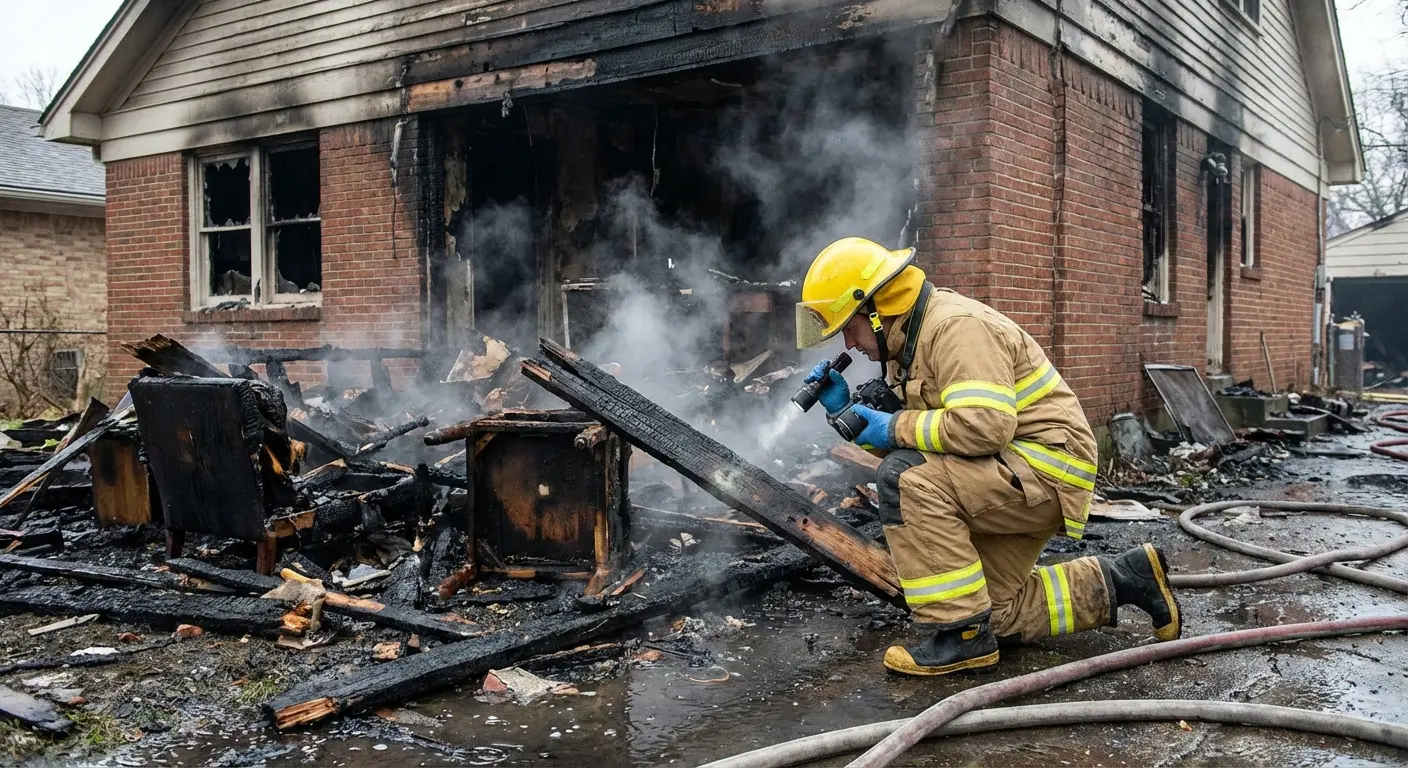
House fire investigation is the systematic process of determining how and why a residential fire started, and what happens in the first 60 minutes after a fire is extinguished often determines whether that process succeeds or fails. This guide breaks down what experienced fire investigators actually do on scene: how they read burn patterns, what evidence they collect, how they classify fire causes, and what documentation standards are required for findings to hold up in court.
Whether you're a fire investigator, an insurance professional, or someone trying to understand what a house fire investigation involves, this is what the process actually looks like from the ground up.
A common misconception is that a house fire investigation begins when the investigator arrives on scene. It doesn't. It begins at the moment of ignition and by the time investigators arrive, they're already working against evidence that is actively deteriorating.
Consider a typical scenario: the last engine pulls away, the homeowner is in shock, and three neighbors have already walked through the structure before anyone thought to establish a perimeter. By that point, critical evidence may already be compromised. Every footstep through ash, every item moved, every window opened for ventilation writes over data that cannot be recovered.
According to national fire incident data tracked by Blazestack's fire incidents database, fire departments across the United States respond to a fire approximately every 23 seconds. Each of these scenes presents the same challenge: preserving evidence before it vanishes.
Investigators refer to the period immediately following suppression as the golden hour: the window between when the last flame dies and when the scene starts producing unreliable information. Rain washes away accelerant residues. Neighbors disturb burn patterns. Well-meaning family members contaminate potential evidence corridors. The degradation isn't always dramatic or obvious, but it's enough to lose data points that can never be recovered.
Every fire scene is treated as a potential crime scene until investigation proves otherwise. That means the same discipline applied to preserving a crime scene applies here — except the evidence is made of fragile carbon deposits and heat-affected materials that are far less forgiving of interference.
Experienced fire investigators often arrive while suppression crews are still working. That's not coincidence, it's strategy.
Active fire suppression fundamentally changes a scene. Water pressure moves debris. Ventilation tactics alter airflow patterns. Overhaul operations (when firefighters open walls and ceilings to check for hidden fire), can destroy the very evidence needed to determine origin and cause.
When investigators are present during suppression, they can document which char patterns existed before overhaul and which structural elements were breached by crews rather than by the fire itself. In one documented case, that distinction proved decisive: an investigator on scene during active suppression observed ceiling damage that crews had made for ventilation access. That context later confirmed the fire originated from an electrical failure in a range hood, not the stove burners a homeowner had reported hearing pop. Without that real-time observation, the cause determination would have been far harder to defend.
Documenting suppression activities is just as important as documenting burn patterns. Which walls were already breached on arrival? Where did crews make entry? What did smoke look like, and where was it coming from? These observations from first-arriving firefighters provide context that physical evidence alone cannot give and they become critical reference points when separating what the fire did from what suppression operations did.
Fire doesn't destroy evidence. It creates it. Understanding fire pattern analysis requires scientific knowledge, field experience, and critically, knowing when a pattern is meaningful versus misleading.
V-Patterns Aren't What TV Taught You
V-patterns form above ignition points as heat rises and spreads outward, but they also form in areas far from the origin due to ventilation, fuel load variations, and suppression effects. A V-pattern is a starting point for inquiry, not a conclusion. The questions that follow matter more than the pattern itself: what was the fuel source? How did air move through space? Did a window fail early, creating a ventilation point that drew fire in a particular direction?
Char Depth and What It Actually Tells You
Deeper charring indicates longer burn time. That's physics. What it doesn't indicate on its own is where the fire started. Deep char appears wherever fire had sustained access to oxygen and fuel, which may be at the origin point or in a room that wasn't involved until well into the incident. Char depth is one data point in a constellation of indicators and is never used in isolation.
Arc Mapping and Electrical Fires
When electrical wiring fails during a fire, it produces arc marks: small beads of melted copper with a distinct appearance under examination. The central question investigators must answer is whether the electrical failure caused the fire or whether the fire caused the electrical failure.
According to the NFPA, electrical malfunction accounts for 6.3% of residential fires, making it the third leading cause after cooking and heating equipment. Most electrical fires don't begin with visible sparks, they start with resistance heating, poor connections, or damaged insulation generating heat over time. Arc mapping traces electrical pathways and identifies which failures occurred first, using arc bead size, location, and copper oxide formation patterns that differ between fire-initiated and electrically-initiated failures.
This distinction is especially critical in appliance fires, where the fire and the electrical fault originate in the same enclosed unit — dishwasher fire investigations are a clear example of how tightly arc evidence and heat damage overlap inside a sealed compartment.
What Suppression Damage Actually Looks Like
Water extinguishes fire and it also moves things. Ash slurry flows across floors, carrying debris away from origin points. Ceiling collapse from water weight buries evidence under wet insulation and drywall. Steam damage produces patterns that can resemble fire travel to an untrained eye. Distinguishing fire damage from suppression damage is a core investigative skill and one that directly affects the accuracy of every origin determination.
Every house fire investigation concludes with one of four cause classifications. These aren't working theories or educated guesses, they are conclusions reached through the scientific method, supported by documented physical evidence, and defensible under legal scrutiny.
Accidental fires represent the majority of house fire investigations: unattended cooking, damaged electrical cords, space heaters placed too close to combustibles, improperly discarded smoking materials. An accidental classification does not mean no one bears responsibility. It means there was no intent to start a fire. Negligence, code violations, and product defects can all produce accidental classifications while still carrying significant legal and financial consequences.
Natural causes such as lightning strikes, wildfire spread, and spontaneous combustion of improperly stored materials, require the same rigorous documentation as any other classification. The investigative process doesn't change because the ignition source was environmental. Insurance claims and legal questions still require resolution, and that requires documented evidence.
Incendiary means intentionally set, a category broader than dramatic arson cases. Permitted burns that escape control, warming fires in abandoned buildings, and debris burning that spreads to structures all fall under this classification. When incendiary fires are suspected, immediate coordination between fire investigators and law enforcement is essential. Motive matters for prosecution but does not affect the investigative classification itself. For arson cases specifically, accelerant detection canine teams have become an increasingly important part of evidence collection.
Undetermined is the classification that carries the most frustration for everyone involved — insurance companies, homeowners, and prosecutors alike. But it is sometimes the only scientifically honest conclusion. When a scene is too damaged, evidence has been contaminated, or multiple ignition sources cannot be eliminated, NFPA 921 is clear: investigators do not speculate. Undetermined is not an investigative failure, it is the standard of intellectual honesty that separates rigorous house fire investigation from junk science.
Physical evidence doesn't lie, but it can be misinterpreted. Witness statements can be entirely honest and still be wrong. The skill of an experienced house fire investigator lies in knowing which to rely on when the two contradict each other.
What Is Collected from Fire Scenes
Fire scene evidence collection differs significantly from other forensic disciplines. Investigators collect materials that may contain accelerant residues, failed electrical components, potential ignition sources, and origin-area samples for laboratory analysis. Every item is photographed in place before collection, documented relative to the overall scene, and entered into chain of custody records from the moment it leaves the scene.
Accelerant detection requires careful contextual judgment. Trace amounts of a petroleum distillate found in a garage where lawn equipment is stored carry an entirely different significance than pour patterns and heavy concentrations found in a bedroom closet. Detection alone is not the conclusion — context, pattern, and concentration together build the evidentiary picture.
Witness Interviews and the Limits of Memory
Human memory is reconstructive rather than reproductive. Each time a person recalls an event, they rebuild it from fragments that are shaped by stress, suggestion, and elapsed time. Investigators interview witnesses as close to the event as possible, focusing on specific sensory details: what was seen, heard, and smelled, and what actions were taken immediately after.
In one residential fire investigation, three neighbors provided conflicting accounts of when flames first became visible. Physical evidence established that the fire originated in a rear bedroom with no street-facing windows, and that front windows did not fail until well into the incident. None of the witnesses were being deceptive, each was reconstructing their experience from a different vantage point under significant stress. The burn patterns and fire department dispatch records provided the accurate timeline. Contradictions between witness statements are more often a product of perspective and stress than of deliberate misrepresentation.
The NFPA 921 Method
NFPA 921 — the Guide for Fire and Explosion Investigations is not a checklist. It is a scientific method: systematic documentation, evidence-based analysis, hypothesis testing, and elimination of causes not supported by data. Investigators who still cite alligatoring as proof of accelerant use, or crazed glass as an indicator of rapid fire spread, are relying on indicators the field has long since debunked. This affirmative, evidence-first approach stands in contrast to negative corpus reasoning, which treats the elimination of causes alone, without supporting positive evidence, as proof of an incendiary origin.
Determining the cause of a house fire is one challenge. Defending that determination under cross-examination (sometimes years later) is another.
Documentation That Survives Legal Scrutiny
Investigations have been lost not because the analysis was wrong, but because documentation couldn't support it. A single inconsistency between a photo log and a scene sketch is enough to give a defense attorney an hour of productive cross-examination, regardless of how sound the underlying fire science was.
Every photograph, measurement, and field observation is potential evidence, subject to review by other investigators, attorneys, insurance adjusters, and juries. That evidentiary standard is one of the main reasons fire investigations take far longer than most property owners expect, the documentation burden alone routinely matches or exceeds the time spent on physical scene work.
Wide shots establish scene context. Mid-range shots show spatial relationships between areas of interest. Close-ups capture specific physical details. Written documentation must be detailed enough that another qualified investigator could review the notes and understand exactly what was observed, where, and why it was relevant to the analysis.
This is where fire investigation case management software makes a material difference, automatically linking photos to scene locations, maintaining chain of custody records, and keeping investigations organized and audit-ready without manual formatting hours after the fact. A thorough house fire investigation that cannot be coherently reconstructed 18 months later in a deposition is not a defensible one.
Expert Testimony and the Daubert Standard
In federal court and many state courts, expert testimony must satisfy the Daubert standard: the methodology must be scientifically valid, testable, peer-reviewed, and generally accepted within the relevant scientific community. Compliance with NFPA 1033 and NFPA 921 helps meet those requirements, but it does not provide automatic immunity from challenge.
Final Thoughts
House fire investigation is not about finding someone to blame. It is about accurately determining what happened, based on physical evidence, scientific process, and intellectual honesty. The first 60 minutes after a fire is extinguished hold more investigative value than the next 48 hours combined and that is precisely the window when scenes are most vulnerable to contamination and evidence loss.
Every cause classification carries real consequences for homeowners, insurance companies, and sometimes criminal defendants. That is why experienced investigators follow NFPA 1033 and NFPA 921, document meticulously, and assign an undetermined classification when the evidence does not support a specific conclusion, even when every stakeholder involved is pushing for a definitive answer.
How long does a typical house fire investigation take?
There is no standard timeline. A straightforward accidental fire with a clear origin and cause may conclude in a few hours on scene and another few writing the report. Complex investigations involving multiple areas of origin, suspected arson, or fatalities can require days of scene examination followed by weeks of laboratory analysis and follow-up interviews. Scene complexity is a more reliable predictor of investigation length than fire size or structural damage alone.
Can investigators really tell if someone used an accelerant to start a fire?
After laboratory analysis — yes, with important caveats. Investigators collect samples from areas where burn patterns or unusual fire spread suggest ignitable liquid use. Those samples undergo gas chromatography-mass spectrometry analysis, which identifies specific hydrocarbon profiles. However, many household materials and building products contain petroleum-based compounds. Detection alone does not indicate arson. Investigators look for context, patterns, and concentrations that cannot be explained by innocent sources.
What happens if suppression crews accidentally destroy evidence?
Suppression crews are doing exactly what they should: saving lives and property. Evidence preservation is important, but it is never the priority when fire is active or victims may be inside. Good communication between suppression crews and investigators mitigates much of this risk. When investigators know which walls were opened, which furniture was moved, and where crews made entry, they can account for those changes in their analysis. The more serious problem is contamination that occurs after the fire is out and scene security has not been established.
How often is arson the cause of a house fire?
Nationally, incendiary fires represent roughly 13–15% of structure fires where cause is determined. That figure varies by region and property type. Vacant structures carry higher rates than occupied homes. The majority of house fires are accidental, though accidental does not mean unforeseeable or unavoidable. Many accidental fires involve clear negligence, code violations, or known hazards that went unaddressed.
Will insurance companies conduct their own house fire investigation?
Often, yes. Insurance companies hold subrogation interests and have independent obligations to verify claims. They may deploy their own investigators or contract private firms. Multiple parallel investigations of the same scene are not uncommon. Property owners are typically required by their policy terms to cooperate with the insurer's investigation. Understanding how origin and cause reports affect insurance claims is valuable context for anyone navigating that process.
What should occupants do if their house catches fire?
Leave immediately and stay out. Structural damage, toxic atmospheres, and hidden fire extension make re-entry dangerous even when a fire appears to be out or contained. Once evacuated, call 911 and do not re-enter until fire officials explicitly clear the structure. Avoid disturbing the scene before investigators arrive, every item moved and every footstep through the affected area potentially compromises evidence. Documenting what is visible from outside: photos, video, and notes about conditions observed before and during the fire, can support both the investigation and any subsequent insurance claim.
Stop Losing Cases to Documentation Gaps Blazestack's Evidence & Media Management automatically links photos to scene locations, tracks chain of custody, and keeps your entire investigation audit-ready — from the first frame to the final report. Start your free 14-day trial →

Trusted by Public and Private Investigator Teams Everywhere
Whether you're a big state agency, a small local fire department or somewhere in between, Blazestack software (NFPA 921® & CJIS compliant) collects fire scene data and generates standardized origin and cause reports in a fraction of the time of other methods.
To learn more about Blazestack, give us a call at (866) 303-4344 or email us at support@blazestack.com
Get Your Free 14-Day Trial and Custom Price Quote Now
We'll let Blazestack do the talking. Try it out right now for free.
A member of our staff will be in touch shortly.