BLEVE vs VCE: What Fire Investigators Need to Know in 2026

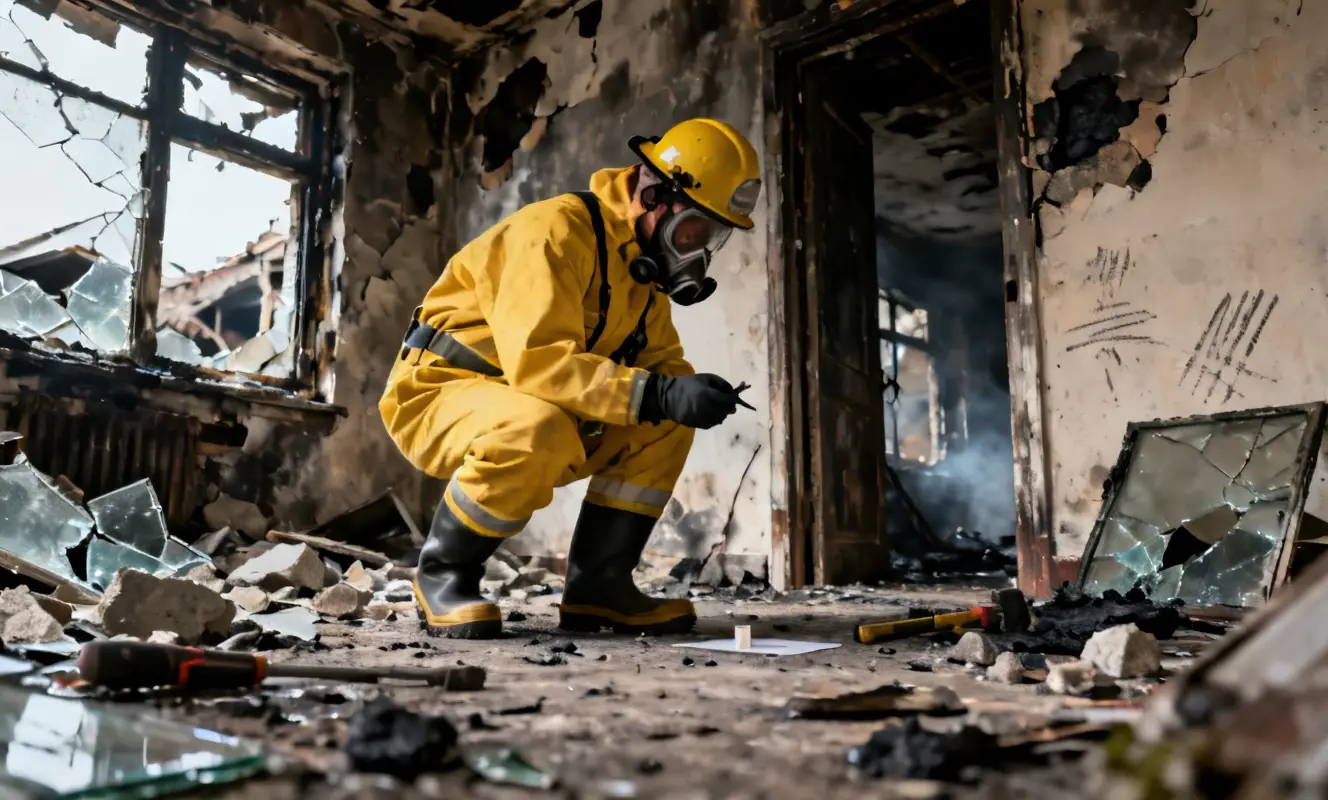
Two explosion mechanisms account for a significant proportion of the complex cases fire investigators encounter, yet they are frequently misidentified in the early stages of scene examination. A Boiling Liquid Expanding Vapor Explosion (BLEVE) and a Vapor Cloud Explosion (VCE) involve fundamentally different physics, leave different physical evidence, and demand different investigation approaches. Getting the determination wrong early redirects evidence collection priorities, brings the wrong experts to the scene, and undermines conclusions that may need to be held up in court months or years later.
This guide covers what separates these two mechanisms at the physics level, how to read the difference on scene, how ignition source determination differs between the two, and what each requires from a documentation standpoint.
BLEVE
A BLEVE occurs when a pressurized container holding liquid above its atmospheric boiling point fails catastrophically. The physics are straightforward but violent: instantaneous depressurization causes the superheated liquid to flash to vapor, releasing energy stored both mechanically from pressure and thermally from the superheated state.
The container itself is the critical element. Propane tanks, rail cars carrying liquefied gases, and industrial pressure vessels are typical BLEVE candidates. What defines a BLEVE is vessel rupture — not gradual leakage. The energy release is simultaneous with container failure. There is no dispersion phase, no waiting for vapor to mix with air before ignition. The explosion is the container rupture and the liquid flashing to vapor.
Not every BLEVE involves flammable materials. Steam boilers and vessels containing non-flammable liquids under pressure can produce BLEVEs without subsequent fire. When flammable contents are involved, a fireball typically follows the initial blast — reaching 200 to 300 feet across from a typical propane tank failure.
VCE
A Vapor Cloud Explosion (VCE) follows a four-stage sequence: leak, dispersion, mixing, ignition. Each stage matters because breaking the chain at any point prevents the explosion.
Fuel escapes from a source — a natural gas line, propane connection, gasoline spill, or industrial chemical release. It disperses through the environment, with density relative to air determining whether it accumulates at floor level or ceiling level. It mixes with air within flammable limits — the mixture must fall within the specific LEL-to-UEL range for the fuel involved. Too lean and combustion will not sustain. Too rich and ignition will not propagate. Finally, a competent ignition source within or at the boundary of the mixed cloud triggers combustion.
The resulting deflagration creates a pressure wave that damages structures. In confined spaces, overpressures can reach 100 psi or more. Even unconfined VCEs generate 1 to 2 psi overpressure — sufficient to cause significant structural damage.
The delayed ignition characteristic is what most clearly separates VCEs from other explosion types, and what makes timeline reconstruction the cornerstone of VCE investigation.
The Fastest Differentiator on Scene
Container condition provides the fastest initial read. Catastrophic pressure vessel failure with extensive fragmentation points toward BLEVE. Intact containers with identifiable leak points and no significant fragment scatter point toward VCE. However, this initial observation should drive hypothesis formation, not lock in conclusions — vessel damage can result from an explosion rather than cause it, and the sequence matters enormously.
BLEVE Damage Signatures
Fragment scatter is the most immediate and distinctive indicator. Tank pieces do not fall nearby, they become high-velocity missiles. Container fragments have been documented embedded in structures more than 350 feet from the failure point. Every fragment must be recovered, mapped, and examined because smaller pieces often contain the failure initiation point.
Blast pattern is characteristically spherical, radiating outward from where the container failed. Structural damage shows outward pressure in all directions: walls blown out, roofs lifted, windows shattered in a pattern that radiates from a central epicenter.
When contents are flammable, thermal damage is extensive. The fireball creates a zone of radiation burns and ignited combustibles at significant distances. Scorching patterns, melted materials, and thermal exposure indicators help establish fireball radius. Crater formation may be present if the container was at or below grade.
Key BLEVE indicators on scene:
- Tank fragments with identifiable pressure vessel markings scattered across the scene
- Spherical damage pattern radiating from a single central point
- Projectile impact damage at significant distances from the origin
- Thermal radiation effects extending well beyond the blast zone when contents were flammable
- Metal failure evidence including tearing, shearing, or brittle fracture at the vessel
- Pressure relief valve condition and operational status
- Witness accounts of initial fire followed by sudden catastrophic explosion
VCE Damage Signatures
Structural damage dominates the VCE scene, but fragment scatter is minimal or absent. Walls are blown outward and windows shattered — but the scene lacks the container missile evidence of a BLEVE.
VCE damage frequently shows directional characteristics based on how the space was confined. A basement explosion vents upward, blowing out the first floor. A vapor cloud in a corridor produces preferential damage along that path. Reading confinement effects is central to establishing where the cloud was densest at ignition.
Thermal damage varies significantly. Rapid deflagration consumes fuel quickly with limited thermal transfer. Slower combustion or transition toward detonation increases thermal effects. The absence of a large fireball — in contrast to flammable BLEVE events — is a meaningful differentiator when flammable materials are involved in both scenarios.
Key VCE indicators on scene:
- Identifiable leak source with gradual release mechanism
- Structural damage without significant container fragmentation
- Directional blast effects that reflect space confinement
- Witness accounts of gas odor before explosion
- Time delay between leak initiation and explosion
- Pressure damage consistent with deflagration rather than detonation
- Minimal or no crater formation
Other Explosion Mechanisms to Consider
BLEVE and VCE are not the only mechanisms worth including in a differential analysis. Four others warrant consideration depending on scene evidence:
Deflagration (non-VCE) — subsonic combustion without a dispersed vapor cloud, including combustible dust explosions and confined gas deflagrations that do not meet VCE criteria. Consider this when combustible dust accumulation is present or pressure rise rates are lower than typical VCE events.
Detonation — supersonic combustion producing pressures up to 20 times atmospheric, causing more severe damage than deflagration. Consider detonation when structural damage shows extreme severity inconsistent with deflagration, witnesses report a sharp crack rather than a boom, or high explosive materials are involved.
Mechanical explosion (non-BLEVE) — catastrophic failure of pressurized equipment without combustion. Compressed air tanks, steam boilers, and hydraulic systems failing from overpressure fall here. Distinguished from BLEVE by the absence of superheated liquid flashing to vapor and no fireball formation.
Flash fire — ignition of a dispersed flammable cloud that burns without generating a significant pressure wave. Distinguished from VCE by the absence of structural overpressure damage.
In BLEVE Investigations
Ignition source determination in BLEVE investigations is important but frequently secondary to the container failure analysis. The initial fire that weakened the vessel is the primary causal element. Determining what caused that fire matters for origin and cause conclusions, but the container failure itself — not the ignition of released vapor — is the explosion mechanism.
Electrical arcing and other conventional ignition sources should be examined for the initial fire that weakened the vessel. Ignition of the vapor cloud post-rupture is typically near-simultaneous with container failure and may involve multiple potential sources within the fireball zone, making specific source identification less critical than establishing what initiated the container heating sequence.
In VCE Investigations
Ignition source determination is the central investigative challenge in VCE cases and the most frequently contested element in litigation. The source must be located within or at the boundary of the flammable cloud, must be competent to ignite the specific fuel-air mixture present, and the timing must align with cloud formation.
Applying the scientific method of fire investigation is essential here. The process should follow systematic elimination:
Step 1 — Establish the vapor cloud boundaries. Reconstruct where the flammable mixture could have existed based on fuel properties, leak rate, ventilation, and elapsed time. Only sources within these boundaries warrant serious consideration.
Step 2 — Inventory potential sources. List all electrical equipment, open flames, pilot lights, mechanical equipment capable of spark generation, and any personnel activities within the probable cloud location.
Step 3 — Evaluate competency. Each source must be assessed for whether it could provide sufficient energy to ignite the specific fuel-air mixture under the conditions present. A source that was present but outside the flammable range, or that lacked sufficient ignition energy, can be eliminated.
Step 4 — Establish operational status. Was the equipment energised or active at the time of the explosion? Utility records, smart device logs, security system data, and witness accounts all contribute to this determination.
Step 5 — Document eliminations and remaining candidates. Every source evaluated should appear in documentation with the reason for elimination or the evidence supporting it as the probable source.
When multiple competent sources existed within the probable cloud boundary and evidence does not eliminate them, honest reporting requires acknowledging the limitation. NFPA 921 does not require absolute certainty — it requires conclusions supported by evidence and reasoning. Documented, systematic elimination of alternatives is what withstands Daubert challenge, even when a definitive single source cannot be identified.
BLEVE Documentation Priorities
Fragment recovery and mapping cannot be a shortcut. Every recoverable piece must be documented with precise location, orientation, and photographs before collection. Smaller fragments frequently contain the failure initiation point (the most critical evidence for determining cause), and are easily overlooked in favour of large visible pieces.
Metallurgical examination of failure points is standard practice, not optional. The failure mode: ductile versus brittle fracture, evidence of material fatigue, corrosion, or manufacturing defects, is central to cause determination and requires laboratory analysis by a qualified metallurgical engineer.
Pressure relief device conditions and settings must be documented and examined. Whether the relief valve operated, at what pressure, and whether it functioned as designed directly affects the failure sequence analysis.
Thermal exposure patterns on container remnants help establish fireball radius and the fire's relationship to the vessel before failure.
VCE Documentation Priorities
Timeline reconstruction is the foundation of VCE documentation. Every piece of information that constrains when the leak began, how long vapors accumulated, and when ignition occurred must be documented and correlated. Utility records, smart meter data, alarm system logs, security camera timestamps, and HVAC system records are as important as physical scene evidence.
Leak source documentation must capture the mechanism of release (failed component, damaged piping, open valve) with measurements, photographs, and condition assessment. Vapor dispersion inputs must be recorded on scene: building dimensions, ventilation system configuration, weather conditions at the time of the incident, and fuel properties.
Maintaining proper chain of custody across what may be an extensive scene with evidence from multiple locations requires systematic tracking from collection through laboratory analysis.
Witness statements require specific detail that generic accounts do not provide. Odour observations help establish leak timing. Visible vapour or atmospheric disturbance maps cloud location. Physical sensations provide overpressure data at specific points. Timing of observations relative to the explosion constrains the accumulation timeline.
Shared Documentation Standards
Both investigation types require comprehensive photographic documentation with spatial context, wide shots establishing scene layout, medium shots showing spatial relationships, and close-up shots capturing detail. Both require damage gradient mapping that documents how severity changes with distance from the origin. And both require systematic evidence organisation that can be interrogated months or years later when litigation demands it.
Blast analysis techniques differ in application between the two mechanisms but the underlying requirement — quantitative documentation of pressure effects at measured distances — applies to both.
Closing the Documentation Gap with Purpose-Built Tools
Blazestack's Fire Scene Data Collection module supports both investigation types through structured mobile data capture that organises fragment locations, damage measurements, evidence items, and photographs in real time on scene. For BLEVE cases, GPS-enabled fragment mapping links each piece to precise coordinates with photographs and dimensional data. For VCE cases, timeline correlation tools connect witness statements with physical evidence, utility records, and weather data into a defensible chronology. Scene data flows directly into NFPA 921-compliant origin and cause reports without manual reformatting, and automatic chain of custody tracking maintains evidence integrity across multi-location scenes.
Investigators can test the platform with a 14-day free trial or schedule a demo to see how the documentation workflow handles both explosion investigation types.
Complex incidents can involve sequential or simultaneous explosion mechanisms. A common scenario involves a gas leak creating a VCE that damages a propane tank, which then fails catastrophically in a secondary BLEVE. Industrial incidents with multiple pressurised systems and flammable materials can produce cascading failures where each explosion event triggers the next.
When this occurs, the investigation must identify each explosion event separately, determine the sequence, and establish causal relationships. The initiating event determines origin and cause, which means getting the sequence right is as important as identifying the mechanisms involved.
Witness statements are particularly valuable in cascade scenarios. Did witnesses hear one explosion or multiple events separated in time? Was there an initial blast followed seconds or minutes later by a larger secondary event? Damage pattern analysis should then be evaluated for whether all destruction is consistent with a single event or shows characteristics of multiple explosions from different locations.
Timeline reconstruction that clearly distinguishes the primary explosion mechanism from secondary events is the investigative foundation in these cases. Documentation from scene arrival must be designed with this separation in mind.
How quickly can I determine whether I'm dealing with a BLEVE or VCE on scene?
Initial determination often happens within the first hour based on observable indicators. Container involvement provides the fastest differentiator, catastrophic pressure vessel failure with extensive fragmentation points toward BLEVE, while intact containers with identified leak points suggest VCE.
But definitive determination requires systematic evaluation of all criteria. Rushing to conclusions based on limited initial observations creates risk of misclassification.
Your initial walkthrough reveals obvious indicators. Massive container fragments scattered across the scene? You're likely investigating a BLEVE. Structural damage without significant fragmentation and an identified gas leak? VCE becomes the working hypothesis.
That said, don't lock into conclusions prematurely. Seen investigators commit to BLEVE determinations based on container involvement, only to discover the vessel failure was a consequence of the explosion rather than the cause. The gas explosion damaged the tank, which then failed, but the VCE came first.
Document systematically, collect evidence thoroughly, let the analysis drive your conclusions instead of forcing evidence to fit initial impressions.
Can a single incident involve both BLEVE and VCE mechanisms?
Yeah, complex incidents can involve sequential or simultaneous explosion mechanisms. A common scenario involves a gas leak creating a VCE that damages a propane tank, which then fails catastrophically in a secondary BLEVE.
Industrial incidents sometimes present multiple explosion events as initial failures cascade through interconnected systems. Your investigation must identify each explosion event separately, determine the sequence, establish causal relationships.
Timeline reconstruction becomes critical for understanding how one event triggered another. Documentation should clearly distinguish primary explosion mechanism from secondary events, as origin and cause determination depends on identifying the initiating event.
Industrial facilities with multiple pressurized systems and flammable materials can experience cascading failures. The initial natural gas VCE damages a pressure vessel containing liquefied petroleum gas. That vessel then fails in a BLEVE, creating additional damage and potentially triggering further failures.
Your investigation separates these events, establishes sequence, determines which explosion caused which damage. Witness statements help establish timing—did people hear one explosion or multiple events separated by seconds or minutes?
Damage pattern analysis reveals whether all destruction resulted from a single event or shows characteristics of multiple explosions from different locations.
What documentation mistakes most commonly undermine BLEVE and VCE investigations?
Incomplete fragment recovery and mapping undermines BLEVE investigations by preventing comprehensive failure analysis. Inadequate timeline reconstruction weakens VCE cases by creating uncertainty about leak duration and cloud formation.
Poor photograph organization like images without location data, timestamps, or clear subject identification, reduces evidentiary value. Failure to document weather conditions at incident time eliminates critical gas dispersion modeling inputs.
Insufficient witness statement detail, particularly regarding timing and observations, creates gaps in timeline reconstruction. Lack of systematic ignition source evaluation and elimination documentation invites successful challenges during Daubert hearings. Chain of custody gaps for physical evidence compromise admissibility.
Fragment recovery shortcuts haunt BLEVE investigations. Investigators collect obvious large pieces but neglect systematic grid search for smaller fragments. Those small pieces often contain the failure initiation point, the critical evidence for determining cause.
Timeline gaps plague VCE cases. You've got witness statements but didn't correlate them with utility company records, alarm system logs, security camera timestamps. The result? Defense experts argue your timeline is speculative rather than evidence-based.
Photograph management failures create credibility problems. You've got 300 scene photos but can't definitively state which image shows the leak source location or when you captured it. That uncertainty becomes "reasonable doubt" in criminal cases or "failure to meet burden of proof" in civil litigation.
How do I handle cases where the ignition source can't be definitively determined?
Ignition source uncertainty occurs more frequently in VCE investigations than investigators acknowledge publicly. When multiple competent sources exist within the probable vapor cloud location and evidence doesn't eliminate alternatives, honest reporting requires acknowledging the limitation.
Understanding how to prepare for Daubert challenges becomes essential when your ignition source determination faces scrutiny, as these legal challenges test the scientific validity of your investigation methodology and conclusions.
NFPA 921 doesn't require absolute certainty—it requires conclusions supported by evidence and reasoning. Document all potential sources, explain why each could have caused ignition, note what evidence would be needed to eliminate each source, explain why that evidence is unavailable.
Courts generally accept well-reasoned analysis acknowledging limitations over speculative conclusions presented as certainties. Your credibility increases when you honestly address investigative constraints rather than overreaching beyond evidence.
VCE scenes often contain multiple potential ignition sources within the probable cloud location. Electric water heater, gas furnace pilot light, light switches, electrical outlets, any could have ignited the mixture.
Explosion damage destroys evidence that might have eliminated sources. You can't determine whether a light switch was in the on or off position when the switch itself was destroyed by blast pressure.
Honest reporting acknowledges these limitations. "The ignition source could not be determined with certainty. However, based on vapor cloud reconstruction, the following sources existed within the flammable mixture: [list sources]. Each represents a competent ignition source for the fuel-air mixture present."
This approach maintains credibility. Judges and juries understand investigative limitations when you explain them clearly. What destroys credibility is claiming certainty when evidence doesn't support it.
What's changed in explosion investigation standards between 2020 and 2026?
Investigation standards have evolved significantly toward greater scientific rigor and documentation requirements. Courts increasingly expect computational modeling support for complex VCE cases, particularly gas dispersion analysis in buildings with complicated layouts or ventilation systems.
Daubert challenges have become more sophisticated, with defense experts scrutinizing investigation methodology in detail. Digital evidence—security camera footage, smart home device logs, utility company SCADA data—now plays a larger role in timeline reconstruction.
NFPA 921 updates have emphasized hypothesis testing and systematic elimination of alternatives. Professional certification requirements have increased, with more jurisdictions requiring CFI or CFEI credentials for expert testimony. Technology adoption has accelerated, with investigation software and digital documentation tools becoming standard rather than optional.
Computational modeling has shifted from "nice to have" to "expected" in complex cases. Insurance carriers and attorneys now routinely ask whether gas dispersion modeling was performed. If you didn't model vapor cloud behavior, you'll need to explain why it wasn't necessary.
Digital evidence integration has expanded dramatically. Smart thermostats, security systems, utility smart meters—these devices generate timestamped data that constrains your timeline reconstruction. Investigators who ignore digital evidence sources face challenges from experts who obtained and analyzed that data.
Documentation standards have risen across the board. Courts expect systematic evidence collection, comprehensive photography with metadata, chain of custody documentation, clear hypothesis testing methodology. The handwritten notebook approach doesn't meet modern standards.
Following NFPA 921 and NFPA 1033 standards provides the professional framework necessary for conducting scientifically sound explosion investigations that meet both legal and technical scrutiny requirements.
Explore how Blazestack transforms explosion investigation documentation from reactive note-taking to proactive evidence management. Because when you're determining whether that pressure vessel failure was a BLEVE or that gas leak caused a VCE, your documentation needs to be as solid as your technical analysis.
The BLEVE vs VCE determination is not a classification exercise, it drives every subsequent decision in the investigation. Evidence collection priorities, expert consultation requirements, timeline reconstruction depth, and documentation standards all flow from which mechanism occurred.
BLEVEs leave tangible, mappable physical evidence in container fragments and a distinctive spherical blast signature. The investigation is anchored in metallurgical analysis and fragment mapping, with ignition source determination focused on the initial fire rather than the explosion itself.
VCEs demand reconstruction of an invisible pre-ignition event. The cloud no longer exists. The evidence is encoded in damage gradients, witness observations, and the systematic elimination of ignition sources — all of which depend on documentation quality that begins at scene arrival and continues through the final report.
For a complete framework covering both investigation types within broader explosion investigation methodology, the fire and explosion investigation guide covers the full process from scene arrival through expert testimony.
The physics determine which mechanism occurred. The documentation determines whether the investigation holds up.

Trusted by Public and Private Investigator Teams Everywhere
Whether you're a big state agency, a small local fire department or somewhere in between, Blazestack software (NFPA 921® & CJIS compliant) collects fire scene data and generates standardized origin and cause reports in a fraction of the time of other methods.
To learn more about Blazestack, give us a call at (866) 303-4344 or email us at support@blazestack.com
Get Your Free 14-Day Trial and Custom Price Quote Now
We'll let Blazestack do the talking. Try it out right now for free.
A member of our staff will be in touch shortly.