Wildfire Arson Investigation: Methods, Evidence & Prosecution

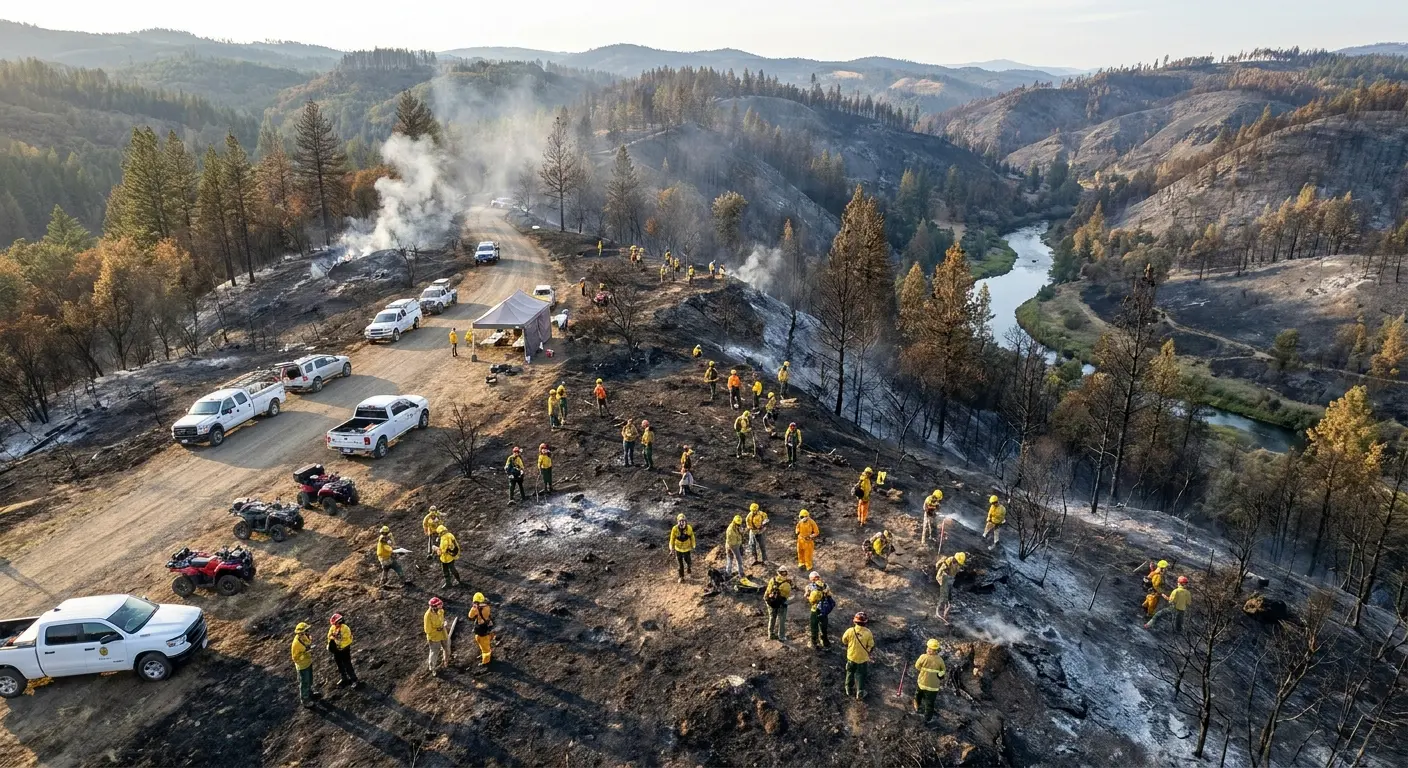
Wildfire arson investigation determines whether a wildland fire originated from intentional human action. Investigators examine physical evidence, fire behaviour patterns, and witness accounts across terrain that may span thousands of acres. The discipline sits at the intersection of fire science, criminal investigation, and wildland fire behaviour analysis.
Wildfire arson differs from other human-caused wildfire categories. Equipment failures, discarded cigarettes, and powerline contacts all ignite wildland fires without criminal intent. Arson requires proof of deliberate ignition. Investigators must distinguish intentional setting from negligence, recklessness, or accident, a process that begins with identifying the source of ignition and ruling out every accidental possibility before arson becomes a viable conclusion.
The stakes extend beyond criminal prosecution. Civil litigation and insurance subrogation claims increasingly hinge on arson determination. Property owners, utilities, and government agencies face liability questions that demand rigorous investigation methodology. Expert witnesses testify on origin and cause findings that carry financial and legal consequences measured in millions of dollars.
Why does wildfire arson investigation require specialised training?
Structure fire investigation credentials do not transfer to wildland contexts automatically. Fire dynamics principles in open terrain follow different rules than fire behaviour in enclosed spaces. Weather, topography, and fuel characteristics create variables absent from structure fires. Investigators need training specific to wildland fire spread, pattern interpretation, and origin determination methodology.
Professional organisations offer wildland fire investigation courses distinct from structure fire programmes. CFITrainer and similar platforms provide specialised instruction for investigators transitioning to wildland contexts. Certification paths recognise wildland investigation as a separate competency requiring dedicated education and field experience. Those exploring arson investigator career paths should note that wildland specialisation commands distinct qualifications and compensation brackets.
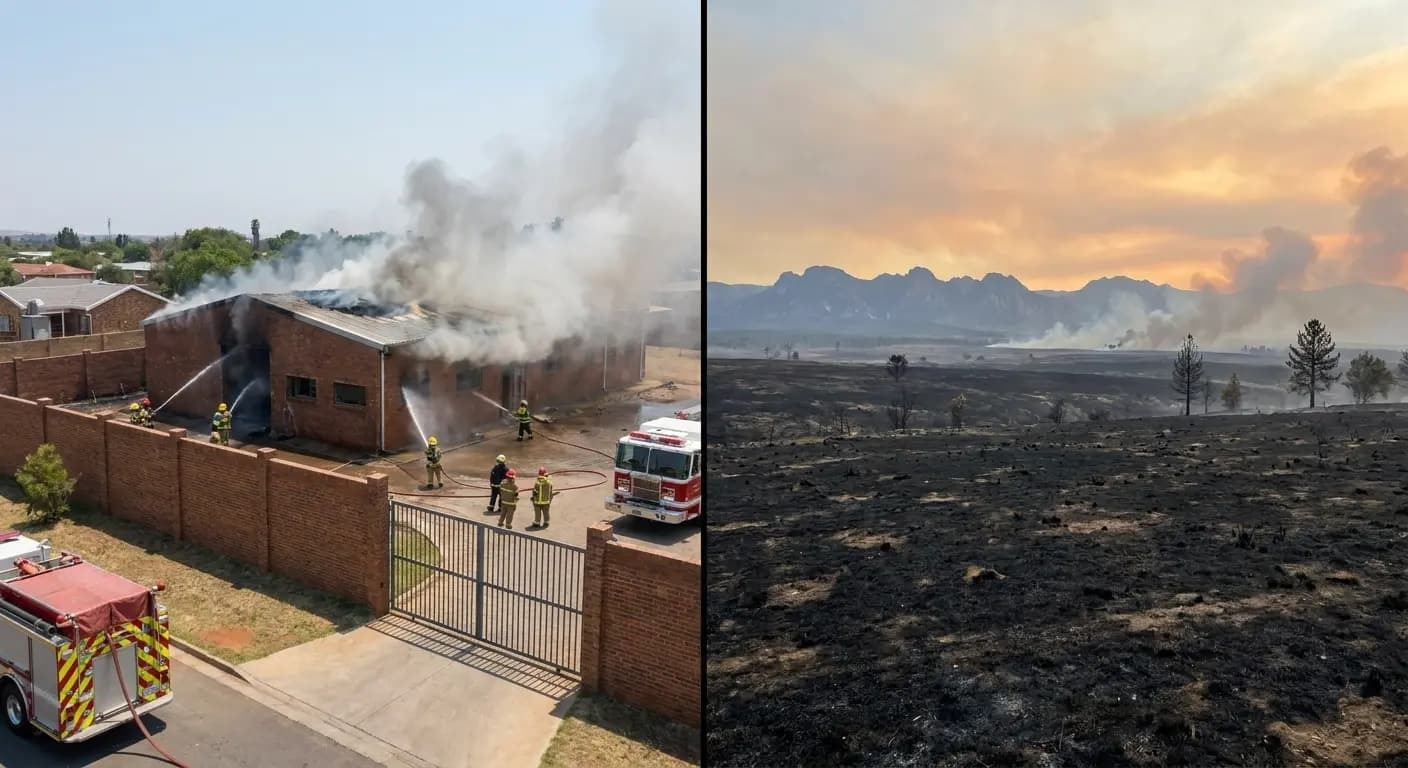
The differences are structural, not superficial. Every aspect of investigation methodology changes when the scene moves from an enclosed building to open terrain.
Scene scale and containment
Structure fires occur within defined boundaries. Walls, ceilings, and floors contain fire spread and create interpretable burn patterns. Investigators work in spaces measured in square feet. Evidence remains relatively concentrated.
Wildfire scenes span acres or square miles. Fire spreads across varied terrain without physical containment. Origin areas may lie miles from where investigators first encounter the scene. Evidence disperses across vast areas subject to weather, wildlife, and continued fire activity. Search patterns must adapt to a scale that makes room-by-room examination impossible.
Weather and environmental variables
Structure fires occur in relatively stable environments. Fire behaviour follows patterns influenced primarily by fuel arrangement, ventilation openings, and structural features.
Wildland fires respond dynamically to weather conditions. Wind speed and direction alter fire spread continuously. Relative humidity affects fuel moisture and ignition susceptibility. Temperature inversions trap smoke or create erratic fire behaviour. Topography channels wind and creates microclimate effects that influence fire movement in ways structure investigators never encounter. These variables complicate origin determination because fire may spread rapidly upslope, slowly downslope, or erratically across level terrain depending on conditions at the moment of ignition.
Timeline and scene access
Structure fire investigations typically conclude within days. Firefighters extinguish the blaze, investigators arrive, and examination proceeds while evidence remains relatively fresh.
Wildfire investigations may begin days or weeks after ignition. Fire continues spreading while investigators wait for safe access. Containment may take months. By the time investigators reach the suspected origin area, weather has affected evidence, suppression activities have disturbed the scene, and witness memories have faded.
No single indicator proves arson. Investigators evaluate the totality of circumstances, assessing physical evidence, elimination of accidental causes, and behavioural factors together. The following indicators direct investigation, not replace it.
Multiple ignition points
Single ignition points suggest accidental or natural causes. Lightning strikes once. Equipment malfunctions at one location. Discarded cigarettes ignite where they land.
Multiple discrete ignition points separated by unburned areas indicate intentional setting. Investigators document each origin area independently, establishing that fires could not have spread from one to another. The spatial relationship between points matters. Points along a roadway suggest a sequential setting. Clustered points may indicate multiple ignition attempts.
False multiples require consideration. Spotting (firebrands carried by wind igniting new fires ahead of the main front) creates multiple ignition points through natural fire behaviour. Investigators must distinguish spotting patterns from deliberately set origins through pattern analysis and timeline reconstruction.
Systematic elimination of accidental and natural causes
Elimination of non-arson causes is a prerequisite, not a shortcut. Investigators cannot conclude arson by failing to find an accidental cause. They must actively investigate and document why each specific cause could not have occurred.
Weather records confirm or exclude lightning activity. Equipment inspections reveal or rule out mechanical failures. Powerline examinations show or eliminate electrical faults. Smoking materials, campfires, and vehicle catalytic converters receive individual investigation. This process mirrors the scientific method applied across all fire investigation: every alternative hypothesis receives active testing before elimination.
Witness observations and behavioural indicators
Witnesses reporting suspicious persons or vehicles near the ignition area before fire discovery provide crucial leads. Observations gain significance when correlated with ignition timing and location.
Behavioural patterns emerge across arson cases. Fires set during red flag warnings suggest knowledge that fire will spread rapidly. Ignition points along roadways indicate easy access and escape. Serial patterns, where multiple fires occur in similar circumstances over time, point toward intentional activity. These indicators inform investigation direction but do not constitute proof on their own.
Origin determination in wildland fires produces an origin area, not an origin point. Scene scale, evidence degradation, and fire behaviour complexity limit precision. This distinction matters for both investigation methodology and legal proceedings.
Directional fire pattern indicators
Fire leaves directional indicators as it spreads. Angle of char on vegetation shows fire direction: stems and trunks char more severely on the side facing the approaching fire. Protected areas behind obstacles (rocks, logs, berms) indicate fire direction as flames move past. Cupping occurs when fire burns into wooden objects, with the curved char pattern pointing toward the origin. Grass and small vegetation lay in the direction fire travelled.
Investigators document these indicators systematically across the burned area. Individual indicators may mislead due to local wind effects or terrain features. Multiple indicators assessed collectively provide reliable directional information. Investigators trace indicators backward, narrowing the search area progressively until reaching the origin area.
Fire perimeter progression and witness accounts
First responders provide critical origin information. Initial attack crews report fire location, size, and spread direction at discovery. Dispatch records timestamp these observations. Subsequent perimeter mapping during suppression operations documents fire progression.
Investigators interview firefighters, pilots, and civilians who observed the fire early in its development. Aerial photographs and infrared imagery captured during suppression provide objective documentation of fire progression at known times. Synthesising this information, investigators reconstruct fire spread backward in time. The earliest confirmed fire location constrains the origin area, and fire behaviour modelling against weather conditions allows estimation of how far fire could have travelled from ignition to first observation.
Physical evidence transforms suspicion into a prosecutable case. Not all arson fires leave obvious physical evidence, particularly when simple ignition methods (a match applied directly to receptive fuel) are used. When evidence does exist, recognition and proper handling determine whether it reaches a courtroom.
Ignition devices and remnants
Arsonists use various devices to initiate wildland fires. Road flares provide sustained flame sufficient to ignite vegetation. Molotov cocktails create immediate flame spread. Fireworks ignite vegetation through sparks and flame.
Investigators search origin areas for device remnants. Flare casings, bottle fragments, match books, lighter components, and firework debris survive fire exposure. These items appear out of place in wildland settings. Their presence near the origin area, particularly when multiple ignition points each contain similar evidence, strongly supports arson determination. For a broader treatment of arson investigation techniques across both structure and wildland contexts, the methodology shares common evidentiary principles even where scene conditions differ.
Accelerant evidence in wildland contexts
Fire accelerants enhance ignition and initial fire spread. Gasoline, diesel, kerosene, and other petroleum products lower ignition temperature and increase flame intensity. Arsonists may pour accelerants directly on vegetation or saturate materials that sustain flame longer than natural fuels.
Burn patterns indicate accelerant use. Vegetation burns more completely in accelerant-saturated areas. Soil discoloration occurs where liquid petroleum products soak into ground. Odours persist in soil and ash even after fire passes. Laboratory analysis using gas chromatography-mass spectrometry identifies petroleum distillates and distinguishes them from natural hydrocarbons present in vegetation. Positive accelerant identification provides strong arson evidence, particularly when found at multiple origin points.
Timing and delay devices
Timing devices delay ignition, creating alibis or allowing escape before fire discovery. Cigarettes placed in matchbooks, candles burning down to surrounding materials, or mechanical timers connected to ignition sources all provide delay mechanisms.
These devices often leave identifiable remnants: clock mechanisms, battery components, wire fragments, and partially consumed delay materials. Their presence at origin areas, combined with other incendiary evidence, demonstrates premeditation inconsistent with accidental ignition.
Evidence handling in wildland settings demands adaptation of standard protocols. Remote locations, weather exposure, and scene scale create conditions absent from structure fire investigation. Every step, from search through collection to preservation, must account for these realities.
Systematic search methodology
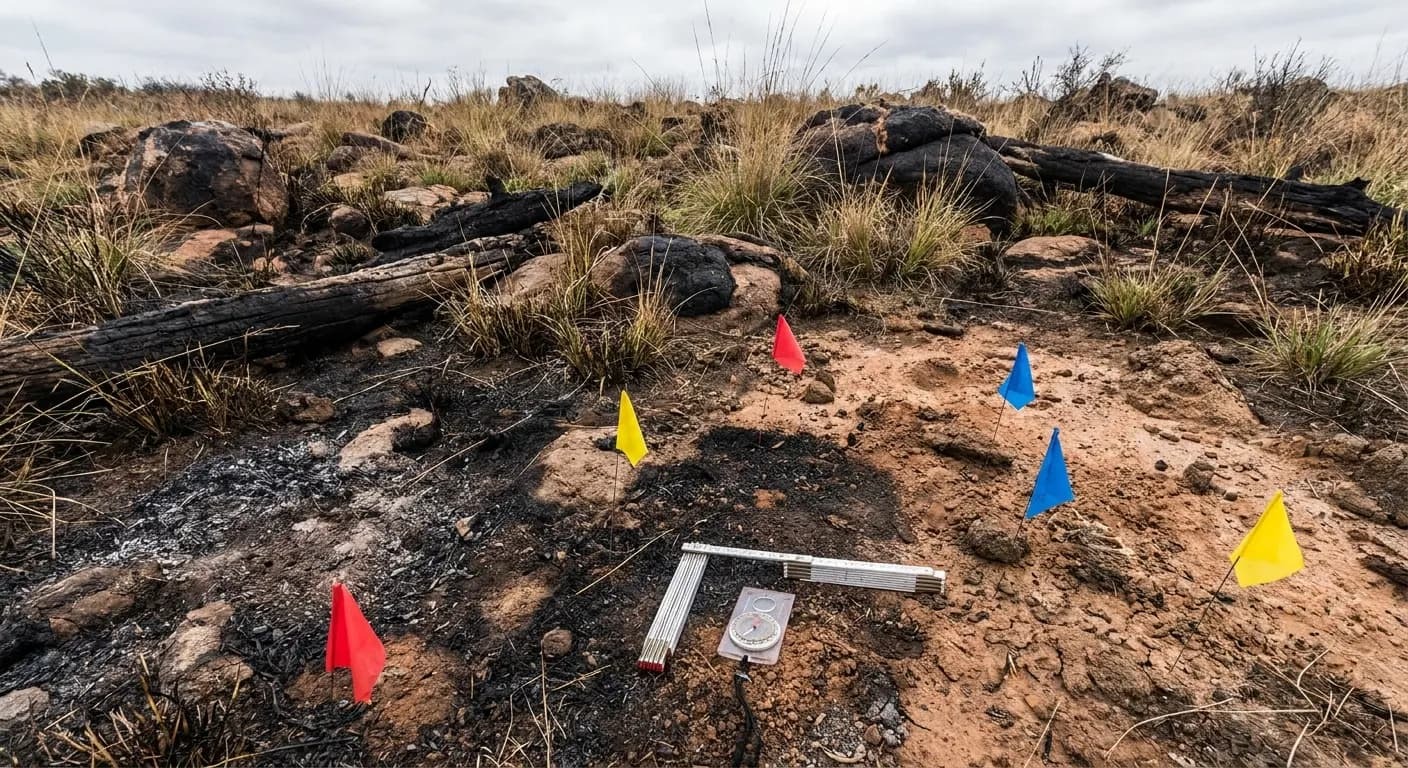
Investigators establish search boundaries based on origin determination, extending beyond the most likely ignition area to account for uncertainty. Grid patterns divide large areas into manageable sections. Search teams move slowly, examining ground surface, vegetation remnants, and ash layers. Raking reveals buried evidence. Metal detectors locate metallic device components. Sifting screens separate small items from ash and soil.
Documentation begins before any evidence is disturbed. Investigators photograph the search area, establish reference points, and create sketch maps. As evidence surfaces, its position is recorded using GPS coordinates, measurements from reference points, and photographs showing spatial relationships to origin indicators.
Collection protocols and chain of custody
Each item receives unique identification linked to documentation. Investigators photograph evidence before collection, showing condition and location. Collection uses clean tools to prevent cross-contamination. Items are packaged separately: metal evidence in paper bags (plastic traps moisture and promotes corrosion), soil samples for accelerant analysis in clean metal cans with tight-sealing lids.
Chain of custody begins at collection. Documentation records who collected the evidence, when, where, and under what circumstances. Transfer to laboratory analysts or evidence storage requires signature and timestamp. This trail ensures evidence admissibility in legal proceedings and guards against spoliation risks that defence attorneys routinely exploit.
Field conditions and weather-driven prioritisation
Wildland scenes remain exposed to weather throughout the investigation. Rain washes away ash, disturbs soil evidence, and degrades materials. Wind scatters lightweight evidence. Temperature extremes affect chemical residues.
Complete weather protection across large wildland scenes is impossible. Investigators prioritise based on degradation vulnerability. Accelerant samples go first: rain washes petroleum products from soil within hours. Lightweight items (paper, fabric, organic materials) follow. Small origin areas may be covered with weighted tarps. Everything else is documented photographically as rapidly as conditions allow, because photographs preserve spatial relationships even when subsequent weather alters the physical scene.
The scientific method protects against wrongful arson determinations. Structured hypothesis testing counters confirmation bias and produces defensible findings. NFPA 921 establishes the framework, and wildland arson investigation applies it with the same rigour required in structure fire cases.
Hypothesis formation and testing
Investigation begins with multiple competing hypotheses. Natural causes (lightning, spontaneous combustion). Accidental human causes (equipment failure, powerline contact, discarded smoking materials, campfire escape). Intentional causes (arson).
Each hypothesis generates testable predictions. If lightning caused ignition, weather records should show thunderstorm activity at the correct time and location. If equipment malfunctioned, failed equipment should exist at the origin area. If arson caused ignition, evidence of incendiary devices or multiple origin points should exist. Investigators test predictions against evidence systematically and eliminate hypotheses that conflict with observations.
Elimination of alternative causes
Arson determination requires active elimination, not passive failure to find alternatives. Lightning elimination requires weather data from the National Weather Service or commercial lightning detection networks showing no strikes within relevant time and distance parameters. Equipment elimination requires locating and examining every piece of equipment that could have malfunctioned. Powerline elimination requires utility records and physical inspection showing no faults.
Investigators document each alternative cause considered, evidence examined, and basis for elimination. This documentation demonstrates thoroughness and supports the conclusion that arson remains the only viable hypothesis consistent with all observed evidence.
Avoiding confirmation bias
Confirmation bias leads investigators to interpret ambiguous evidence as supporting a preconceived conclusion. An investigator suspecting arson may overlook evidence suggesting accidental causes.
Structured methodology counters this. Investigators actively seek evidence that could disprove the arson hypothesis. They document evidence supporting alternative causes even when those causes are ultimately eliminated. Peer review by other qualified investigators provides additional protection. Documentation reveals whether methodology was followed properly: investigators who record only supporting evidence demonstrate bias, while proper documentation shows balanced consideration and logical progression from observations to conclusions.
Wildland arson investigation operates under constraints that structure fire investigators rarely face. These challenges compound each other, creating investigation environments where some cases remain unsolved despite competent methodology.
Scene scale and accessibility
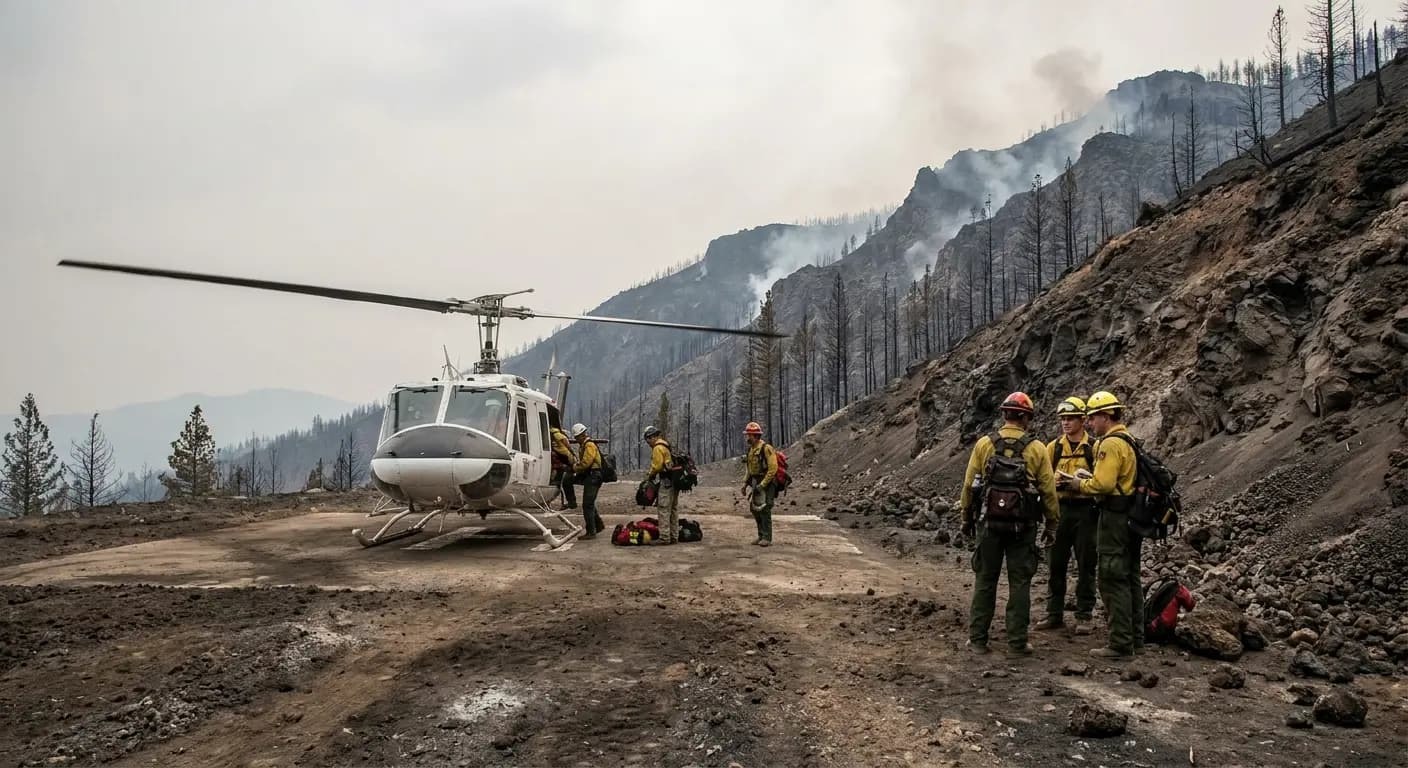
Origin areas may lie miles from roads, requiring helicopter access or extensive hiking over difficult terrain. A road flare casing represents a tiny piece of evidence in acres of burned ground. Systematic search becomes impractical across square miles. Investigators must narrow origin areas as precisely as possible before committing resources to ground searches, but precision has inherent limits in wildland contexts.
Access timing compounds the problem. Investigators cannot enter scenes until suppression creates safe conditions. Days or weeks may pass. During this delay, evidence degrades continuously.
Suppression impact on evidence
Firefighting activities necessarily disturb scenes. Handlines cut through origin areas. Retardant drops cover evidence. Dozers create firebreaks that obliterate burn patterns. Water application alters soil and ash. These activities serve critical safety purposes but complicate investigation.
Early coordination helps. Investigators embedded with incident management teams can flag suspected origin areas for preservation. Incident command teams may route suppression activities around critical areas when tactical situations permit. Firefighter safety and suppression effectiveness always take precedence, but documentation of suppression activities (incident action plans, suppression maps, equipment logs) allows investigators to distinguish fire effects from suppression effects when interpreting what remains.
Limited witnesses and resources
Wildland fires often ignite in remote areas with no potential witnesses. No neighbours observe suspicious activity. No security cameras capture events. Hours or days may pass before anyone discovers the fire.
Resource constraints compound witness limitations. Law enforcement agencies in rural areas have limited investigative capacity. Fire agencies focus resources on suppression. Specialised wildland fire investigators remain scarce. Some cases receive minimal investigation despite suspicious circumstances, not because evidence is absent, but because no one is available to look for it.
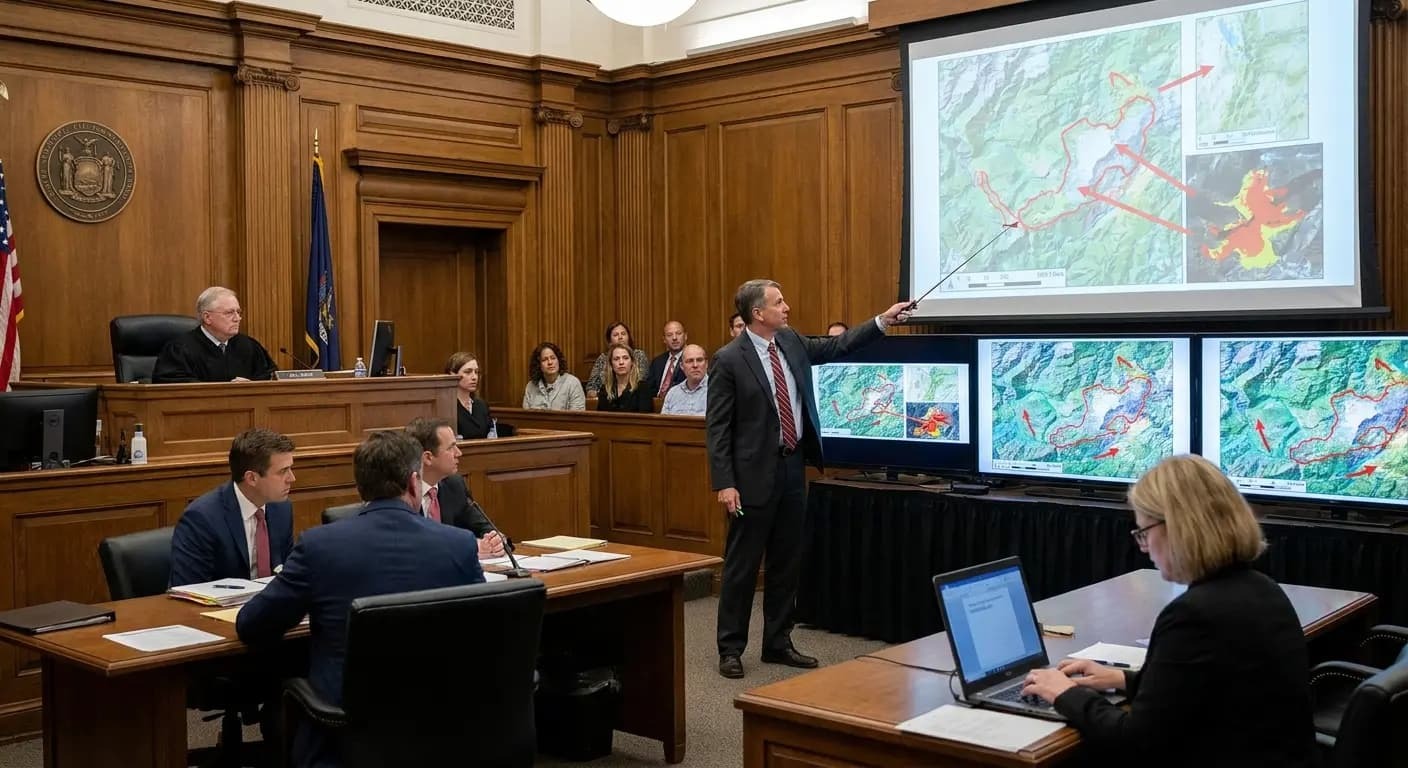
Wildfire arson prosecution carries high stakes and high complexity. Criminal charges, sentencing exposure, and evidentiary standards all reflect the severity of deliberately igniting fires that destroy landscapes, structures, and lives.
Criminal charges and jurisdiction
Fires on federal lands (national forests, BLM areas, national parks) fall under federal jurisdiction. Fires on state or private lands are prosecuted under state law unless interstate commerce impacts trigger federal interest.
Charges vary with circumstances. Arson statutes apply to wildland fires in most jurisdictions. Reckless burning charges may apply when intent cannot be proven but reckless disregard for fire danger is evident. Murder or manslaughter charges follow when deaths result from intentionally set fires. Federal sentencing guidelines consider acreage burned, suppression costs, property damage, and injuries. State sentencing increasingly treats wildfire arson as a serious felony warranting substantial prison time.
Proving intent and establishing presence
Prosecution must prove the defendant intentionally ignited the fire. Physical evidence (incendiary devices, accelerants) demonstrates intentional ignition but must be linked to the defendant. Witness testimony placing the defendant near the origin area at the relevant time provides presence evidence. Forensic evidence (fingerprints, DNA on devices) creates direct links.
Circumstantial evidence builds intent cases. Prior threats, conflicts with affected parties, fire-setting history, or internet searches about arson techniques all support intent findings. Defence attorneys challenge origin determination, fire spread timeline, and evidence collection methodology. Expert witnesses testify for both prosecution and defence, presenting competing interpretations. Investigation methodology must withstand this scrutiny through thorough documentation and logical reasoning from evidence to conclusion.
Insurance companies pay policyholders for wildfire losses: structure damage, contents loss, additional living expenses, business interruption. When investigation determines that arson caused the fire, insurers pursue subrogation against the responsible party to recover payments made.
Civil litigation standards
Civil cases require proof by preponderance of evidence (more likely than not) rather than the criminal standard of beyond reasonable doubt. This lower burden means civil subrogation may succeed even when criminal prosecution fails or is never initiated. A single wildfire may destroy dozens or hundreds of structures, generating tens of millions in insured losses. Successful subrogation recovers these costs from responsible parties.
Documentation quality directly affects outcomes. Thorough scene documentation, systematic evidence collection, and detailed investigation reports provide the evidentiary basis for civil claims. Investigators who cut corners create vulnerabilities that defence attorneys exploit through depositions and cross-examination.
Multi-party litigation complexity
Wildfire subrogation often involves multiple parties and complex liability questions. An arsonist may carry primary liability, but other parties may share responsibility. Property owners who failed to maintain defensible space, utilities whose equipment contributed to fire spread, or government agencies whose suppression decisions affected outcomes may all face claims.
Investigators must document all relevant factors without limiting focus to arson alone. Equipment conditions, vegetation management, and suppression activities all warrant documentation. This comprehensive approach serves investigation integrity and provides the information that multi-party litigation demands. For a deeper treatment of how investigation findings drive recovery outcomes, see the full guide to fire investigation and the subrogation process.
Wildfire arson investigations generate documentation requirements that exceed structure fire cases by orders of magnitude. Origin determination across large scenes, evidence tracking from multiple locations, witness interviews, weather data compilation, and suppression activity records create information management challenges that paper-based systems and structure-focused software cannot handle.
Blazestack's evidence and media management platform addresses these wildland-specific requirements. Investigators log observations, photograph evidence, and record GPS coordinates in a single system that maintains spatial relationships and timeline organisation across the entire scene. Evidence tracking from collection through laboratory analysis to testimony preparation stays organised within case files accessible to prosecution teams and civil attorneys.
The automated origin and cause report pulls documented information into formats meeting NFPA 921 standards without requiring investigators to compile data from scattered notebooks, photo sets, and field notes manually. When cases extend over months or years from initial investigation through prosecution and civil litigation, documentation created at the scene remains accessible, organised, and ready for discovery requests, deposition preparation, and courtroom testimony.
What qualifications do wildfire arson investigators need?
Wildfire arson investigators require training in both fire investigation fundamentals and wildland fire behaviour. Structure fire investigation certification provides foundational knowledge but does not cover wildland methodology. Specialised courses in wildland origin determination, fire behaviour analysis, and open-terrain evidence collection are necessary. Many investigators combine fire service experience with law enforcement training and hold certifications from organisations offering dedicated wildland investigation programmes.
How long does a typical wildfire arson investigation take?
Timelines vary based on fire size, scene accessibility, and evidence complexity. Small fires with clear origin areas and obvious evidence may be investigated in days. Large fires requiring extensive origin determination and multiple evidence locations may take weeks or months. Criminal prosecution and civil litigation extend the overall case timeline to years, requiring investigators to maintain files and remain available for testimony long after fieldwork concludes.
Can wildfire arson be proven without finding ignition devices?
Physical evidence of ignition devices strengthens cases but is not always necessary. Multiple origin points separated by unburned area provide strong arson evidence even without device recovery. Elimination of all accidental and natural causes, combined with suspicious circumstances and witness observations, can support arson conclusions. Cases without physical evidence face greater prosecution challenges and require particularly thorough documentation of alternative cause elimination.
How do investigators distinguish arson from lightning strikes?
Lightning elimination requires weather data from the National Weather Service or commercial lightning detection networks. These systems record strike locations and times with precision sufficient to determine whether strikes occurred near the origin area during relevant timeframes. Lightning strikes also leave distinctive physical patterns on struck objects, including splintered wood, root damage, and metal fusion, that differ from arson evidence. The combination of weather data and physical evidence allows reliable lightning elimination in most cases.
What happens when suppression activities destroy origin area evidence?
Suppression activities take precedence over evidence preservation. When origin areas are disturbed, investigators work with remaining evidence and documentation. Early fire behaviour observations, witness accounts, and fire progression data become more important when physical evidence is compromised. Investigators document suppression impacts and explain evidence limitations in reports. Some cases cannot be definitively resolved when critical evidence is destroyed, but thorough investigation of available information often still supports conclusions.
Do all human-caused wildfires get investigated for arson?
Resource limitations prevent thorough investigation of every human-caused wildfire. Agencies prioritise based on fire severity, damage costs, suspicious circumstances, and available resources. Large fires causing significant damage typically receive full investigation. Small fires in remote areas with no structures threatened may receive minimal attention unless circumstances suggest serial arson. Some arson fires go unprosecuted due to resource constraints rather than lack of evidence.
What role do fire behaviour analysts play in arson investigation?
Fire behaviour analysts contribute expertise in wildland fire spread modelling and behaviour prediction. They help investigators understand how weather, topography, and fuel conditions affected spread from ignition through containment. This expertise supports origin determination by establishing plausible spread scenarios and eliminating inconsistent ones. In litigation, fire behaviour analysts may testify alongside origin and cause investigators, explaining fire dynamics to juries and supporting or challenging origin conclusions.
How does wind affect wildfire origin determination?
Wind drives fire spread direction and rate, creating the directional patterns investigators rely on for origin determination. Strong winds produce clear directional indicators. Variable winds create complex patterns requiring careful interpretation. Investigators obtain weather data showing wind speed and direction during the period of fire spread and use this information to read patterns correctly. Wind also affects evidence preservation by scattering lightweight materials and accelerating degradation of chemical evidence.


Trusted by Public and Private Investigator Teams Everywhere
Whether you're a big state agency, a small local fire department or somewhere in between, Blazestack software (NFPA 921® & CJIS compliant) collects fire scene data and generates standardized origin and cause reports in a fraction of the time of other methods.
To learn more about Blazestack, give us a call at (866) 303-4344 or email us at support@blazestack.com
Get Your Free 14-Day Trial and Custom Price Quote Now
We'll let Blazestack do the talking. Try it out right now for free.
A member of our staff will be in touch shortly.