How Long Does a Fire Investigation Take? The Phases and Timelines Every Investigator Should Know
You want a number. Your chief wants a number. The insurance adjuster definitely wants a number. The property owner living in a hotel is calling twice a day asking for a number.
Here's what investigators tell people: anywhere from three days to six months, and both extremes are completely normal. That answer frustrates everyone, but it's honest. A straightforward accidental kitchen fire in a single-family home might wrap in 72 hours. An arson case involving multiple structures and potential criminal charges? You're looking at months, possibly longer if litigation enters the picture.
What most timeline discussions miss entirely: the fire is usually the simplest part to figure out. The technical investigation (the part you trained for) rarely controls your calendar. Administrative coordination does. Stakeholder communication does. Documentation does. Report revisions based on legal review do.
Every fire investigation runs at least four distinct timelines simultaneously: your evidence collection and analysis timeline, the laboratory testing timeline, the stakeholder coordination timeline, and the documentation and reporting timeline. They don't run in parallel. They intersect, depend on each other, and create bottlenecks in unpredictable ways.
Case in point: A residential electrical fire where the investigator identified the origin within six hours. The faulty outlet was obvious, burn patterns were clear, maintenance records were on hand. Six hours of actual investigative work, five weeks to close the case. The insurance carrier requested additional neighborhood documentation, lab confirmation took three weeks, and legal review flagged potential manufacturer liability requiring report revisions.
That's not an unusual outcome. It's the norm. And it's why understanding what's actually controlling your clock, not just what phase you're in, is the more useful question.
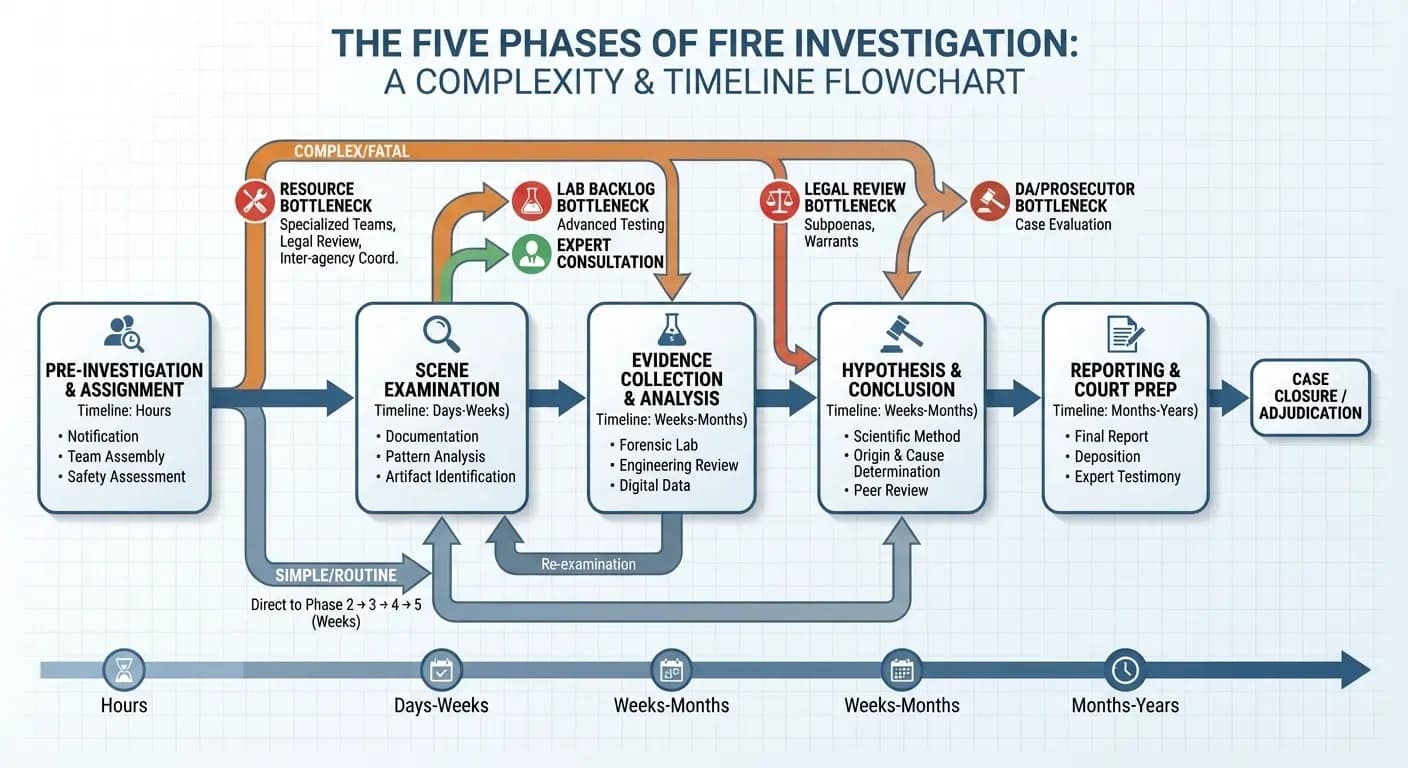
Phase 1: Initial Response and Scene Security
Timeline: Hours to days
You're typically on scene within hours, but scene security may continue for days or weeks. Preliminary examination, photo documentation, initial evidence identification. For a residential fire, you might complete this in 4–8 hours. For commercial or industrial fires, expect multiple days of scene processing.
What controls this phase isn't investigation complexity, it's logistics. Is the structure safe to enter? Do you need heavy equipment to remove debris? Are you waiting for utilities to be secured? These questions eat time before any real investigation begins.
Phase 2: Evidence Collection and Preservation
Timeline: Days to weeks
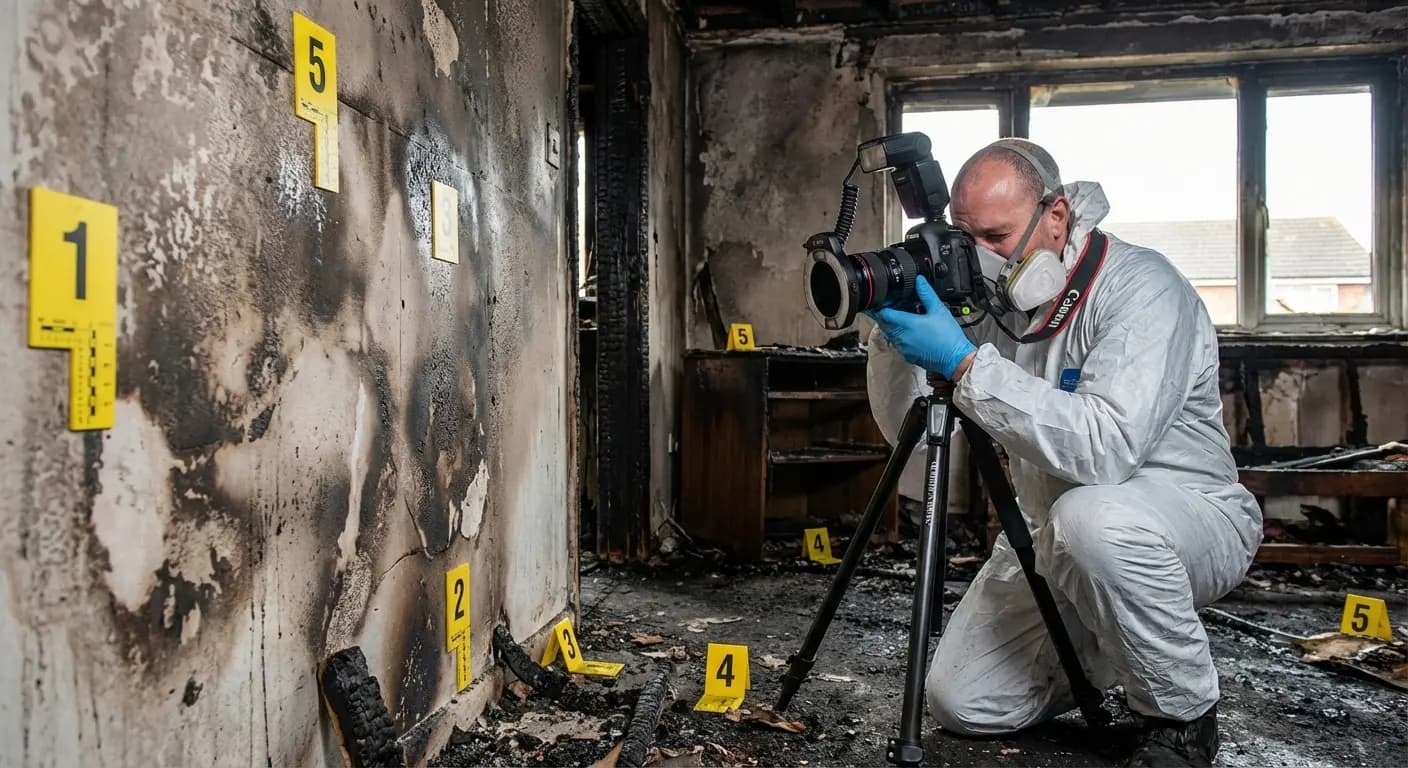
Collecting physical evidence, conducting interviews, gathering records. Small fires might involve a dozen evidence items. Large commercial fires regularly involve 200+. Each one requires documentation, photography, packaging, and tracking per NFPA 921 standards. The math is straightforward, and unforgiving.
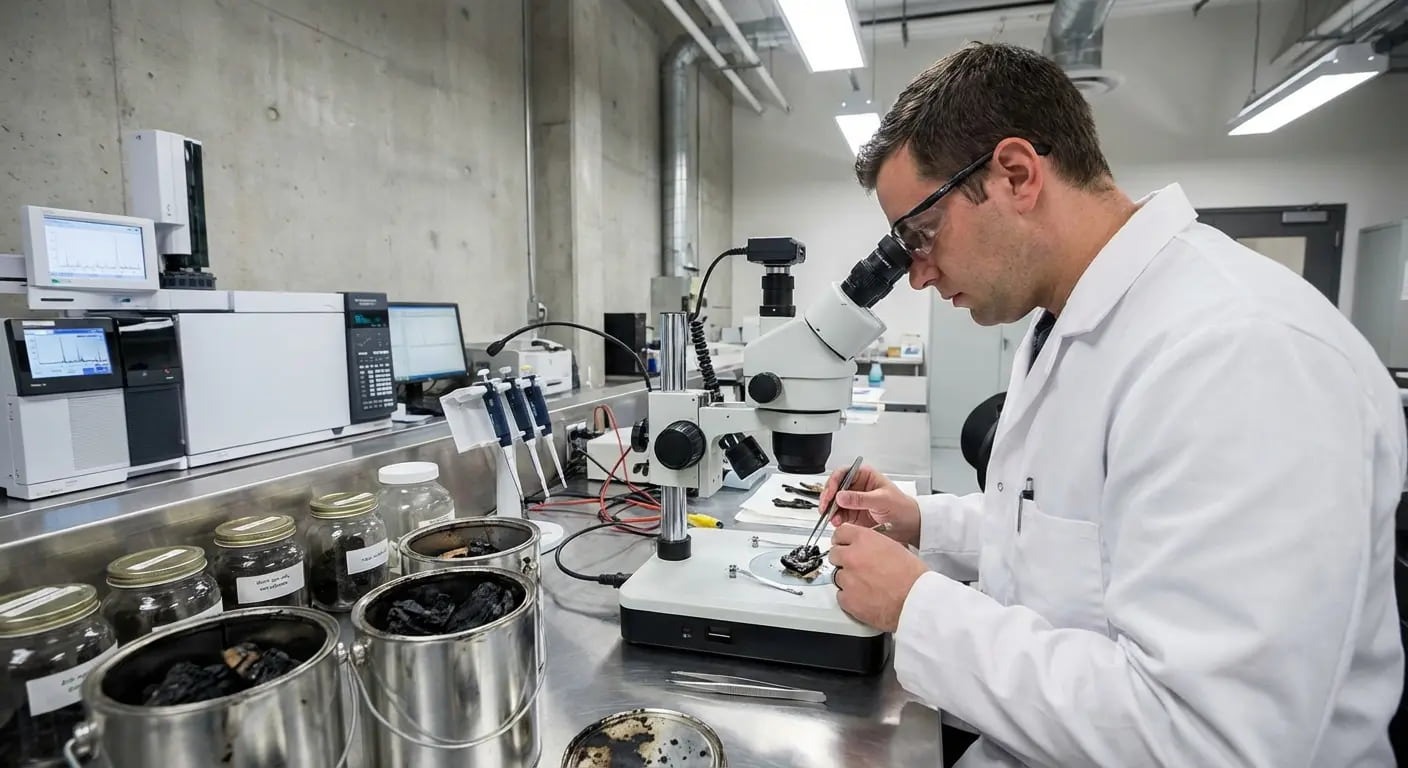
Timeline: Weeks to months — and rarely your timeline
Once samples leave your hands, your timeline depends on someone else's schedule. Most labs are backlogged. Even expedited testing rarely comes back in under two weeks. And lab work often requires multiple submission cycles — initial results raising new questions, additional samples needed, specialized testing at facilities out of state. It's not unusual for everything else to wrap in ten days while you wait six weeks for lab confirmation.
Phase 4: Analysis and Cause Determination
Timeline: Days to weeks
Reviewing everything collected, cross-referencing witness statements against physical evidence, consulting specialists. Straightforward cases take days. Complex fires with multiple potential ignition sources or conflicting evidence can take weeks, plus additional investigation triggered by your analysis. Every new thread extends this phase.
Cause Determination Checklist:
- Review all photographic documentation in chronological sequence
- Cross-reference witness statements for consistency and conflicts
- Map physical evidence locations against burn pattern analysis
- Eliminate ruled-out ignition sources with documented reasoning
- Test remaining hypotheses against physical evidence
- Document alternative explanations considered and why they were eliminated
- Confirm findings align with fire behavior science and NFPA 921 methodology
- Schedule peer review or supervisory consultation if case involves complexity
Phase 5: Report Generation and Review
Timeline: Days to weeks — where most cases bog down
You've done the investigation. You know the cause. Now you need to document everything in a format that satisfies NFPA 921 requirements, meets legal standards, addresses insurance company questions, and holds up under cross-examination. A basic origin and cause report might run 15–30 pages. Complex cases easily exceed 100 pages with appendices. Then it goes through review: supervisor, possibly legal counsel, sometimes insurance representatives come back with revisions, and you're editing again.
A fire investigator in Massachusetts put it plainly: "An investigation takes as long as it takes." For complex cases, a year to final report is not unheard of.
Arson suspicion changes everything immediately. What might have been a week-long investigation becomes multi-week or multi-month because you're working a potential criminal case. You're coordinating with law enforcement, handling evidence with greater precision, conducting additional interviews, and preparing documentation that will withstand criminal court scrutiny. When the Palisades Fire investigation began in January 2025, Cal Fire noted that when arson is suspected, determining whether crimes were committed adds an entirely different layer. You can't control whether a fire is arson. You can control how efficiently you handle the additional requirements once you suspect it is.
Stakeholder quantity multiplies your coordination burden exponentially. One property owner and one insurance carrier? Manageable. Multiple property owners, multiple carriers, a mortgage company, law enforcement, and the fire marshal's office? Every decision requires multiple notifications, every report draft gets reviewed by multiple parties, and every question generates follow-up questions from people who weren't in the original conversation.
Weather can shut down scene access for days. Rain makes the scene unsafe, or snow covering evidence you need to document in situ — you can't rush nature, and you can't compromise scene safety to meet someone's timeline expectations.
Here's something nobody talks about enough: you'll spend more time documenting your investigation than conducting it. That's not an exaggeration — it's math.
Scene examination takes eight hours. Photographing, logging, and organizing those photos takes another four. Evidence collection takes six hours. Documenting chain of custody, creating evidence logs, and ensuring NFPA 1033 compliance takes another eight. Interviews take ten hours. Transcribing or summarizing those interviews takes twelve.
Simple fires might run 1:1 in documentation-to-investigation ratio. Complex fires easily hit 3:1 or 4:1. The question isn't whether you'll do it — NFPA 921 requires it, courts require it, insurance companies require it. The question is how efficiently you can get through it.
Documentation Efficiency Template
Scene documentation block — complete before leaving scene
- Photo log with timestamps, locations, and descriptions
- Initial sketch with measurements and cardinal directions
- Evidence location map with item numbers
- Witness contact information with availability notes
- Utility status and scene security arrangements
Evidence processing block — complete within 24 hours
- Chain of custody forms for each item
- Evidence inventory with descriptions and conditions
- Lab submission forms (if applicable) with priority level
- Photographic evidence of packaging and labeling
Interview documentation block — complete within 48 hours
- Recorded or written statements
- Interview summary with key points highlighted
- Follow-up questions identified
- Consistency check against other witness statements
Report assembly block — final phase
- Executive summary (1–2 pages)
- Methodology section (NFPA 921 compliance)
- Cause determination with supporting reasoning
- Appendices: photos, diagrams, lab reports, statements
- Review checklist completion before submission
Residential structure fires — 3 days to 4 weeks
Single-family residential fires move fastest when the cause is accidental and clear. One property owner, usually one insurance carrier, a confined scene. Timelines extend with multi-family dwellings or rental properties where landlords and tenants have conflicting interests.
Commercial and industrial fires — 2 weeks to 6 months
Commercial fires introduce business interruption claims, potential code violations, employee interviews, and complex systems. You're not just determining origin and cause — you're documenting conditions that multiple parties will scrutinize for liability.
A commercial kitchen fire in a multi-tenant restaurant building illustrates this well: a 400-square-foot fire that should have been straightforward took seven weeks because nine different stakeholders — five restaurant tenants with separate carriers, a landlord's insurer, the health department, the fire suppression manufacturer, and three employees with conflicting statements — each had their own documentation requirements and review cycles.
Vehicle fires — 1 week to 2 months
Obvious mechanical failure might close in a week. A suspected arson vehicle fire with insurance fraud implications can drag on for months — especially when you're waiting on financial records, GPS data, or phone records. Vehicle fires also frequently cross jurisdictions, and each coordination handoff adds time.
Wildland-urban interface fires — weeks to months
Multiple properties, potentially multiple points of origin, state and federal agency coordination, and intense public scrutiny. Scene examination that might take hours for a structure fire takes days or weeks when you're covering acres of burned area. If you want to understand what drives ignition in these environments, see how wildfires start and why origin determination is so complex across large burn areas.
Insurance involvement doesn't just add time to your investigation — it fundamentally restructures your timeline around external schedules you don't control.
Most people assume insurance companies want investigations completed quickly. They do, but they also want specific documentation, specific analysis, and specific answers to specific questions — requirements that often emerge mid-investigation. You'll submit a preliminary report. The carrier comes back with questions. You address those. They have follow-up questions. Meanwhile, they're conducting their own investigation, which might surface information requiring you to revisit aspects of your analysis. Each cycle adds days or weeks.
Subrogation cases multiply this effect — now multiple carriers with competing interests are scrutinizing every statement for anything they can use to shift responsibility. It's not unusual to close investigative work in two weeks, then spend another six weeks addressing insurance questions and revision requests. The investigation was done. The case wasn't closed.
Multiple jurisdictions don't just add complexity, they add calendar coordination that extends timelines by weeks regardless of investigative complexity. You need to interview a witness three hours away in another jurisdiction. You're coordinating schedules with investigators who may want to be present. Everyone's calendar is full. The earliest date that works is three weeks out. Your investigation just paused for three weeks because of scheduling, not because of any investigative challenge.
The investigation into a deadly fire at Fall River's Gabriel House assisted living facility involved the Department of Fire Services, Fall River police and firefighters, state troopers assigned to the district attorney's office, and the DFS Code Compliance unit.
Spokesperson Jake Wark noted that given the scale of the fire, investigators are working "carefully, methodically, and diligently" and significant developments were not expected in the near term. The coordination involved, not the investigation itself, sets the pace.
Can you speed up a fire investigation without compromising quality?
Yes — but only in specific areas. You can't rush scene examination, evidence analysis, or lab work without risking mistakes. You can dramatically speed up documentation and report generation with the right tools, and reduce coordination delays by establishing clear communication protocols upfront. The investigative work takes as long as it takes. Administrative overhead is where you'll find efficiency gains.
What's the fastest a fire investigation can realistically close?
Simple residential fires with an obvious cause, no lab work required, and a single insurance carrier have closed in 48–72 hours, but that requires everything going right. Most investigations take at least a week even under ideal conditions once report writing and review are factored in.
Why do some investigations take months?
Complex commercial fires, arson cases, multi-jurisdiction investigations, and cases involving litigation can easily extend to months. Lab backlogs, stakeholder coordination, additional evidence requests, and legal review all compound. Investigative work completed in four weeks, final report approval taking another two months because of legal review and insurance revision cycles, that's a realistic scenario, not an outlier.
What can property owners do to speed up the investigation?
Provide requested documents quickly: building plans, maintenance records, equipment receipts. Be available for scheduled interviews. Don't disturb the scene before investigators arrive. Respond promptly to follow-up questions. Property owners can't accelerate the technical investigation, but they can prevent administrative delays by being responsive and cooperative.
Do insurance companies slow down investigations?
Not intentionally, but their requirements and review processes add time. They're entitled to thorough documentation and answers to their questions. The back-and-forth between investigator and adjuster, especially in subrogation cases, can add weeks. This isn't anyone being difficult. It's the nature of ensuring all parties have the information they need.
Cutting Weeks Off Your Timeline Without Cutting Corners
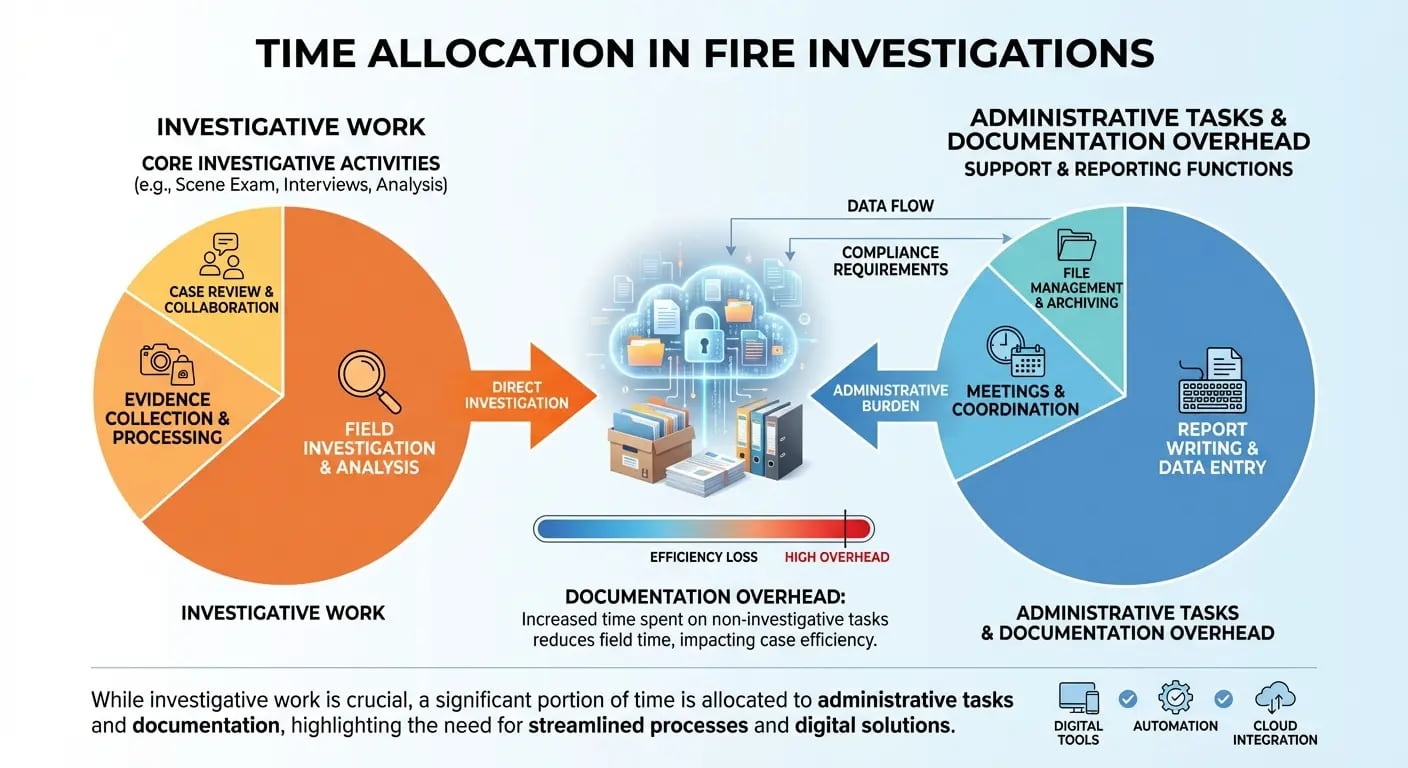
You're probably noticing a pattern: the investigation rarely controls your timeline. Information management does. Every hour spent manually creating photo logs is an hour not spent analyzing evidence. Every time you re-enter the same information into different forms, you're creating opportunities for errors that require correction later. Every stakeholder thread where information gets lost creates delays you'll spend days recovering from.
This is exactly why Blazestack was built. The platform generates NFPA 921-compliant reports automatically, creates photo logs, maintains chain of custody documentation, and keeps all case information in one place accessible from any device. Investigators using Blazestack complete cases 62% faster — not because they investigate faster, but because they're not buried in administrative tasks that software should handle automatically.
If you're consistently frustrated by how long it takes to close cases even after you've determined origin and cause, the problem isn't investigative skill. It's information management, and that's solvable.
You wanted to know how long a fire investigation takes. The honest answer is still "it depends" but now you know what it depends on.
Scene complexity matters less than stakeholder coordination. Lab work creates bottlenecks you can anticipate but rarely control. Documentation consumes more time than the investigation itself. Insurance involvement restructures your timeline around external review cycles. Multi-jurisdiction cases introduce scheduling delays that dwarf technical challenges.
The investigations that close fastest aren't necessarily the simplest fires, they're the ones where information flows efficiently, stakeholders communicate clearly, and administrative overhead doesn't multiply investigative work by a factor of three or four.
Your next investigation will take as long as it takes. The question is whether you're spending that time on investigative work or on administrative tasks that better tools could handle for you.

Trusted by Public and Private Investigator Teams Everywhere
Whether you're a big state agency, a small local fire department or somewhere in between, Blazestack software (NFPA 921® & CJIS compliant) collects fire scene data and generates standardized origin and cause reports in a fraction of the time of other methods.
To learn more about Blazestack, give us a call at (866) 303-4344 or email us at support@blazestack.com
Get Your Free 14-Day Trial and Custom Price Quote Now
We'll let Blazestack do the talking. Try it out right now for free.
A member of our staff will be in touch shortly.