Spoliation of Evidence in Fire Investigation: Legal Consequences and How to Protect Your Case

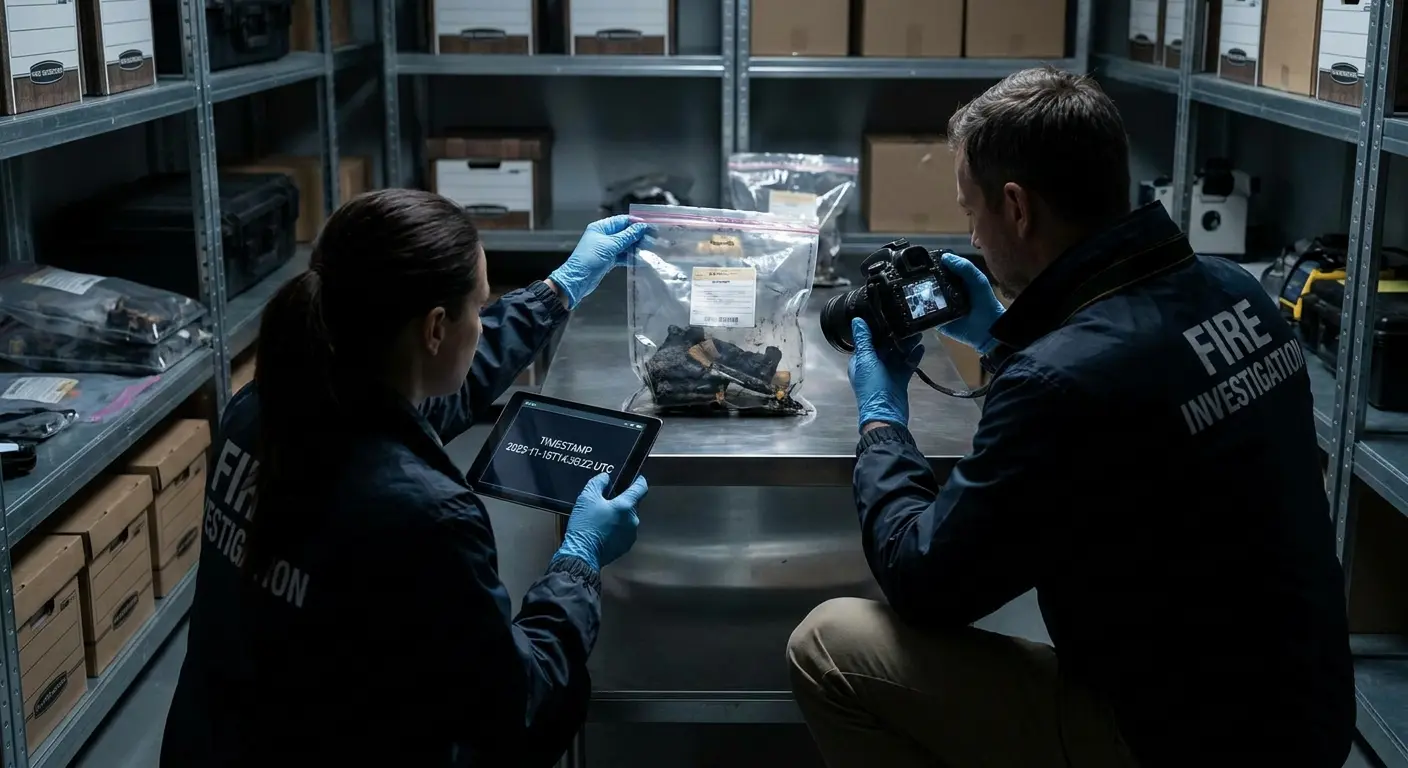
Spoliation of evidence in fire investigation refers to the destruction, alteration, or failure to preserve evidence that parties reasonably anticipated would be needed for litigation. Courts treat spoliation as an interference with the judicial process itself, not merely a procedural misstep. In origin and cause work, where determinations shift millions of dollars in liability and establish criminal culpability, the consequences extend far beyond procedural sanctions, they dismantle otherwise solid cases and end investigative careers.
Fire scenes present conditions that make spoliation both more likely and more damaging than in almost any other forensic discipline. Property owners face immediate pressure to demolish unsafe structures. Insurance adjusters need rapid determinations. Weather degrades evidence by the hour. Multiple parties (insurers, subrogation teams, property owners, potential defendants), all hold legitimate interests in examining the same limited physical evidence, and they rarely arrive simultaneously.
The discipline compounds this problem because origin and cause work is inherently destructive. Determining origin means moving debris. Identifying ignition sources means disassembling components. Ruling out accidental causes requires testing that consumes or alters evidence. Every investigative action changes the scene in some way.
Consider a residential fire where an investigator has identified a malfunctioning space heater as the likely ignition source. Confirming that hypothesis requires disassembling the heater's internal components, examining the heating element for failure patterns, and conducting electrical testing that will permanently alter the device. Meanwhile, the manufacturer's liability insurer holds a legitimate interest in examining that same heater before disassembly. If the investigator proceeds with destructive testing before providing access, evidence has been spoliated, even if the testing methodology was sound and necessary. The manufacturer's expert will never examine the heater in its post-fire condition, cannot verify the observations independently, and can credibly argue that the testing created or obscured the failure patterns the investigator claims to have discovered.
Courts understand the reality of fire investigation, but they still require all interested parties to receive a meaningful opportunity to examine evidence in substantially the same condition it was found. When that does not happen, through the investigator's actions, the property owner's decisions, or the passage of time, spoliation claims follow.
The duty to preserve evidence does not begin when someone files a lawsuit. It begins when litigation becomes reasonably foreseeable, a standard courts interpret broadly. Understanding the fire investigation timeline helps all parties establish realistic preservation windows before demolition pressure becomes critical.
A structure fire with significant loss almost always triggers preservation duties immediately. Subrogation is predictable. If insurance coverage exists and losses exceed the deductible, investigators should assume multiple parties will want scene access and physical evidence examination.
Criminal cases add a separate layer. The moment an investigator suspects incendiary origin, preservation duties intensify. Defense counsel will eventually need to examine the same evidence used to build the case. Failure to preserve (or at minimum document before alteration) gives defense attorneys a powerful tool to challenge conclusions and exclude testimony.
The duty extends beyond investigators to everyone who controls the scene. Property owners rarely understand they hold preservation obligations. They see a burned structure and want it removed. Demolition contractors face liability when they proceed knowing parties want scene access. Insurance adjusters who authorize debris removal without recognizing spoliation risk create liability for their employers. Fire departments receive general protection for scene alteration during active suppression and overhaul, but that protection has limits once the fire is controlled.
Investigators are frequently the first professionals at the scene who understand the legal implications of evidence preservation. That creates a professional obligation to communicate preservation duties to property owners (without providing legal advice) and to document those communications thoroughly. When a property owner chooses to demolish despite being advised of the risks, that is their decision and their liability. The documentation of the conversation is what protects the investigator.
Spoliation eliminates the ability to prove origin and cause with the certainty of litigation demands. An investigator may have detailed photographs, comprehensive notes, and a clear ignition theory — but if the opposing party's expert never had the opportunity to examine the physical evidence, those conclusions become significantly easier to challenge.
Every origin and cause investigation depends on context. The spatial relationship between the point of origin and potential ignition sources matters. The condition of electrical conductors relative to surrounding materials provides critical information. The patterns visible in structural elements tell a story that photographs capture imperfectly.
In a subrogation case involving a commercial warehouse fire, an investigator determined the fire originated in an electrical panel and identified a manufacturing defect in a specific circuit breaker as the cause. The investigator photographed the panel thoroughly and removed the suspected breaker for laboratory analysis. Before notifying the breaker manufacturer, however, the property owner demolished the building and disposed of the remaining electrical system components.
At trial, the manufacturer's expert testified that without examining the panel's overall condition, the installation quality, load calculations, and surrounding breakers, independent verification of whether the origin was correctly identified or alternative causes properly ruled out was impossible. The court granted summary judgment for the defendant. The plaintiff had spent over $200,000 on investigation and litigation before the case was dismissed because evidence was destroyed before all parties could examine it.
A common misconception is that thorough photographic documentation compensates for destroyed physical evidence. It does not. Documentation protects investigators from some consequences of spoliation, it demonstrates they understood preservation duties and acted in good faith, but it does not eliminate the spoliation itself.
Courts recognise that photographs provide a two-dimensional representation of a three-dimensional scene, capturing what the investigator chose to photograph from the angles selected under the lighting conditions present. An opposing expert examining photographs cannot move debris, examine the undersides of components, or conduct independent testing. The best documentation in the world will not save a case where critical evidence was destroyed before interested parties had access. What it will do is protect against arguments of bad faith or deliberate deprivation — a distinction that matters significantly when courts determine sanctions.
Courts distinguish between intentional spoliation (destruction undertaken to prevent evidence use in litigation) and negligent spoliation, which results from carelessness or ignorance of preservation duties. The standard for intent is not whether a party actually intended to deprive someone of evidence, but whether a reasonable person would conclude from the actions taken that deprivation was the goal. Investigators who had clear notice that multiple parties wanted to examine evidence and destroyed it anyway without providing access risked an inference of intent even if they had legitimate investigative motivations.
Negligent spoliation is more common and almost equally damaging. It occurs when an investigator knew or should have known a preservation duty existed but failed to take reasonable steps to fulfill it. Good intentions do not excuse negligent spoliation. Time pressure does not excuse it. Budget constraints do not excuse it. Courts expect investigators to understand preservation duties and fulfill them even when doing so creates practical difficulties.
The sanctions courts impose reflect the severity and nature of the spoliation:
Adverse inference instructions are particularly devastating. The investigator is asking a jury to accept conclusions about origin and cause while the judge instructs the jury they may assume the missing evidence contradicts those conclusions. Even strong cases collapse under that burden. Case dismissal represents the most severe outcome, an investigator can build a technically sound case, document everything meticulously, and reach scientifically valid conclusions, yet have the entire matter dismissed before it reaches a jury because evidence was spoliated.
Beyond litigation outcomes, investigators face direct professional consequences. Courts can exclude expert testimony, impose personal monetary sanctions, and refer matters to licensing boards. Professional organisations can revoke certifications. Insurance carriers track spoliation history, and a prior sanction becomes ammunition for opposing counsel in every subsequent case.
Fire investigation expert testimony faces increasing scrutiny through Daubert challenges, and spoliation provides opposing counsel with powerful ammunition to exclude opinions entirely. Daubert challenges focus on the reliability of methodology in the specific case at hand, and spoliation directly undermines that reliability across multiple factors courts assess.
Testability is the first casualty. If evidence has been destroyed, other experts cannot replicate testing or verify conclusions. The methodology may be sound in theory, but if it cannot be independently verified in this specific case, it fails Daubert's reliability standard. Peer review becomes problematic for the same reason — the scientific method depends on other experts being able to examine the same evidence and reach their own conclusions. Spoliation removes the work from the peer review process that gives scientific conclusions credibility in court.
Error rate analysis suffers because spoliation introduces an unquantifiable variable. Known error rates apply under normal conditions; when evidence has been destroyed or altered, the effect on conclusion reliability cannot be assessed. Courts resolve that uncertainty by excluding the testimony. General acceptance in the scientific community becomes harder to demonstrate when deviation from NFPA 921's preservation requirements provides opposing counsel with the argument that the entire approach falls outside accepted methodology.
The practical argument opposing counsel makes is straightforward: the investigator claims the fire originated in a specific location caused by a specific ignition source; critical evidence was destroyed before the opposing party's expert could examine it; the conclusions therefore rest on observations and testing that cannot be independently verified. Under Daubert, unverifiable conclusions are inadmissible regardless of the expert's qualifications. An investigator with decades of experience, multiple certifications, and an impeccable track record can find themselves unable to testify about any of it because of a spoliation event in that specific case.
Premature demolition
Demolition is the single most common source of spoliation litigation in fire investigation. Investigators must identify all potentially interested parties as soon as an ignition source is suspected — the property insurer, subrogation department, manufacturers of suspected products, utility companies, contractors who worked on the property pre-fire, and criminal defense counsel if incendiary origin is suspected.
Written notification to all identified parties should include the scene address, fire date, current scene condition, proposed demolition date with at minimum ten business days notice where possible, and contact information for scheduling access. Every notification must be documented with delivery confirmation. When demolition proceeds despite these steps, investigators should photograph the scene immediately before it begins, note who authorized demolition, and record all efforts made to prevent or delay it.
Overhaul before documentation
Firefighters checking for extensions pull apart construction assemblies, remove smoldering materials, and disturb the scene in ways that eliminate spatial relationships critical to origin determination. Burn patterns and other directional indicators that would have pointed to origin get obscured. Undamaged materials that would have established fire spread direction get removed. Investigators cannot prevent suppression activities and should not attempt to — firefighter safety takes precedence.
What investigators can do is request that departments photograph conditions before beginning overhaul, interview incident commanders and company officers about what was moved and when, and document all pre-arrival alterations to establish the limitations those alterations created.
Improper evidence handling
Chain of custody failures create spoliation even when physical evidence is not destroyed. Collecting evidence without proper documentation, storing it in unsecured locations, failing to document access, transferring evidence without records, and allowing testing without notifying interested parties all create opportunities for opposing counsel to argue evidence was tampered with or contaminated.
Evidence that existed but whose integrity cannot be documented becomes legally spoliated. The solution is systematic documentation from the moment potential evidence is identified: photograph in place before collection, document collection procedures, maintain detailed custody logs, use tamper-evident packaging, and store in secure facilities with access controls.
Failure to notify interested parties
An investigator can preserve evidence perfectly and still face spoliation claims by failing to notify parties with legitimate examination interests. In insurance subrogation cases, potential defendants and their insurers need notification. In product liability cases, manufacturers and component suppliers require access. In criminal cases, defense counsel must be notified. An investigator examining a restaurant fire identified a commercial deep fryer as the likely ignition source, conducted her investigation, reached conclusions, and sent her report to the restaurant's insurer before the fryer manufacturer was notified.
By the time the manufacturer requested examination, the investigator had already disassembled the thermostat, conducted destructive metallurgical testing, and disposed of the exterior housing. The manufacturer's expert could not determine whether the thermostat failed from a manufacturing defect or improper installation and maintenance. The court granted summary judgment for the manufacturer. Notification must occur while evidence is still available in substantially the condition it was found — not after conclusions have been reached and testing completed.
Chain of custody documentation begins the moment potential evidence is identified. Before collection, photograph evidence in place, documenting its location relative to the suspected origin, structural elements, and other evidence. Note condition, damage, contamination, or alteration visible before collection. Collection documentation must identify who collected the evidence, when, its specific location, and the collection method. Package evidence immediately in appropriate containers, label with case information, evidence description, collection date and time, and collector name, and use tamper-evident seals with documented seal numbers.
Transfer documentation records every change of custody: who released evidence, who received it, when, what was transferred, and the purpose. Both parties should sign all transfer documentation. Storage documentation establishes that evidence remains secure between examination and analysis: location, access controls, environmental conditions, and security measures protecting the evidence. Testing documentation is critical when examination alters or consumes evidence. Before destructive testing, photograph evidence thoroughly, document methodology, examiner identity, timing, equipment, and results. Where possible, preserve portions for verification testing.
Digital documentation creates a parallel chain of custody that is difficult to challenge. Photographs taken with modern devices embed metadata showing when and where images were captured, corroborating written documentation and providing independent verification of the investigative timeline. Cloud-based storage with automatic synchronisation creates real-time records that prove documentation was not created retrospectively. GPS data embedded in photographs verifies scene location. Video documentation provides additional protection — a walkthrough with contemporaneous narration demonstrates conditions before alteration and establishes methodology in real-time.
Investigation reports must identify every piece of evidence collected, describe it specifically, note its relevance, and state its current location. Reports must also document scene alterations that occurred before arrival, explain testing that consumed or altered evidence, and directly address interested party notifications: who was notified, when, and what response was received. Transparency about limitations created by pre-arrival overhaul or environmental degradation does not constitute spoliation; concealing those limitations does.
When investigators discover after the fact that they have inadvertently spoliated evidence, disclosure is mandatory. Attempting to conceal spoliation converts negligent destruction into intentional spoliation and draws the harshest sanctions. Proactive disclosure, documentation of what occurred and why, and immediate notification to all interested parties about what evidence remains available demonstrate good faith and mitigate consequences. Voluntary disclosure will still carry legal consequences, but those consequences are measurably less severe than concealment.
Traditional documentation methods create gaps that spoliation claims exploit. Handwritten notes get lost. Photographs sit on memory cards for days before downloading. Evidence logs get created retrospectively. Each gap creates an opportunity for opposing counsel to argue fabrication or bad faith.
Blazestack is built specifically to address the documentation and evidence tracking challenges that generate spoliation risk. The platform creates timestamped, photographically supported records of the entire investigation process, from initial scene documentation through final evidence disposition. Every piece of evidence collected is tracked with automatic chain of custody documentation. Every notification sent is logged with delivery confirmation. Every photograph is geotagged and timestamped in ways that prove when and where documentation was created, providing the independently verifiable metadata that courts find persuasive.
Systematic documentation protocols built into the platform ensure critical steps are not skipped. Prompted fields for evidence collection information capture chain of custody data at the moment of collection. Required photographs at specific examination stages create comprehensive visual records that demonstrate proper methodology. Centralised evidence tracking shows the complete history of each item from collection through final disposition — an auditable trail that survives the most aggressive Daubert challenge.
Proper fire scene evidence collection procedures integrated into a case management workflow create systematic spoliation protection that does not depend on individual investigator memory or diligence. Collaboration features allow investigators and interested parties to access documentation simultaneously. When opposing experts can view photographs, read field notes, and examine evidence logs in real-time, spoliation claims become harder to sustain. Transparency and access are the core requirements of the preservation duty, and technology is now the most reliable way to demonstrate both.
Courts are scrutinising evidence preservation more closely than at any point in the discipline's history. The documentation created during the investigation (not the explanations offered afterward) determines whether an investigator survives a spoliation challenge. Investigators who can demonstrate systematic, technology-supported preservation practices have a significant advantage when those challenges arise.
Spoliation destroys cases that should be winnable and careers that should be sustainable. Prevention is entirely within the investigator's control, and the tools to achieve it have never been more accessible.

Trusted by Public and Private Investigator Teams Everywhere
Whether you're a big state agency, a small local fire department or somewhere in between, Blazestack software (NFPA 921® & CJIS compliant) collects fire scene data and generates standardized origin and cause reports in a fraction of the time of other methods.
To learn more about Blazestack, give us a call at (866) 303-4344 or email us at support@blazestack.com
Get Your Free 14-Day Trial and Custom Price Quote Now
We'll let Blazestack do the talking. Try it out right now for free.
A member of our staff will be in touch shortly.