What Is a Backdraft Fire? Causes, Warning Signs, and Investigative Impact

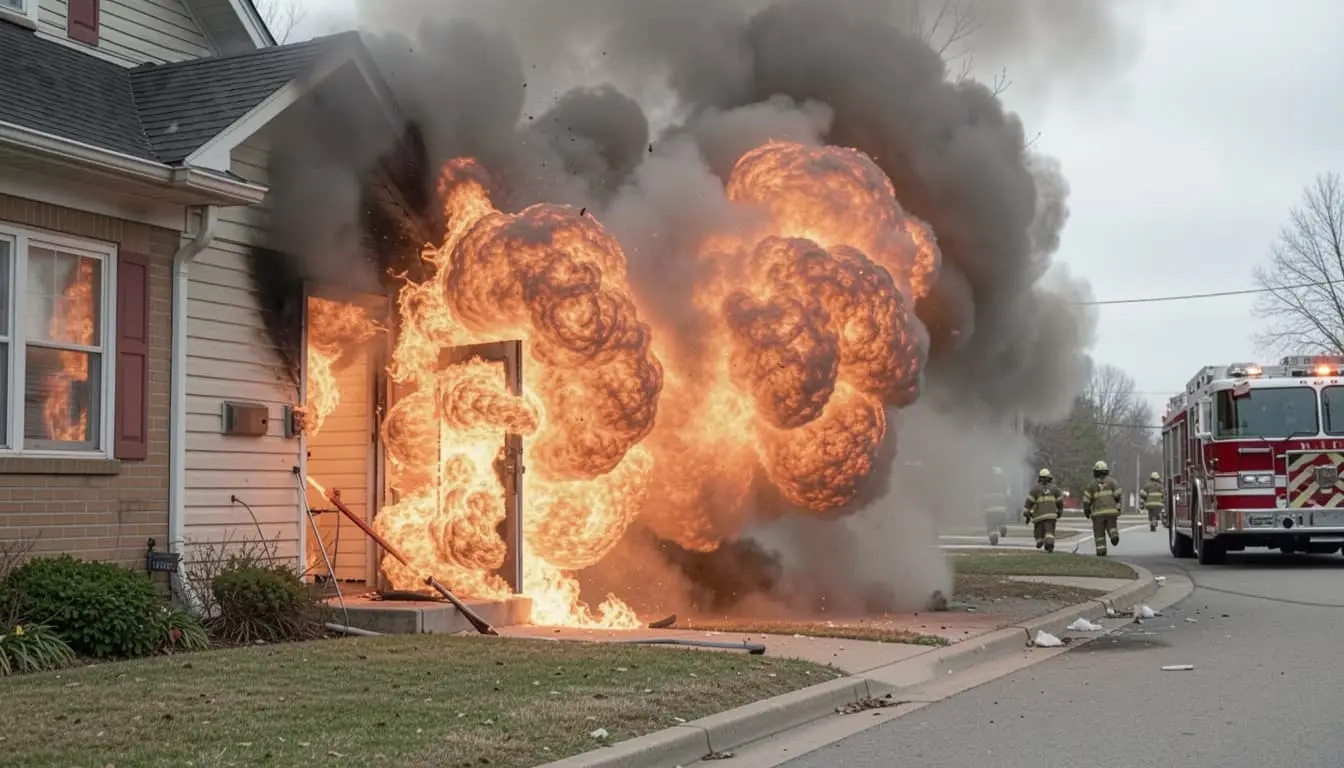
On February 11, 1998, two firefighters entered a commercial tire-service center in Illinois to evaluate the interior. No smoke or fire was visible from the outside. Minutes later, a backdraft killed both of them and nearly claimed everyone else inside. That incident, documented by NIOSH as case 98‑F‑05, is a stark illustration of why backdraft is treated as one of the most dangerous phenomena in structural firefighting, and why understanding it matters just as much after the fire as during it.
This guide covers what a backdraft is, what causes one, the warning signs that precede it, and what it means for reconstructing a fire scene, a subject covered in more depth in Blazestack's guide to burn pattern analysis.
A backdraft is an explosive event that occurs when oxygen is suddenly introduced into a confined space filled with superheated, unburned combustion products. NFPA 921 frames it as a deflagration, an explosive combustion event, triggered by the sudden introduction of air into a space that has become oxygen-deficient as the fire consumed the available oxygen but continued producing unburned fuel gases.
The distinction that matters most is that a backdraft is fundamentally an oxygen problem, not a heat problem. A fire burning in a sealed or tightly confined space can consume its available oxygen and shift into a smoldering, ventilation-limited state. It keeps producing heat, carbon monoxide, and other unburned pyrolysis products, but without enough oxygen to sustain open flaming combustion. Those gases accumulate at extreme temperatures, effectively primed and waiting. When a door opens, a window fails, or any opening suddenly introduces fresh air, the fire can reignite with explosive force.
Three conditions generally need to be present for a backdraft to occur: a ventilation-limited fire (meaning it is starved for oxygen rather than fuel), a substantial buildup of unburned fuel gases and carbon monoxide at high temperature within that sealed or near-sealed space, and a sudden introduction of air, most often from firefighters or occupants opening a door or window without recognizing the risk.
This is why backdraft is strongly associated with buildings that appear deceptively calm from the outside. A structure that looks like it has little or no active fire, sometimes with minimal visible smoke, can still be building toward a backdraft internally. The 1998 Illinois incident referenced above fits this pattern closely: firefighters observed only a light haze in the showroom before encountering heavier smoke deeper in the building, with no visible fire anywhere, immediately before the backdraft occurred.
Several conditions are widely taught as backdraft indicators, generally observed together rather than in isolation:
- Pulsing or "breathing" smoke, where smoke pushes out of gaps around doors or windows and then appears to be pulled back in rhythmically.
- Smoke-stained, discolored, or cracked windows, often appearing dark or oily from prolonged heat exposure.
- Little or no visible flame despite significant heat, since a ventilation-limited fire can be intensely hot while producing minimal visible flaming combustion.
- A low neutral plane, with turbulent, dense smoke forced out low through small gaps.
- A sudden, rapid rush of air and smoke inward the moment an opening is made, as the oxygen-starved space draws in fresh air.
These indicators matter for firefighter safety in the moment, and they also matter to investigators afterward, since witness accounts, body-cam footage, and photographs capturing these conditions can help establish what the structure looked like in the moments before ignition.
Backdraft and flashover are frequently confused, but they are driven by different mechanisms. Flashover is a thermal event: it occurs when radiant heat raises the temperature of exposed surfaces throughout a compartment to their ignition point at close to the same time, causing near-simultaneous ignition rather than an explosion. Backdraft is an oxygen event: it occurs when a ventilation-starved fire is suddenly supplied with fresh air, triggering an explosive deflagration of gases that had nowhere to burn.
A useful distinction for reading a scene afterward is that flashover results in full room involvement through a rapid but non-explosive transition, while backdraft can produce genuine explosive overpressure, capable of blowing out walls, throwing occupants or firefighters off their feet, and projecting debris well beyond the building itself. For a full side-by-side comparison, see Backdraft vs Flashover: Key Differences Explained.
This is a genuinely unsettled area in fire science, and it is worth being direct about that rather than presenting a clean distinction that does not exist in practice. NFPA 921's current definition of a smoke explosion does not stand on its own. It refers the reader back to the definition of backdraft, effectively treating the two as the same phenomenon.
Some researchers and other standards, including NFPA 1700, have attempted to draw a sharper line between them, generally proposing that backdraft specifically requires a sudden change in ventilation as the triggering event, while a smoke explosion can occur from delayed ignition of accumulated gases without that same abrupt ventilation change. Even researchers working directly on this question describe the existing standards' treatment of the two terms as ambiguous and frequently used interchangeably in the fire service.
For investigators, the practical takeaway is that the terms are often used loosely and sometimes interchangeably in casual reporting and even in some training materials, and it is worth confirming which definition a given source or jurisdiction is actually using before treating the distinction as settled.
Backdraft changes the physical evidence at a scene in ways that differ meaningfully from a standard fire progression. The explosive overpressure associated with a backdraft can displace structural elements, blow out windows and doors, and scatter debris well beyond where it would land from ordinary fire spread. An investigator who does not account for this can misread displaced structural elements or a wide debris field as evidence of a diffuse explosion from another source entirely, such as a gas leak or an intentional device, when the actual cause was a backdraft.
The same sudden inrush of oxygen can also produce irregular, ventilation-generated burn patterns that investigators have mistaken for accelerant pour patterns, since both can create directional, turbulent burn geometry rather than the pattern a standard fuel-controlled fire would leave.
Documenting the ventilation history of the structure matters as much as documenting the fire itself. Establishing which openings existed before the event, which one was created or expanded immediately before the backdraft occurred, and the direction and extent of debris projection can help reconstruct not just where the fire originated, but the sequence of events that turned a ventilation-limited fire into an explosive one. This sequencing often depends on witness and firefighter accounts of what was opened and when, which makes early interviews particularly valuable in backdraft-involved cases.
Backdraft cases typically involve a wide, physically scattered debris field, structural damage from overpressure, and a ventilation timeline that depends heavily on witness and firefighter accounts collected soon after the incident.
Blazestack's evidence and media management tools help organize scene photography and debris documentation by location, which matters when damage extends well beyond the compartment of origin, and its chain-of-custody tracking helps ensure that evidence collected across a wide, sometimes multi-agency scene remains properly documented from collection through reporting.
Is a backdraft the same thing as an explosion?
Functionally, yes. NFPA 921 defines it as a deflagration, which is a type of explosive combustion event, distinguishing it from flashover, which is a rapid but non-explosive transition.
Can a backdraft happen without anyone opening a door or window?
It is less common, but a backdraft can be triggered by any sudden introduction of air, including a window failing from heat, a section of the structure collapsing, or mechanical ventilation activating unexpectedly.
Do all ventilation-limited fires eventually backdraft?
No. Most ventilation-limited fires self-vent gradually or burn out before conditions align for a backdraft. Backdraft requires the specific combination of accumulated unburned gases at high temperature and a genuinely sudden introduction of air, not a gradual one.
How can investigators tell backdraft-related damage apart from an explosion caused by something else, like a gas leak?
This usually requires correlating the pattern and extent of structural damage with the fire's documented progression, ventilation history, and witness accounts, since backdraft-related overpressure and other explosive events, including detonation events involving actual explosives, can leave superficially similar shock-wave and displacement damage. This is an area where a detailed reconstruction, rather than damage patterns alone, is often necessary.
Why do backdraft indicators matter to someone investigating after the fact, not just to firefighters during the incident?
Because photographs, body-cam footage, and witness statements describing pre-ignition conditions (pulsing smoke, minimal visible flame, sudden pressure changes) can help establish the sequence of events and rule in or rule out backdraft as a contributing factor in the final report.


Trusted by Public and Private Investigator Teams Everywhere
Whether you're a big state agency, a small local fire department or somewhere in between, Blazestack software (NFPA 921® & CJIS compliant) collects fire scene data and generates standardized origin and cause reports in a fraction of the time of other methods.
To learn more about Blazestack, give us a call at (866) 303-4344 or email us at support@blazestack.com
Get Your Free 14-Day Trial and Custom Price Quote Now
We'll let Blazestack do the talking. Try it out right now for free.
A member of our staff will be in touch shortly.