Backdraft vs Flashover: Key Differences Explained

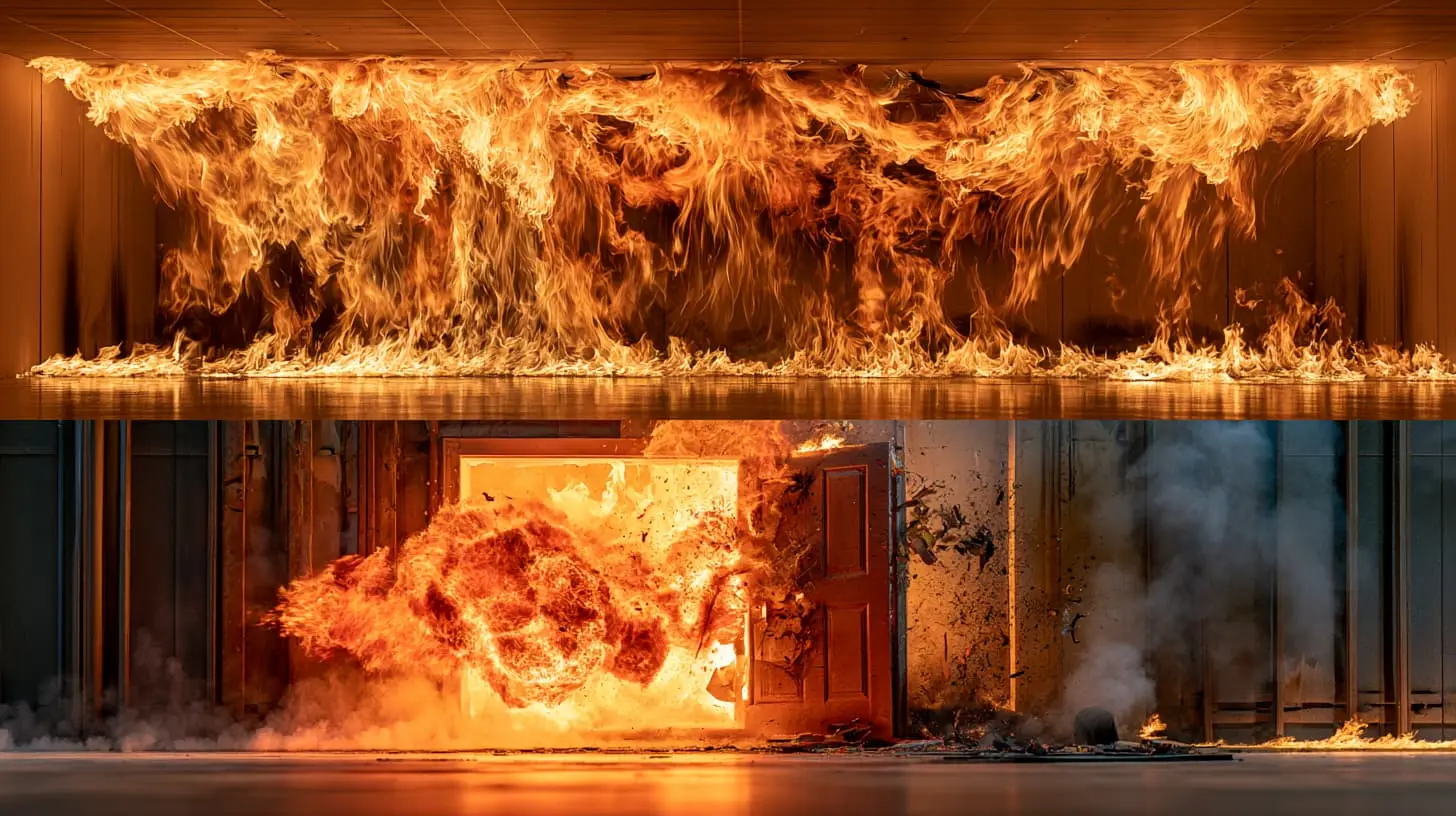
Witnesses at a fire scene tend to reach for the same word regardless of what actually happened: explosion. A window blows out, a wall of flame rolls across a ceiling, a door bursts open ahead of a fireball, and to anyone standing outside, it all looks like the same violent event. It isn't.
Backdraft and flashover are two of the most consequential transitions in structure fire behavior, and they are driven by opposite mechanisms. One is a fuel problem. The other is an oxygen problem. Confusing them in a report, a courtroom, or a training class does not just get the terminology wrong: it can misstate how the fire actually grew, which changes how the scene should be read afterward.
This piece lays out what separates them, why even experienced witnesses mix them up, and what each one leaves behind for an investigator to find.
Backdraft happens when a fire has been burning in a space with too little oxygen to sustain open flame, but plenty of heat and unburned fuel in the form of pyrolysis gases, essentially fuel that has been cooked off surfaces but never found enough air to ignite.
That compartment is sitting at or above ignition temperature, starved for oxygen, and full of combustible gas. When an opening is introduced, a door forced by a firefighter, a window failing from heat, air rushes in, meets that superheated fuel, and ignites almost instantly. The result is closer to a deflagration than a normal fire event: a pressure wave, a fireball, sometimes structural displacement.
Flashover works differently. It does not require a new source of oxygen. A room that already has enough air to support combustion can still flash over, because the driving factor is radiant heat, not fuel starvation. As a fire grows, heat collects at the ceiling and radiates back down onto every combustible surface in the room. Once enough surfaces reach their own ignition temperature at roughly the same time, they all ignite nearly simultaneously, and the fire jumps from a localized event to full room involvement. It is a fuel driven transition on the growth curve, not an oxygen driven explosion.
The rollover-fire that often precedes flashover, flame licking across the ceiling ahead of full involvement, is one of the clearest visible warnings that a room is approaching that threshold. Backdraft gives a different set of warnings, and they are worth knowing separately, because mistaking one set for the other is how firefighters get hurt.
Part of the confusion is genuinely terminological. Fire science has not always drawn a clean line here. Current NFPA 921 guidance groups backdraft together with a related phenomenon, smoke explosion, under close definitions, and that overlap alone causes disagreement among investigators about which term fits a given event. Flashover, by contrast, is defined more consistently, but it still gets used loosely in witness statements and even in early incident reports as a catch all for "the fire suddenly got much bigger."
Media coverage does not help. Both events get called explosions in local news, both are associated with doors and windows failing, and both can injure firefighters positioned at an entry point. To someone who was not trained to look for the specific precursors, they read as the same story with different actors.
The practical result is that fire scene narratives, especially ones built from witness accounts rather than physical evidence, will sometimes label a flashover as a backdraft or vice versa simply because both words mean "it got dangerous fast." An investigator's job is to set that loose language aside and work from what the compartment itself shows.
After the fact, the two events tend to leave different signatures, though neither is unambiguous on its own.
Backdraft evidence often centers on the opening where the air entered. Look for outward displacement at that specific point: a blown door, a window frame pushed outward rather than simply failed by heat, glass showing pressure fracturing rather than heat crazing alone. Smoke staining patterns around that opening, particularly a starved, oily, or heavily sooted appearance before the event, support the idea that the compartment was oxygen limited beforehand. Structural damage from a backdraft tends to radiate outward from the point of air entry, because that is where the pressure wave originated.
Flashover evidence is less about a single point and more about uniform involvement. Look for consistent, room wide burn patterns rather than damage concentrated at one opening, V patterns and ceiling level char that suggest heat built up broadly before ignition, and fire damage on surfaces that had no direct exposure to an ignition source but ignited anyway because they reached their own ignition temperature from radiant heat.
Victim positioning and injury patterns can also help distinguish the two: backdraft injuries frequently cluster near the specific opening that failed, while flashover injuries are more consistent with someone caught by heat and fire that engulfed the whole space at once.
Neither pattern is a substitute for a full fire behavior analysis of the scene, and witness accounts of "an explosion" should be treated as a starting point for investigation, not a conclusion. The physical evidence, not the word a witness used, determines which event actually occurred.
The distinction is not academic. A report that misidentifies a flashover as a backdraft, or the reverse, can misrepresent the fire's growth timeline, which matters for reconstructing when victims were exposed, whether ventilation tactics contributed to the outcome, and how the cause and origin narrative holds together under cross examination. Getting the mechanism right is part of getting the whole sequence of events right, and that sequence is often the thing a report actually gets challenged on.
That is part of why keeping scene documentation organized and consistent matters as much as the analysis itself. When photos, notes, and timestamps from a scene are scattered across devices or handed off between investigators, it becomes harder to reconstruct exactly where damage originated relative to openings, which is precisely the detail that separates these two events. Centralizing that documentation as it is collected, rather than reassembling it after the fact, makes the eventual analysis easier to defend.
Distinguishing backdraft from flashover after the fact comes down to exactly where the damage is concentrated relative to openings, and how consistent that pattern is across the whole compartment. That's a detail that's easy to lose if photos, notes, and timestamps from a scene are scattered across devices or handed off between investigators partway through a case.
Blazestack keeps that documentation centralized as it's collected rather than reassembled afterward: photos tagged by location within the scene, notes attached to the specific evidence they describe, and a consistent timeline that ties it all together. When the eventual determination comes down to whether damage radiated outward from a single opening or showed up more or less simultaneously across a room, having that evidence organized from the start makes the analysis easier to build, and easier to defend later.
Can a Fire Produce Both a Backdraft and a Flashover?
Yes, though not as the same event. A fire can flash over in one room, then later, if it becomes ventilation limited elsewhere in the structure, produce a backdraft when an opening is introduced to that separate area. They are distinct mechanisms that can occur at different points in the same incident, which is exactly why an investigator needs to evaluate each transition on its own physical evidence rather than assuming a structure only experienced one type of violent fire behavior.
Is a Backdraft the Same as a Smoke Explosion?
They are closely related, not identical. Both involve unburned, superheated fuel gases igniting once they find enough oxygen. The general distinction is location: a backdraft ignites in the same compartment where the fire has been burning and starving for air, while a smoke explosion happens when those unburned gases have migrated away from the fire, into an adjoining room, a void space, or up a stairwell, and ignite there instead, often with no visible flame nearby beforehand.
Current NFPA 921 guidance treats the two as closely related phenomena rather than sharply distinct categories, which is part of why investigators don't always agree on which label fits a given event.
How Long Does It Take a Room to Flash Over?
There's no fixed number, it depends on the room's volume, how much fuel is available, what that fuel is made of, and how much ventilation the room has. What is well established is that the fuel load in a typical room has changed a lot over the past several decades: modern furnishings are heavier on synthetic materials, which tend to burn faster and hotter than the natural fill materials common in older furniture, so a comparably sized room can reach flashover meaningfully faster today than it would have decades ago.
If you want a specific time comparison for the article or training material, I'd recommend pulling the exact figures from a UL or NIST fire dynamics study rather than a general estimate from me, since I don't have a precise, verified number I'm confident citing here.
Can Sprinklers Prevent a Backdraft or a Flashover?
Sprinklers are more directly aimed at flashover. By controlling heat early, they keep the ceiling and upper room temperatures from ever reaching the point where every surface in the room is close to its own ignition temperature, which is the condition flashover depends on.
Backdraft is a different problem: it depends on a fire becoming ventilation limited, superheated, and fuel rich, and a sprinkler knocking a fire down doesn't automatically address oxygen availability, in a fully involved compartment that is already ventilation limited, sprinkler activation is not a substitute for the ventilation and entry tactics firefighters use specifically to manage backdraft risk.
Early, effective suppression can help indirectly, since a fire that's controlled quickly is less likely to reach the fuel rich, oxygen starved state that leads to backdraft in the first place.


Trusted by Public and Private Investigator Teams Everywhere
Whether you're a big state agency, a small local fire department or somewhere in between, Blazestack software (NFPA 921® & CJIS compliant) collects fire scene data and generates standardized origin and cause reports in a fraction of the time of other methods.
To learn more about Blazestack, give us a call at (866) 303-4344 or email us at support@blazestack.com
Get Your Free 14-Day Trial and Custom Price Quote Now
We'll let Blazestack do the talking. Try it out right now for free.
A member of our staff will be in touch shortly.