Flashover Fire: Definition, Warning Signs, and What Investigators Need to Know


Flashover is one of the most consequential events in a compartment fire, and understanding it changes how an investigator reads a scene. When flashover occurs, evidence that would normally point toward an origin gets partially erased or rewritten by the fire itself. This guide covers what flashover is, the conditions under which it happens, and what it means for reconstructing burn patterns.
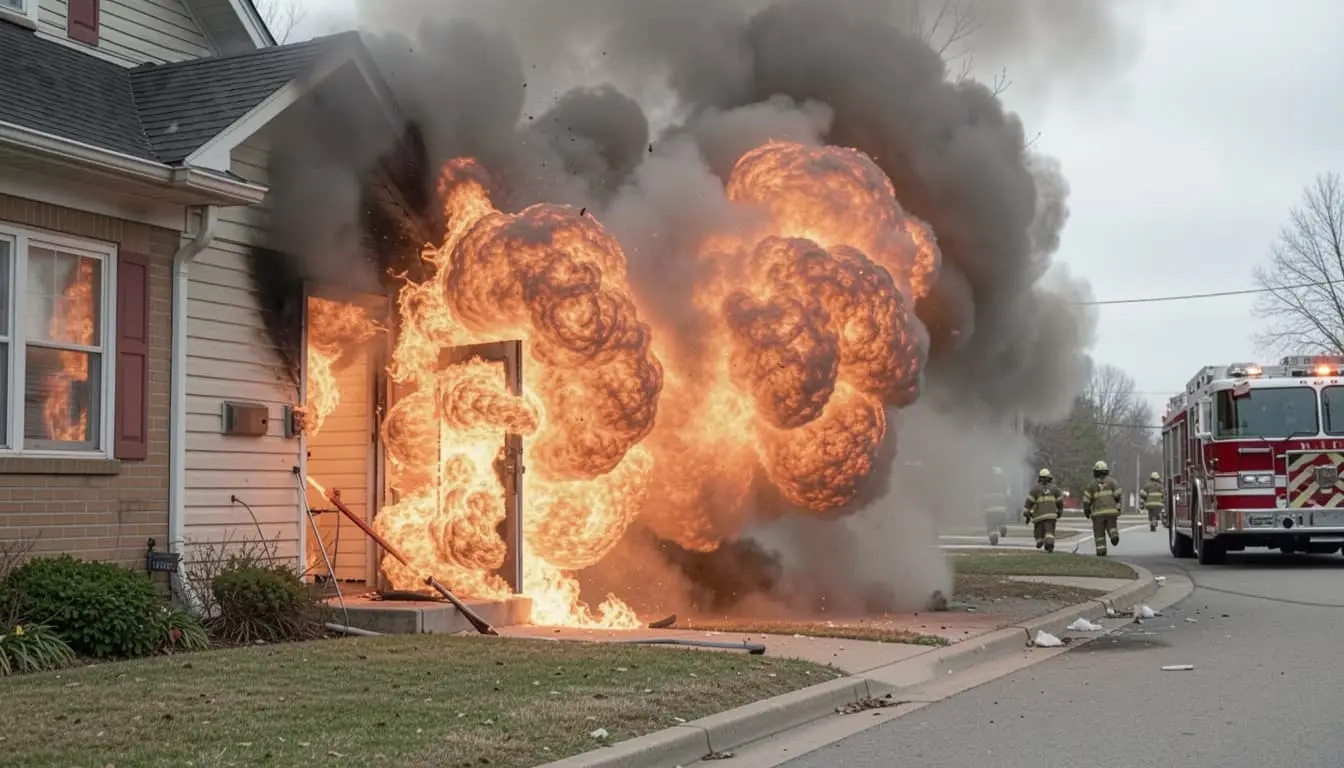
A flashover is the point in a compartment fire when nearly every exposed combustible surface in a room ignites within moments of each other. Rather than one item burning while others remain untouched, the entire space transitions to full involvement almost simultaneously.
NFPA 921 frames this as a transitional phase driven by thermal radiation: surfaces across the compartment reach ignition temperature at close to the same time, and the fire spreads through the space rather than object to object.
Flashover marks the boundary between the growth phase of a fire and the fully developed phase. Before flashover, a fire is fuel-controlled and localized. After flashover, it becomes ventilation-controlled, meaning available oxygen, not fuel, dictates how the fire behaves.
Flashover is generally associated with ceiling-level gas temperatures in the range of approximately 500°C to 600°C (roughly 932°F to 1,112°F), with an incident heat flux at floor level of approximately 20 kilowatts per square meter.
NIST's fire research describes the same threshold slightly differently, citing fire gases in excess of 600°C as the trigger for near-simultaneous ignition of exposed surfaces. The two figures are consistent with each other rather than contradictory, but the range itself (500 to 600°C) reflects real variation depending on fuel load, ventilation, and compartment geometry, not measurement error.
Time to flashover varies enormously based on fuel type, room size, and ventilation. Under favorable growth conditions, a residential fire can reach flashover in a matter of minutes, sometimes less, which is why fire crews train to recognize warning signs long before full room involvement occurs.
Modern furnishings built from synthetic materials also tend to reach flashover faster than the legacy natural-fiber furnishings common in older fire science studies, a shift that has reshaped how both fire crews and investigators think about fire growth timelines in contemporary structures.
Several observable conditions tend to precede flashover:
- Rapid, escalating heat that becomes difficult to tolerate even at floor level.
- Rollover, where flames intermittently ignite unburned gases across the ceiling without full room involvement yet.
- Thick, dark, turbulent smoke banking down toward the floor rather than staying near the ceiling.
- A sudden, unexplained brightening of the fire, sometimes just before full involvement.
- Auto-ignition of isolated items across the room, not just near the original fuel package.
These signs matter to firefighters for survival and to investigators after the fact, since photographs, witness statements, and body-cam or dash-cam footage capturing these conditions can help establish a timeline of fire growth.
The three terms describe distinct phenomena and are frequently confused in reporting and even in testimony.
Rollover can happen before flashover, but the two are not interchangeable: rollover ignites only the gas layer near the ceiling, not the room's contents. Backdraft is a different event entirely, driven by a sudden influx of oxygen into a sealed or oxygen-starved compartment. For a closer look at how backdraft and flashover compare specifically, see the differences between backdraft and flashover.
Flashover changes the physical evidence an investigator has to work with. Before flashover, burn patterns tend to be uneven: some materials show heavy charring while nearby items remain largely untouched, and that unevenness is often what points toward an origin area. After flashover, burning becomes far more uniform across the room, which can mask or destroy the very patterns investigators rely on.
This creates two practical risks.
- First, an investigator unfamiliar with post-flashover conditions may misread uniform, severe damage as evidence of an accelerant, when it may simply reflect the effects of full room involvement.
- Second, once a fire moves beyond a single compartment into full structural involvement, pattern-based origin analysis becomes markedly less reliable, and investigators typically need to shift toward other lines of evidence, including witness observations, fire dynamics modeling, and physical evidence collected before conditions were altered.
Recognizing whether flashover occurred, and roughly when, is therefore a foundational step before drawing conclusions from burn pattern evidence.
Cases involving flashover typically generate a large volume of time-sensitive evidence: scene photographs taken at different stages of overhaul, witness and firefighter statements describing fire behavior, and thermal or burn pattern documentation that needs to be tied to a defensible chain of custody.
Blazestack's evidence and media management tools are built to organize this kind of material by scene location and timeline, and its chain-of-custody tracking helps ensure that photographs and physical samples collected under post-flashover conditions hold up under later scrutiny.
Is flashover the same as a fully developed fire?
Flashover is the transition into a fully developed fire, not the fully developed stage itself. Once flashover occurs, the fire is generally considered to have entered full room involvement.
Can a fire flashover more than once in the same structure?
Yes. A fire can flashover in one compartment and later cause conditions in an adjoining compartment to reach flashover separately, particularly once doors, windows, or walls fail.
Does flashover always destroy origin evidence?
Not always, but it substantially increases the risk. Areas outside the fully involved compartment, or evidence collected before flashover occurred, may still be intact and diagnostic.
Is flashover survivable for occupants inside the room?
Survivability inside a compartment at the point of flashover is not considered likely given the temperatures involved, though this depends heavily on protective equipment and position in the room. This is a serious safety topic, and if you are researching it for anything beyond investigative or professional purposes, it's worth speaking with a fire service safety professional directly.

Trusted by Public and Private Investigator Teams Everywhere
Whether you're a big state agency, a small local fire department or somewhere in between, Blazestack software (NFPA 921® & CJIS compliant) collects fire scene data and generates standardized origin and cause reports in a fraction of the time of other methods.
To learn more about Blazestack, give us a call at (866) 303-4344 or email us at support@blazestack.com
Get Your Free 14-Day Trial and Custom Price Quote Now
We'll let Blazestack do the talking. Try it out right now for free.
A member of our staff will be in touch shortly.