Fire Investigation Timeline Reconstruction: Building the Sequence of Events
A fire investigation report answers two related but distinct questions: what happened, and when. Origin and cause work answers the first. Timeline reconstruction answers the second, and it's easy to confuse with a different question entirely: how long the investigation itself takes to complete. That's a real, separate topic, covered in detail in how long a fire investigation takes, which is about case duration, lab backlogs, and stakeholder coordination.
Timeline reconstruction is not about how long the investigation runs. It's about establishing, in order, what happened during the fire itself, when it started, how it progressed, and what people did and observed along the way.
Timeline reconstruction is the process of establishing a chronological, evidence-supported sequence of events surrounding a fire: when ignition likely occurred, how the fire developed and spread, when detection and notification happened, when occupants and responders took specific actions, and how all of that lines up against the physical evidence found at the scene.
NFPA 921 treats this as a core part of building a factual narrative rather than a standalone task performed after the investigation is otherwise complete. Witness and first-responder observations, flame color, smoke conditions, odor, and fire behavior noted on arrival, are treated as data points that feed directly into this narrative, not just supporting color commentary. Investigators corroborate individual accounts against each other and against the physical evidence, looking for both consistencies and discrepancies, since either one can be informative.
A reconstructed timeline is not simply a list of times. It's a structure that gets tested: if a witness reports smelling smoke at a time inconsistent with how the fire pattern evidence suggests the fire was developing, that inconsistency is itself a finding worth investigating, not a detail to quietly smooth over.
A defensible timeline draws on multiple independent sources, since any single source, a witness's memory, a device's internal clock, a security camera's timestamp, can be wrong in ways that are only detectable by cross-referencing against something else.
Emergency Communication Records
911 call logs and dispatch records provide some of the most reliable timestamps available, since they're generated and preserved independently of anyone involved in the incident. The time of the first call, and what the caller reported at that moment, anchors much of the rest of the timeline.
Building System Logs
Smoke detector activation, fire alarm panel logs, and sprinkler system activation records, where the system retains this data, provide precise, device-generated timestamps for when detection and suppression systems responded. These logs are especially valuable because they're automatic and not subject to the same memory distortion that affects human testimony.
Video and Digital Evidence
Security cameras, doorbell cameras, and other recording devices in or near the structure can provide visual confirmation of fire and smoke conditions at specific times. This evidence carries a caveat worth taking seriously: device clocks frequently drift from actual time, sometimes by minutes, occasionally by much more, which makes clock verification a necessary step rather than an optional one, covered in more detail below.
Witness and First-Responder Statements
Occupants, bystanders, and the first responders on scene all provide observations tied to specific moments: when smoke was first noticed, what the fire looked like on arrival, when specific rooms or areas became involved. NFPA 921 places particular weight on first-responder observations, since firefighters and paramedics often have both timing precision (radio logs, dispatch times) and trained observational judgment about fire behavior that a lay witness may not.
Physical Fire Pattern Evidence
Burn patterns, char depth, and fire spread indicators provide an independent check against the reported timeline. If witness accounts suggest a slow-developing fire but the physical evidence is more consistent with rapid fire growth, that tension needs to be investigated and resolved, or at minimum documented as unresolved, rather than picking whichever account is more convenient.
Local News and Media Coverage
Local news reports, timestamped video, published quotes, and archived early coverage, can serve as an independent check against other timeline sources, particularly in wildfire cases where a wildfire news resources hub exists for nearly every state. Early reports are especially valuable since they're often revised or removed as a story develops, making timely archiving worthwhile.
Every timeline reconstruction eventually runs into the same underlying problem: different systems and different people record time differently, and those differences need to be identified before the timeline can be trusted.
Clock Drift Across Devices
Security camera systems, alarm panels, and personal devices each keep their own internal clock, and those clocks are frequently unsynchronized with actual time, sometimes by a meaningful margin.
A security camera's timestamp being off by several minutes is common enough that investigators generally need to verify device time against a known reference point (such as a 911 call log or another synchronized system) rather than accepting an on-screen timestamp at face value. Skipping this step is one of the more common, avoidable errors in timeline work.
Reconciling Witness Accounts
Witnesses rarely agree on exact timing, and that's expected rather than a red flag on its own. The investigative task is corroboration: identifying where independent accounts converge, where they diverge, and whether the divergence is explainable (different vantage points, different units of measurement like "a few minutes" versus a precise time) or represents a genuine conflict that needs further investigation.
When the Timeline and the Physical Evidence Disagree
The most consequential reconciliation work happens when reported timing conflicts with what the fire pattern evidence suggests actually occurred. This isn't necessarily a sign that a witness is being untruthful, memory of time under stress is notoriously unreliable, but it does mean the investigator needs to determine which piece of evidence is more reliable, or whether both can be reconciled under a different interpretation of events, before finalizing the timeline.
A reconstructed timeline doesn't replace physical evidence analysis in origin and cause work. It constrains and tests it.
Consider, for illustration, a case where a witness reports first noticing flames in a specific room at a given time. If the fire pattern evidence in that room is inconsistent with a fire having only just begun at that reported time, either more developed or less developed than would be expected, that mismatch is a signal worth pursuing, not a loose end to leave alone. It might indicate the reported time was inaccurate, that the witness's initial observation point wasn't actually the area of origin, or that fire spread and ventilation conditions affected fire development in a way the timeline needs to account for.
This is also where the scientific method as applied to fire investigation becomes directly relevant: the timeline functions as a hypothesis to be tested against evidence, and a fire pattern reconstruction, rather than a fixed narrative accepted once a plausible sequence has been assembled.
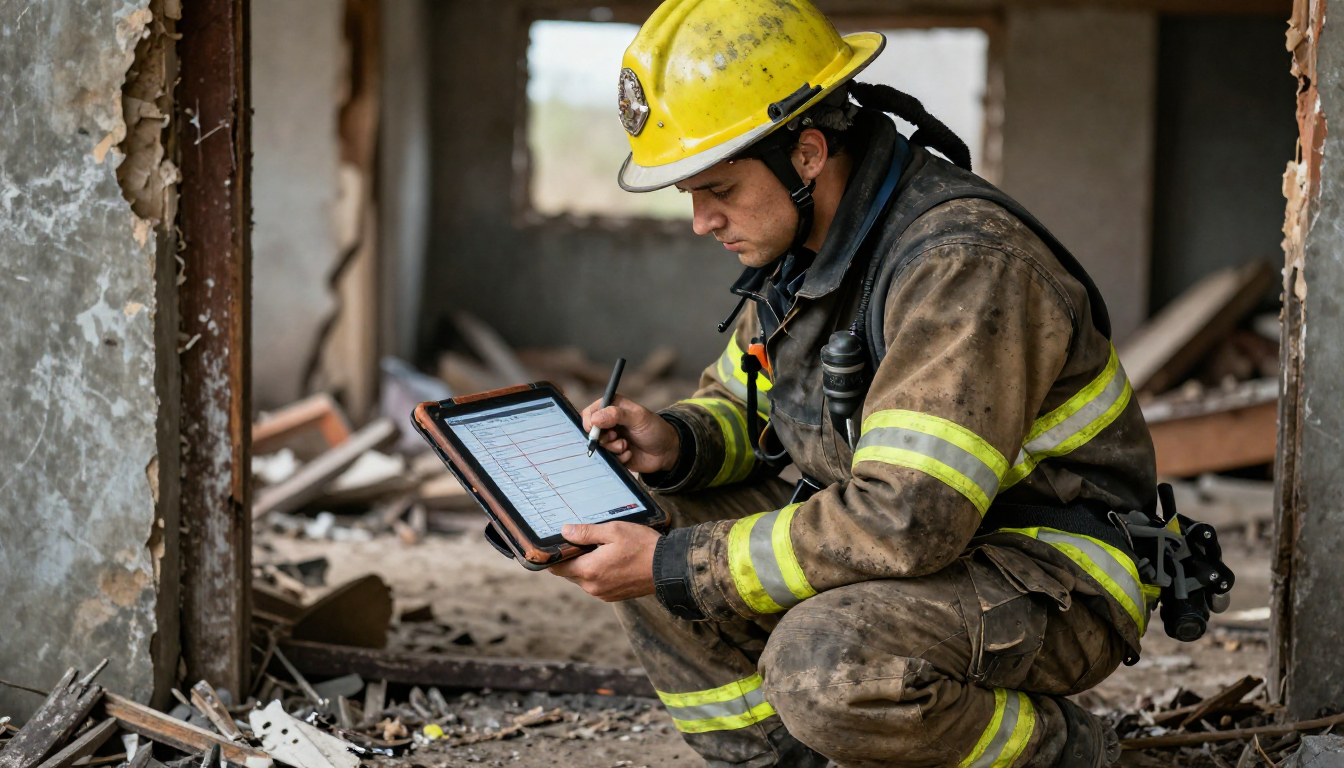
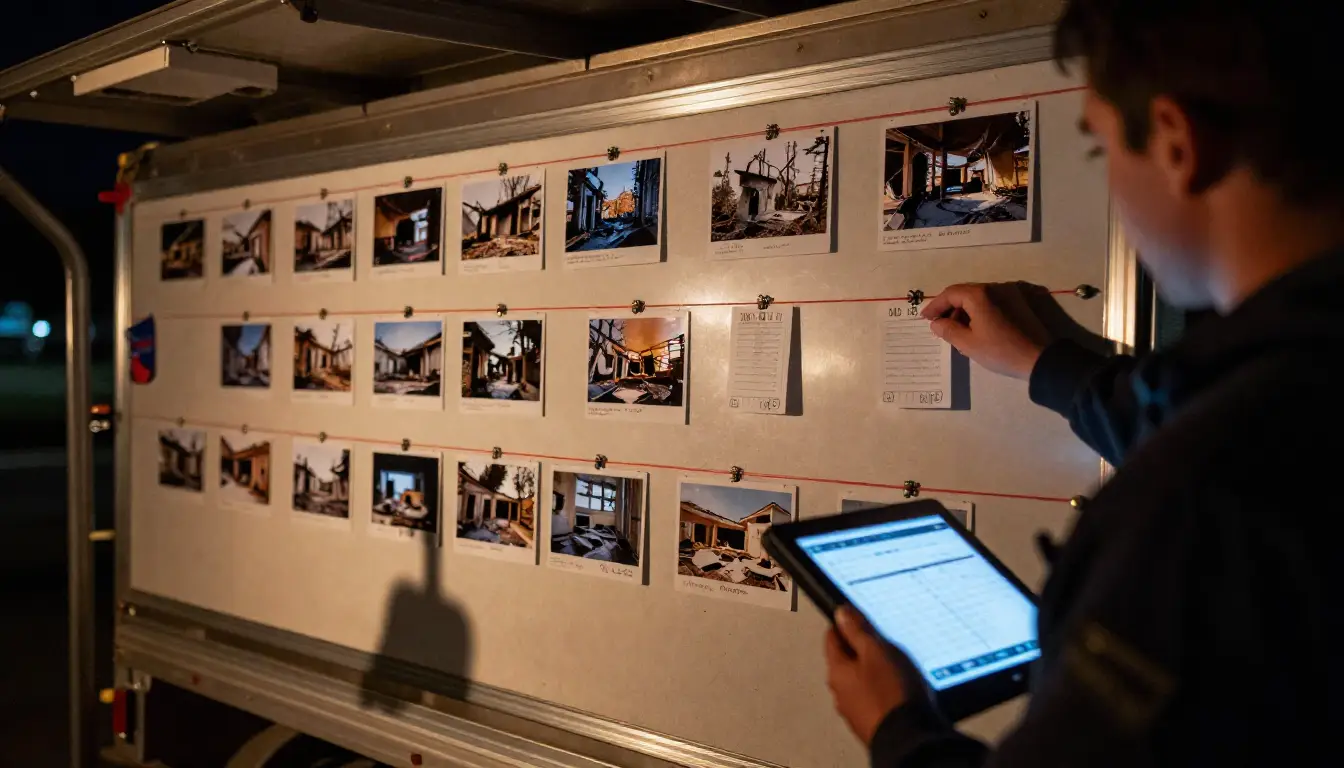
Timeline reconstruction depends on pulling together evidence from sources that rarely live in the same place: dispatch records, alarm panel logs, witness statements collected across multiple interviews, security footage, and photographs documenting physical evidence, each with its own timestamp that needs to be checked against the others.
Blazestack's evidence and media management tools let investigators tag evidence with specific timestamps and scene locations as it's collected, rather than reconstructing the sequence later from scattered files and handwritten notes. Photographs, witness statement summaries, and supporting documentation can be organized chronologically within a single case record, making it easier to spot where different evidence sources agree or conflict while the investigation is still active, when following up on a discrepancy is far easier than trying to do so weeks later.
This same organized structure supports the reporting requirements covered below: a timeline that can show exactly which piece of evidence supports each entry is a timeline that holds up under later scrutiny.
A timeline included in a final report needs to show its work. Each entry should be traceable to a specific, cited source, a 911 call log, a witness statement, a device timestamp, rather than presented as an unattributed sequence of events. This matters for the same reason chain of custody documentation matters: a finding that can't demonstrate where it came from is a finding that's vulnerable to challenge.
Where timestamps from different sources were reconciled or where a discrepancy was resolved a particular way, the reasoning behind that reconciliation belongs in the report as well, not just the final agreed-upon time. A timeline that silently smooths over a conflict between a witness account and the physical evidence, without explaining why one was favored over the other, is a weaker piece of documentation than one that shows the reasoning explicitly. The same chain of custody discipline that governs physical evidence applies conceptually here: every timestamp in the final timeline should be attributable to a specific, documented source.
Is timeline reconstruction the same as figuring out how long an investigation takes?
No. Timeline reconstruction establishes the sequence of events during the fire itself, when it started, how it spread, and what happened and when. How long an investigation takes is a separate, administrative question about case duration, covered in detail in our guide to fire investigation timelines. The two share the word "timeline" but refer to entirely different things.
What's the most reliable evidence source for building a timeline?
There isn't a single most reliable source; reliability depends on corroboration across multiple independent sources. Device-generated records like 911 logs and alarm system data tend to be more precise than human memory, but even those need verification against a known reference point, since device clocks can drift.
What happens when witness accounts contradict each other?
Contradictions between witnesses are common and not automatically a problem. The investigator's task is to determine whether the discrepancy is explainable (different vantage points, imprecise time estimates) or represents a genuine conflict requiring further investigation, and to document that reasoning rather than silently picking one account.
Does a timeline need to account for every reported observation?
Not every observation carries equal weight, but every observation that's used in the final timeline needs its source documented, and any observation excluded because it conflicted with stronger evidence should ideally be noted along with the reasoning, rather than simply omitted without explanation.
Final Thoughts
Timeline reconstruction turns a scattered collection of timestamps, witness accounts, device logs, and physical evidence into a coherent, defensible account of what happened during a fire and in what order. It's distinct from questions of investigation duration, and it's distinct from origin and cause determination on its own, but it supports and constrains the latter by giving investigators a structure to test physical evidence findings against. A timeline built on corroborated, clock-verified, clearly sourced evidence is one that holds up under the same scrutiny every other part of a fire investigation report needs to withstand.


Trusted by Public and Private Investigator Teams Everywhere
Whether you're a big state agency, a small local fire department or somewhere in between, Blazestack software (NFPA 921® & CJIS compliant) collects fire scene data and generates standardized origin and cause reports in a fraction of the time of other methods.
To learn more about Blazestack, give us a call at (866) 303-4344 or email us at support@blazestack.com
Get Your Free 14-Day Trial and Custom Price Quote Now
We'll let Blazestack do the talking. Try it out right now for free.
A member of our staff will be in touch shortly.