Fire Code Violations in Investigations: What You Actually Need to Document


A fire code violation, in the context of a fire investigation, is a condition present at the time of a fire that departs from the adopted code, and that may have affected fire development, occupant safety, or system performance. This is a narrower and different question than the one a fire marshal asks during a routine compliance inspection.
Fire marshals and code enforcement officers visit buildings to verify compliance before an incident occurs. Fire investigators arrive after the fact. The violations an investigator documents are not citations being issued, they are conditions that existed when the fire started, and they frequently explain outcomes: why a fire spread further than a functioning system should have allowed, or why occupants could not reach safety despite adequate warning time.
This distinction shapes the documentation itself. An investigator is establishing what was actually present, not simply what current code requires, though understanding the applicable code is what makes it possible to recognize a departure from it in the first place.
How Do the Two Model Fire Codes Work?
The United States has no single national fire code. Jurisdictions typically adopt either NFPA 1 (Fire Code) or the International Fire Code (IFC), then layer on local amendments. Some states mandate one system statewide, while others leave the choice to individual municipalities.
NFPA 1 incorporates by reference dozens of other NFPA standards, including NFPA 101 for life safety, NFPA 72 for fire alarm systems, and NFPA 13 for sprinkler installation. The IFC similarly references the International Building Code and other International Codes. Effective investigation requires knowing which system a given jurisdiction has adopted and which edition applied to the structure under examination, since older buildings are typically evaluated against the code in effect at the time of construction, plus any amendments triggered by later renovation, rather than against the current edition.
How Do Investigators Distinguish Pre-existing From Post-Fire Conditions?
Water damage looks different from a door that was chained shut before a fire started. Suppression system damage differs from a system that was already out of service. Part of an investigator's task is distinguishing violations that existed before ignition and contributed to fire development or occupant harm from conditions created by the fire itself or by suppression activity.
Not every non-compliant condition observed at a scene was necessarily present before the fire, and conversely, fire damage obscuring a violation does not mean the violation cannot still be established through careful examination and documentation.
Three categories of violation carry the most investigative weight: egress, because obstructed exits cost lives; suppression systems, because their failure allows fires to spread; and electrical conditions, because these can function as an ignition source rather than only a contributing factor.
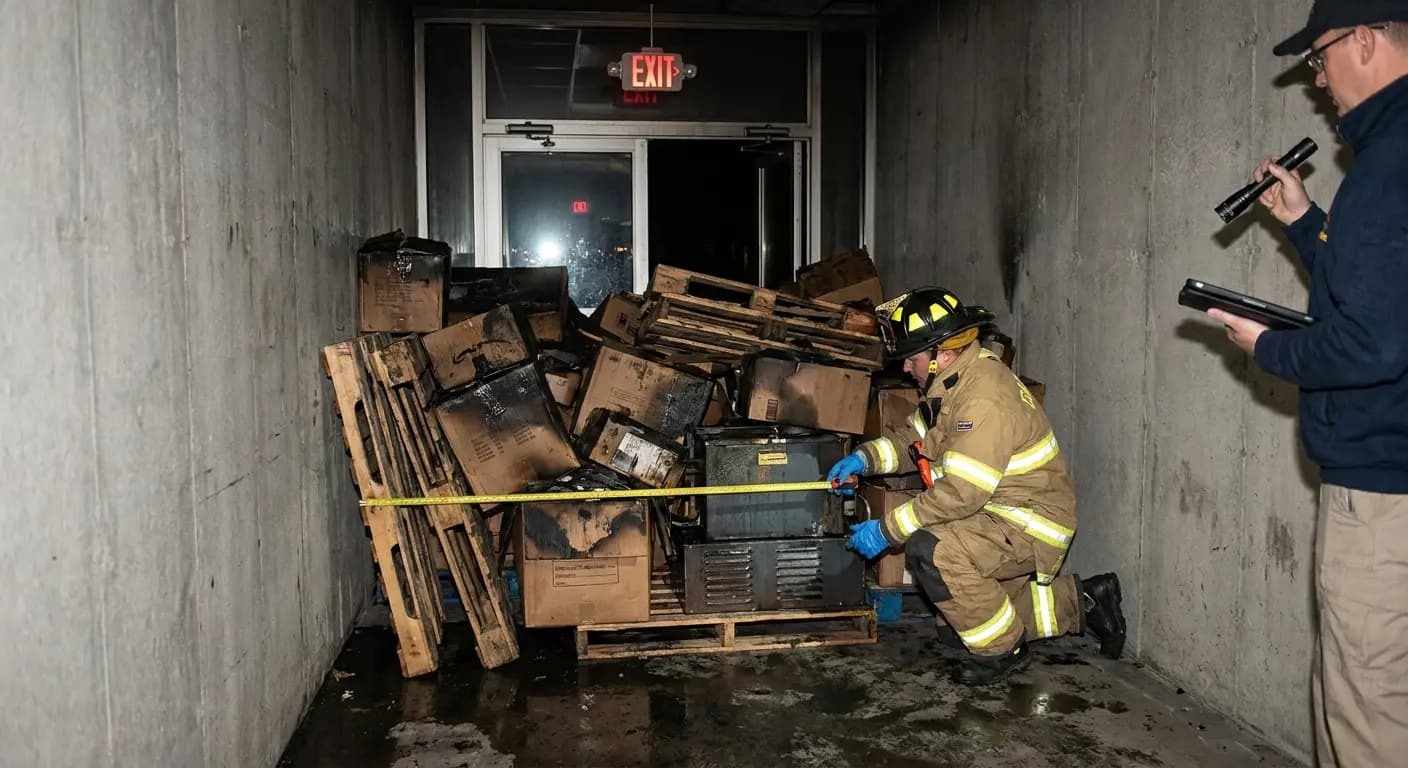
Blocked or Obstructed Egress
NFPA 101, the Life Safety Code, sets requirements for means of egress, including minimum widths, maximum travel distances, and a general prohibition on locking hardware that requires a key, tool, or special knowledge to operate from the egress side.
Common findings include exit doors locked, chained, or otherwise secured from the interior; exit pathways obstructed by storage, equipment, or furniture; missing or obscured exit signage; and inadequate or entirely absent emergency lighting along egress routes.
These violations do not cause fires, but they determine whether occupants can escape one. In an investigation involving fatalities, egress violations often explain why victims could not reach safety despite sufficient warning time. Documentation should capture the specific nature of the obstruction rather than a general description: the type of lock, the direction it requires to operate, and whether a key was reasonably accessible.
Impaired or Out-of-Service Suppression Systems
NFPA 25 governs inspection, testing, and maintenance of water-based fire protection systems, while NFPA 13 covers installation standards. Investigation-relevant violations include control valves left in the closed position, particularly when unsupervised or untagged; inadequate water supply or pressure; sprinkler heads that are painted over, obstructed, or lack required clearance; missing or damaged heads; and systems that were never fully commissioned despite the building being occupied.
Investigators establish system status by examining components that survived the fire. Control valve position indicates whether the system was capable of operating at all. Pressure gauge readings, where legible, indicate whether adequate supply existed. A building without a functioning suppression system generally sustains greater fire spread, and documenting system status at the time of the fire provides important context for damage patterns and spread analysis.
Consider, for illustration, a scenario in which sprinkler heads had been painted over during a series of past renovations. Heat from a fire may still activate such heads, but the paint seal can delay or prevent water discharge long enough for a fire to spread well beyond what the system should have controlled. Macro photography of the affected heads, showing the paint buildup, is the kind of documentation that supports this finding without relying on assumption.
Non-Operational or Silenced Fire Alarm Systems
NFPA 72, the National Fire Alarm and Signaling Code, covers requirements for fire alarm installation, performance, and maintenance. Relevant violations include alarm panels left in test or silence mode, disconnected or de-powered panels, missing or painted-over detection devices, inadequate device coverage for the occupancy type, and notification appliances that were inoperative.
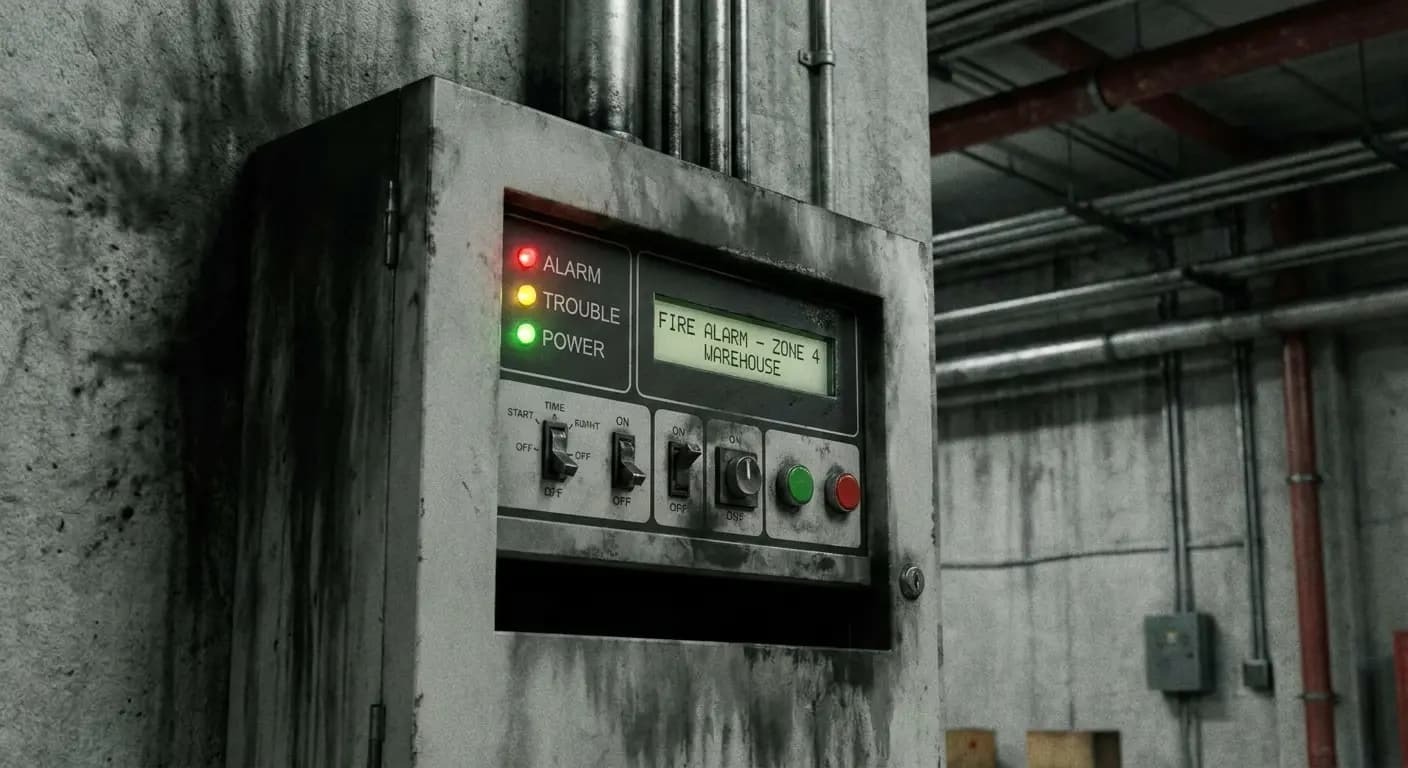
Witness interviews establish whether alarms sounded, while physical examination of the panel, where fire or power loss has not destroyed it, indicates its status at the time of the fire. Investigators documenting fire alarm system status typically follow the same systematic approach used in a broader fire scene investigation checklist, since a scattered examination is how these conditions get missed.
Improper Storage Clearances and Hazardous Material Storage
Both NFPA 1 and the IFC set requirements for the storage of combustible materials and hazardous substances. Common findings include storage placed too close to sprinkler heads for the applicable clearance, which varies by code edition and occupancy type; combustibles stored in exit pathways or near ignition sources; flammable liquids in unapproved containers or locations; quantities exceeding permitted limits; and hazardous materials lacking required separation.
These conditions affect fire development directly. Storage too close to the ceiling impedes sprinkler activation and effectiveness, combustibles near an ignition source provide fuel, and improperly stored flammable liquids create flash fire potential. Photographs need to capture spatial relationships, not just the presence of stored material, since the relevant question is proximity to an ignition source or protection system, not the storage itself.
Electrical Violations Relevant to Ignition Source Findings
NFPA 70, the National Electrical Code, governs electrical installations. When an investigation identifies an electrical ignition source, associated code violations become especially significant: extension cords used as permanent wiring, overloaded circuits or panels, damaged or deteriorated wiring insulation, missing junction box covers or exposed connections, undersized wire for the circuit load, and the absence of required ground-fault or arc-fault protection.
An electrical fire in a properly installed and maintained system suggests a different investigative path than one in a system carrying multiple pre-existing violations. Consider, for illustration, a circuit wired with a smaller gauge conductor than the breaker rating requires, feeding far more outlets than the circuit was designed to carry. Chronic overheating at a terminal under that kind of sustained load is a plausible failure mode, and in a case like this, the code violation is not merely context for the ignition, it is part of the ignition sequence itself: undersized wire creates resistance heating over time, which degrades a connection, which eventually fails under load.
Proper documentation is what transforms an observed condition into evidence capable of withstanding challenge later.
Photographing Conditions as Found
Initial photographs must capture conditions before anyone alters them. For egress violations, this means photographing exit doors from both sides, showing locking hardware, obstructions, and signage or its absence, with wide shots for context and close-ups of specific hardware. For suppression systems, control valve positions and gauge readings should be photographed before anyone touches them; testing a valve before documenting its as-found position can undermine an otherwise sound finding. Fire alarm panels warrant a photograph of the full panel face, followed by close-ups of the display, switch positions, and any printed event log before it is removed. Storage conditions require spatial context, showing how materials were positioned relative to sprinkler heads, exits, and electrical equipment.
Systematic Examination Protocols
An investigator can only document violations that are actually noticed, which is why a systematic approach matters more than instinct. A useful sequence starts with an initial walkthrough, photographing exits, noting valve positions, and checking alarm status before anything is moved.
From there, examination proceeds methodically: every exit route from the fire area to the exterior, every accessible sprinkler head and the riser and control valves feeding them, every electrical panel and subpanel relevant to a potential ignition source, and close, detailed documentation of the area of origin itself. Available paperwork, inspection records, maintenance logs, and prior code enforcement history, should be requested and reviewed, since it can establish whether a violation was pre-existing and known.
Chain of Custody for Violation-Related Evidence
Some violations require collecting physical evidence: a padlock and chain from a secured exit, a painted sprinkler head, a section of cord used as permanent wiring. Standard evidence protocols apply.
Documentation should show what was collected, when, by whom, and from where, with photographs showing the item in place before collection and packaging that prevents damage or alteration, consistent with standard chain of custody practice for any physical evidence.
Code violations and fire cause exist on different analytical planes, and conflating them is a common and consequential error.
Violations Coexist With Any Cause Classification
An accidental fire can occur in a building with numerous code violations, and an incendiary fire can occur in a fully compliant structure. The presence or absence of violations says nothing definitive about ignition cause. Cause classification follows standard methodology: examining the area of origin, identifying potential ignition sources and first fuels, analyzing fire patterns and damage, weighing witness statements and other evidence, and reaching a conclusion consistent with the scientific method and NFPA 921. Code violations enter the analysis separately, as conditions that existed at the time of the fire and may have affected its development or outcome, without indicating what ignited it.
Contributing Factors Versus Causal Factors
NFPA 921 distinguishes between the cause of a fire and factors that contributed to its development or outcome, and code violations almost always fall into the latter category. A blocked exit did not start a fire, but it can contribute to fatalities by preventing escape.
An impaired suppression system did not ignite anything, but it can contribute to fire spread by failing to control a fire in its early stages. A report should maintain this distinction with precision: a statement that a fire "was caused by code violations" is not defensible, while a statement that specific violations "contributed to fire spread and occupant casualties" is both accurate and appropriate.
The Rare Exception: Violations as Direct Causes
Electrical code violations occasionally function as a direct cause rather than a contributing factor. Improper wiring that creates a short circuit or a sustained overheating condition is simultaneously a code violation and an ignition source. Even here, the analysis should remain precise: the violation created the condition that produced the ignition sequence, and it is being treated as part of that causal chain, not as a separate finding running alongside it.
Avoiding Conflation With Intent or Negligence
Code violations do not establish intent. An incendiary fire can occur in a compliant building, and a heavily non-compliant building can experience a purely accidental fire; violations alone do not make a fire suspicious. Nor do violations automatically establish negligence in the legal sense, which is a determination for courts or juries, not for the investigator.
Reports should present violations as factual conditions without legal characterization. A statement that an exit was "secured with an interior padlock, contrary to NFPA 101" is appropriate; a statement that "the property owner was negligent" crosses into a legal determination outside the investigator's role.
Documenting violations with photographs, notes, and evidence bags is not new. The harder problem is organizing that information in a way that still holds up months or years later, when a case reaches court or an insurance review.
Blazestack's evidence and media management tools let investigators tag photographs with specific location data and link them directly to the code violation being documented, rather than leaving hundreds of images in an unsorted folder to be sorted through later. Each photograph connects to the specific finding, the scene location, and the relevant section of the investigation, so a report section on egress violations already has its supporting images attached rather than requiring a search through unrelated files.
The same structure supports chain of custody for any physical evidence collected in connection with a violation, tracking who handled it, when, and where, from collection through final disposition, the kind of record that civil litigation involving disputed violations regularly requires.
Report generation follows the same principle of separation that a well-written investigation depends on: violations are documented in their own section with supporting evidence and code references, while cause and origin findings stand separately with their own analysis, referenced together only where a violation genuinely contributed to the outcome. This structure supports reports that meet NFPA 921 and NFPA 1033 standards while remaining clear to the attorneys, adjusters, and other non-technical readers who will ultimately rely on the findings.
An investigation report is often the starting point, not the end, of a much longer legal and insurance process, and the violations documented in it become evidence multiple parties use for different purposes.
Civil Liability and Negligence Claims
Property owners can face liability when code violations contribute to fire-related injuries or deaths, and plaintiffs pursuing negligence claims frequently point to documented violations as evidence that a property was not maintained in a safe condition.
An investigator's documentation, photographs, notes, and report findings, becomes the factual foundation for legal arguments made by others, not by the investigator. Courts may also consider whether a violation was known, which is where prior inspection reports showing the same condition, or interviews establishing an owner's awareness, become relevant.
The specific violation matters differently depending on the claim: egress violations are often central in wrongful death cases, while suppression system violations matter more where property damage exceeded what a functioning system should have limited.

Insurance Coverage Disputes
Insurance policies frequently contain exclusions for losses resulting from known, uncorrected code violations. Insurers may deny or reduce coverage based on violation findings, and an investigator's documentation of when a violation began and whether it was known to the policyholder can determine which way that dispute resolves. Subrogation actions, in which an insurer sues to recover a payment made to its insured, frequently rely on the same violation evidence, placing an investigator's findings at the center of litigation to which the investigator is not a party.
Criminal Proceedings
Code violations rarely form the basis for criminal charges related to fire causation on their own, but they can support charges when a fire results in death, where criminally negligent homicide or manslaughter charges may reference documented violations as evidence of recklessness. An investigator's role does not change in this context: the findings remain factual observations and professional conclusions, while prosecutors determine whether charges are warranted and defense counsel challenges the methodology behind the findings.
Why Documentation Standards Matter Here
Every legal or insurance outcome that depends on violation findings depends, in turn, on documentation that withstands challenges. Photographs that clearly show conditions as found, notes recorded systematically, evidence handled with an intact chain of custody, and a report that separates fact from inference are what allow a finding to hold up under deposition or cross-examination years after a scene has been cleared. A finding that a control valve was closed before a fire, rather than after, is only as strong as the photograph proving it.
Do investigators need to cite specific code sections when documenting violations?
Yes, and the citation should reference the specific code and edition year that applied to the structure at the time of the fire, since older buildings are generally evaluated against the code in effect when they were built, plus any amendments triggered by later renovation. A general statement that "egress was blocked in violation of fire codes" lacks the specificity a defensible finding requires; a citation to the applicable code section and edition, confirmed against the current text of that standard, is what the finding needs to hold up under review.
What if it is unclear whether a violation existed before the fire or resulted from it?
The condition should still be documented thoroughly regardless of certainty about its origin: photographed, measured, and recorded in relation to other building elements. Where fire damage or structural collapse makes the timing genuinely unclear, the report can describe the condition factually while noting that a definitive determination requires further review, potentially including input from the local fire marshal or building official, rather than guessing.
How should violations that affected the outcome, but not the cause, be handled in a report?
They belong in a section distinct from the cause and origin analysis, clearly framed as contributing factors rather than causal ones. A blocked exit did not start a fire, but it can explain fatalities; an impaired suppression system did not ignite anything, but it can explain fire spread. Keeping this distinction visible in the report structure, rather than folding violations into the cause narrative, is what prevents the two from being conflated by a reader.
Final Thoughts
Code violations discovered during a fire investigation serve a function well beyond compliance enforcement. They are evidence of conditions that affected fire development, occupant safety, and system performance, and the documentation of those conditions shapes legal proceedings and insurance determinations long after an investigation has closed.
The distinction between documenting a violation and determining its legal consequences matters throughout: an investigator establishes what existed and how it affected the fire and its outcome, while courts, insurers, and attorneys make the determinations that follow from those facts. Documentation standards that separate pre-existing conditions from fire-created ones, distinguish contributing factors from causal factors, and support every finding with corresponding evidence are what allow that work to survive scrutiny well after the scene itself is gone.


Trusted by Public and Private Investigator Teams Everywhere
Whether you're a big state agency, a small local fire department or somewhere in between, Blazestack software (NFPA 921® & CJIS compliant) collects fire scene data and generates standardized origin and cause reports in a fraction of the time of other methods.
To learn more about Blazestack, give us a call at (866) 303-4344 or email us at support@blazestack.com
Get Your Free 14-Day Trial and Custom Price Quote Now
We'll let Blazestack do the talking. Try it out right now for free.
A member of our staff will be in touch shortly.